Salo Päivi M, Jaramillo Renee, Cohn Richard D, London Stephanie J, Zeldin Darryl C
National Institute of Environmental Health Sciences, National Institutes of Health, Department of Health and Human Services, Research Triangle Park, North Carolina 27709, USA.
Environ Health Perspect. 2009 Mar;117(3):387-91. doi: 10.1289/ehp.11847. Epub 2008 Oct 6.
Most studies investigating the role of residential mouse allergen exposures in asthma have focused on inner-city populations.
We examined whether elevated mouse allergen levels were associated with occupants' asthma status in a nationally representative sample of U.S. households.
Data for this study were collected as part of the National Survey of Lead and Allergens in Housing. This cross-sectional study surveyed 831 housing units inhabited by 2,456 individuals in 75 different locations throughout the United States. The survey obtained information on demographics, household characteristics, and occupants' health status by questionnaire and environmental observations. We used a polyclonal immunoassay to assess concentrations of mouse urinary protein (MUP) in vacuumed dust collected from various indoor sites.
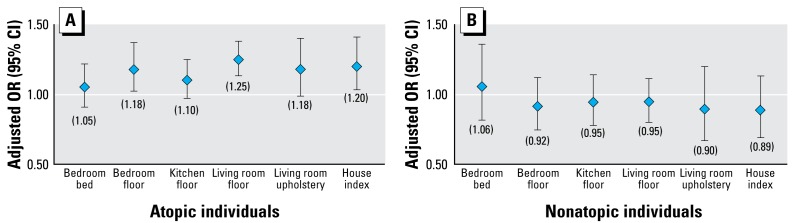
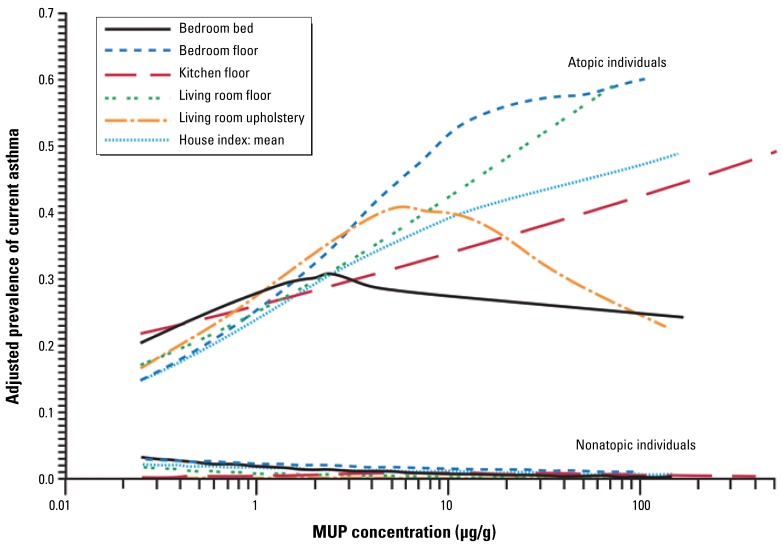
Of the surveyed homes, 82% had detectable levels of MUP, and in 35% of the homes, MUP concentrations exceeded 1.6 microg/g, a level that has been associated with increased mouse allergen sensitization rates. Current asthma, defined as having doctor-diagnosed asthma and asthma symptoms in the preceding 12 months, was positively associated with increased MUP levels. The observed association was modified by atopic status; in allergic individuals, elevated MUP levels (>1.6 microg/g) increased the odds of having asthma symptoms [adjusted OR=1.93; 95% confidence interval (CI), 1.14-3.27], but we found no association in those who did not report allergies (adjusted OR=0.69; 95% CI, 0.33-1.44).
In allergic asthma, residential mouse allergen exposure is an important risk factor for asthma morbidity.
大多数研究住宅中鼠类过敏原暴露在哮喘发病中的作用的研究都集中在城市中心人群。
我们在美国具有全国代表性的家庭样本中,研究了鼠类过敏原水平升高是否与居住者的哮喘状况相关。
本研究的数据作为住房铅与过敏原全国调查的一部分进行收集。这项横断面研究调查了美国75个不同地点的831个居住单元中的2456个人。该调查通过问卷调查和环境观察获取了有关人口统计学、家庭特征和居住者健康状况的信息。我们使用多克隆免疫测定法评估从各个室内场所收集的真空灰尘中鼠尿蛋白(MUP)的浓度。
在被调查的家庭中,82%的家庭检测到了MUP水平,35%的家庭中MUP浓度超过1.6微克/克,这一水平与鼠类过敏原致敏率增加相关。当前哮喘定义为在过去12个月内经医生诊断患有哮喘且有哮喘症状,其与MUP水平升高呈正相关。观察到的关联因特应性状态而有所改变;在过敏个体中,MUP水平升高(>1.6微克/克)会增加出现哮喘症状的几率[调整后的比值比(OR)=1.93;95%置信区间(CI),1.14 - 3.27],但在未报告过敏的个体中我们未发现关联(调整后的OR = 0.69;95% CI,0.33 - 1.44)。
在过敏性哮喘中,住宅中鼠类过敏原暴露是哮喘发病的一个重要危险因素。