Bell Iris R, Howerter Amy, Jackson Nicholas, Aickin Mikel, Bootzin Richard R, Brooks Audrey J
Department of Family and Community Medicine, The University of Arizona, College of Medicine, Tucson, AZ 85719, USA.
Homeopathy. 2012 Jul;101(3):182-92. doi: 10.1016/j.homp.2012.05.007.
Investigators of homeopathy have proposed that nonlinear dynamical systems (NDS) and complex systems science offer conceptual and analytic tools for evaluating homeopathic remedy effects. Previous animal studies demonstrate that homeopathic medicines alter delta electroencephalographic (EEG) slow wave sleep. The present study extended findings of remedy-related sleep stage alterations in human subjects by testing the feasibility of using two different NDS analytic approaches to assess remedy effects on human slow wave sleep EEG.
Subjects (N=54) were young adult male and female college students with a history of coffee-related insomnia who participated in a larger 4-week study of the polysomnographic effects of homeopathic medicines on home-based all-night sleep recordings. Subjects took one bedtime dose of a homeopathic remedy (Coffea cruda or Nux vomica 30c). We computed multiscale entropy (MSE) and the correlation dimension (Mekler-D2) for stages 3 and 4 slow wave sleep EEG sampled in artifact-free 2-min segments during the first two rapid-eye-movement (REM) cycles for remedy and post-remedy nights, controlling for placebo and post-placebo night effects.
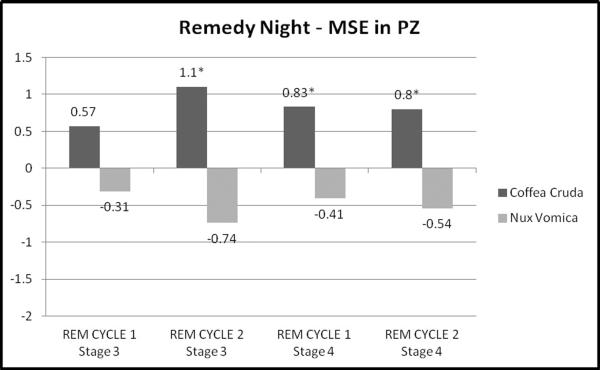
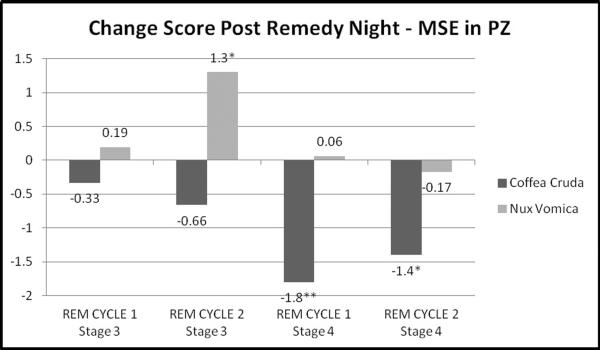
MSE results indicate significant, remedy-specific directional effects, especially later in the night (REM cycle 2) (CC: remedy night increases and post-remedy night decreases in MSE at multiple sites for both stages 3 and 4 in both REM cycles; NV: remedy night decreases and post-remedy night increases, mainly in stage 3 REM cycle 2 MSE). D2 analyses yielded more sporadic and inconsistent findings.
Homeopathic medicines Coffea cruda and Nux vomica in 30c potencies alter short-term nonlinear dynamic parameters of slow wave sleep EEG in healthy young adults. MSE may provide a more sensitive NDS analytic method than D2 for evaluating homeopathic remedy effects on human sleep EEG patterns.
顺势疗法的研究者提出,非线性动力系统(NDS)和复杂系统科学为评估顺势疗法药物的效果提供了概念和分析工具。先前的动物研究表明,顺势疗法药物会改变脑电图(EEG)的δ波慢波睡眠。本研究通过测试使用两种不同的NDS分析方法评估药物对人类慢波睡眠EEG的影响的可行性,扩展了人类受试者中与药物相关的睡眠阶段改变的研究结果。
受试者(N = 54)为有咖啡相关失眠史的年轻成年男女大学生,他们参与了一项为期4周的更大规模研究,该研究针对顺势疗法药物对居家整夜睡眠记录的多导睡眠图影响。受试者在睡前服用一剂顺势疗法药物(咖啡碱或吐根碱30c)。我们计算了在前两个快速眼动(REM)周期中,在无伪迹的2分钟片段内采样的第3和第4阶段慢波睡眠EEG的多尺度熵(MSE)和关联维数(Mekler-D2),以控制安慰剂和安慰剂后夜间效应,分别针对用药当晚和用药后当晚进行分析。
MSE结果表明存在显著的、特定药物的方向性影响,尤其是在夜间后期(REM周期2)(咖啡碱:在两个REM周期的第3和第4阶段,多个部位的用药当晚MSE增加,用药后当晚MSE降低;吐根碱:用药当晚MSE降低,用药后当晚MSE增加,主要在REM周期2的第3阶段MSE)。D2分析得出的结果更为零散且不一致。
30c药力的顺势疗法药物咖啡碱和吐根碱会改变健康年轻成年人慢波睡眠EEG的短期非线性动力学参数。对于评估顺势疗法药物对人类睡眠EEG模式的影响,MSE可能比D2提供更敏感的NDS分析方法。