Sigma-Tau Industrie Farmaceutiche Riunite, Pomezia, Italy.
Malar J. 2012 Jul 20;11:233. doi: 10.1186/1475-2875-11-233.
Resistance in Plasmodium falciparum to commonly used anti-malarial drugs, especially chloroquine, is being increasingly documented in India. By 2007, the first-line treatment for uncomplicated malaria has been revised to recommend artemisinin-based combination therapy (ACT) for all confirmed P. falciparum cases.
The objective of this study was to compare the efficacy, safety and tolerability between dihydroartemisinin-piperaquine (DP) and artesunate plus mefloquine (A + M) drug combinations in the treatment of uncomplicated P. falciparum malaria in India.
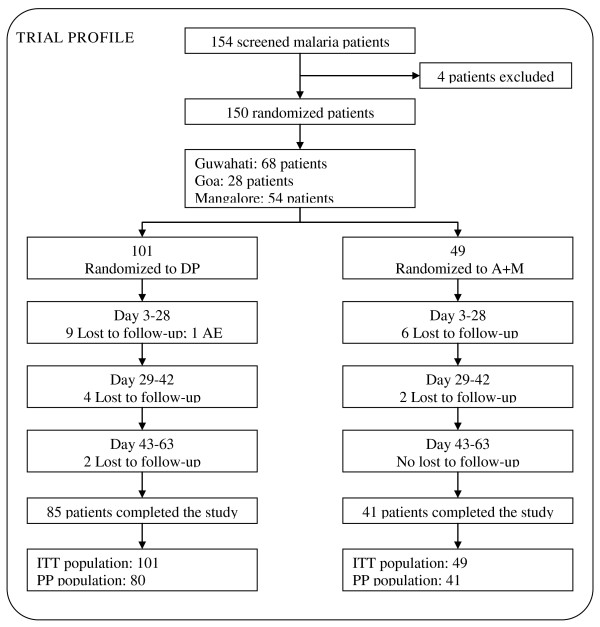
Between 2006 and 2007, 150 patients with acute uncomplicated P. falciparum malaria were enrolled, randomized to DP (101) or A + M (49) and followed up for 63 days as part of an open-label, non-inferiority, randomized, phase III multicenter trial in Asia.
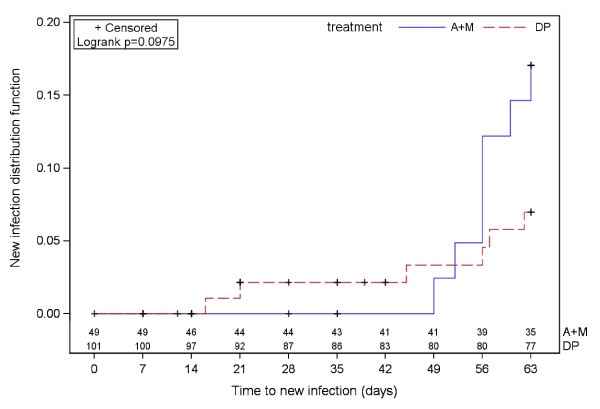
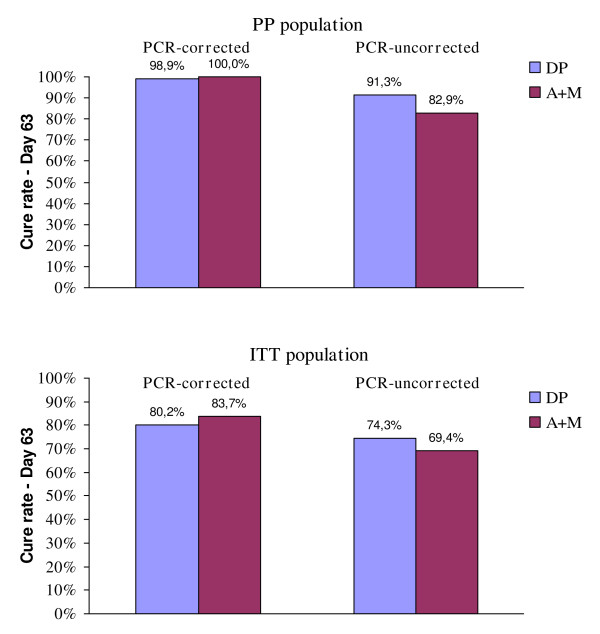
The heterogeneity analysis showed no statistically significant difference between India and the other countries involved in the phase III study, for both the PCR-corrected and uncorrected cure rates. As shown at the whole study level, both forms of ACT were highly efficacious in India. In fact, in the per protocol population, the 63-day cure rates were 100% for A + M and 98.8% for DP. The DP combination exerted a significant post-treatment prophylactic effect, and compared with A + M a significant reduction in the incidence of new infections for DP was observed (respectively 17.1% versus 7.5% of patients experienced new infection within follow up). Parasite and fever clearance was rapid in both treatment arms (median time to parasite clearance of one day for both groups). Both DP and A + M were well tolerated, with the majority of adverse events of mild or moderate severity. The frequencies of individual adverse events were generally similar between treatments, although the incidence of post treatment adverse events was slightly higher in patients who received A + M with respect to those treated with DP.
DP is a new ACT displaying high efficacy and safety in the treatment of uncomplicated P. falciparum malaria and could potentially be considered for the first-line treatment of uncomplicated falciparum malaria in India.
Current Controlled Trials ISRCTN 81306618.
在印度,疟原虫对常用抗疟药物(尤其是氯喹)的耐药性日益明显。截至 2007 年,对无并发症疟疾的一线治疗已修订为建议对所有确诊的恶性疟原虫病例使用青蒿素为基础的联合疗法(ACT)。
本研究旨在比较双氢青蒿素-哌喹(DP)和青蒿琥酯-甲氟喹(A+M)联合用药治疗印度无并发症恶性疟原虫疟疾的疗效、安全性和耐受性。
2006 年至 2007 年,共纳入 150 例急性无并发症恶性疟原虫疟疾患者,采用 DP(101 例)或 A+M(49 例)进行随机分组,并进行为期 63 天的开放性、非劣效性、随机、III 期多中心临床试验随访。
异质性分析显示,在 PCR 校正和未校正的治愈率方面,印度与 III 期研究涉及的其他国家之间均无统计学差异。从整体研究水平来看,两种 ACT 在印度均具有很高的疗效。事实上,在符合方案人群中,A+M 的 63 天治愈率为 100%,DP 为 98.8%。DP 联合用药具有显著的治疗后预防作用,与 A+M 相比,DP 组新感染发生率显著降低(分别为 17.1%和 7.5%的患者在随访期间发生新感染)。两组的寄生虫和发热清除均迅速(两组的寄生虫清除中位时间均为 1 天)。DP 和 A+M 均具有良好的耐受性,大多数不良反应为轻度或中度。两种治疗方法的个别不良反应发生率通常相似,尽管 A+M 组治疗后不良反应的发生率略高于 DP 组。
DP 是一种新的 ACT,在治疗无并发症恶性疟原虫疟疾方面具有高效性和安全性,可考虑作为印度无并发症恶性疟原虫疟疾的一线治疗药物。
当前对照试验 ISRCTN81306618。