• 文献检索
  • 文档翻译
  • 深度研究
  • 学术资讯
  • Suppr Zotero 插件Zotero 插件
  • 邀请有礼
  • 套餐&价格
  • 历史记录
应用&插件
Suppr Zotero 插件Zotero 插件浏览器插件Mac 客户端Windows 客户端微信小程序
定价
高级版会员购买积分包购买API积分包
服务
文献检索文档翻译深度研究API 文档MCP 服务
关于我们
关于 Suppr公司介绍联系我们用户协议隐私条款
关注我们

Suppr 超能文献

核心技术专利:CN118964589B侵权必究
粤ICP备2023148730 号-1Suppr @ 2026

文献检索

告别复杂PubMed语法,用中文像聊天一样搜索,搜遍4000万医学文献。AI智能推荐,让科研检索更轻松。

立即免费搜索

文件翻译

保留排版,准确专业,支持PDF/Word/PPT等文件格式,支持 12+语言互译。

免费翻译文档

深度研究

AI帮你快速写综述,25分钟生成高质量综述,智能提取关键信息,辅助科研写作。

立即免费体验

日常食用巧克力和非巧克力零食会影响餐后焦虑、能量和情绪状态。

Everyday eating experiences of chocolate and non-chocolate snacks impact postprandial anxiety, energy and emotional states.

机构信息

BioAnalytical Science, Nestlé Research Center, Nestec Ltd, Lausanne 26, Switzerland.

出版信息

Nutrients. 2012 Jun;4(6):554-67. doi: 10.3390/nu4060554. Epub 2012 Jun 20.

DOI:10.3390/nu4060554
PMID:22822453
原文链接:https://pmc.ncbi.nlm.nih.gov/articles/PMC3397353/
Abstract

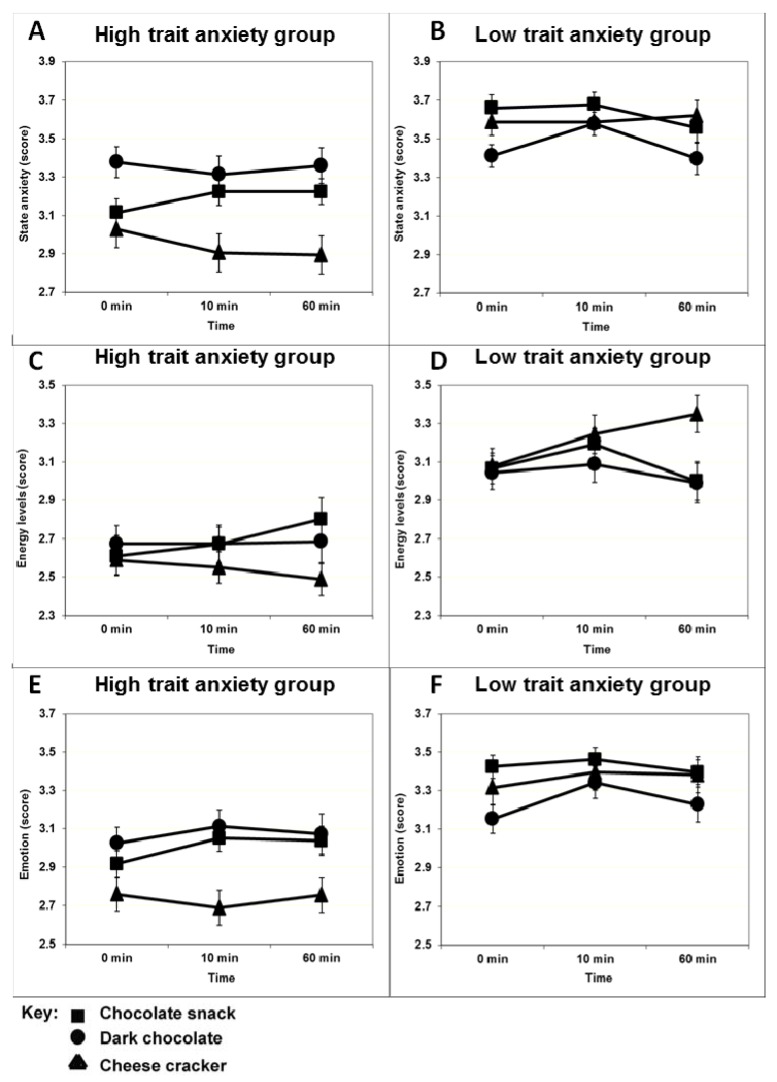
Social and psychological stressors are both a part of daily life and are increasingly recognized as contributors to individual susceptibility to develop diseases and metabolic disorders. The present study investigated how snacks differing in sensory properties and presentation can influence ratings of affect in consumers with different levels of dispositional anxiety. This study examines the relationships between a pre-disposition to anxiety and food using a repeated exposures design with three interspersed test days over a period of two weeks. The study was conducted on ninety free-living male (n = 28) and female (n = 62) Dutch participants aged between 18 and 35 years old, with a BMI between 18 and 25 kg/m(2) and different anxiety trait levels assessed using State-Trait Anxiety Inventory tests. The study was randomized by age, gender, anxiety trait score, and followed a parallel open design. Three test products: dark chocolate, a milk chocolate snack and crackers with cheese spread (control), which differed in composition, sensory properties and presentation, were evaluated. Changes in self-reported anxiety, emotion, and energetic states were assessed as a function of eating the snacks just after consumption and up to one hour. The repeated exposure design over a period of two weeks enabled the investigations of potential cumulative effects of regular consumption of the food products. The milk chocolate snack resulted in the decrease of anxiety in high anxiety trait subjects, whereas dark chocolate and cheese and crackers respectively improved the anxiety level and the energetic state of low anxiety trait participants. The mood effects were not altered with repeated exposure, and the magnitude of changes was similar on each test day, which illustrates the repeatability of the effects of the food on subjective measures of postprandial wellness.

摘要

社会和心理压力源都是日常生活的一部分,并且越来越被认为是导致个体易患疾病和代谢紊乱的因素。本研究调查了具有不同特质焦虑水平的消费者,感官特性和呈现方式不同的零食如何影响他们的情绪评价。本研究使用重复暴露设计,在两周的时间内穿插三个测试日,研究了焦虑前倾向与食物之间的关系。该研究在 90 名自由生活的荷兰男性(n = 28)和女性(n = 62)中进行,年龄在 18 至 35 岁之间,BMI 在 18 至 25 kg/m²之间,使用状态-特质焦虑量表测试评估不同的焦虑特质水平。该研究按年龄、性别、焦虑特质评分随机分组,并遵循平行开放设计。评估了三种测试产品:黑巧克力、牛奶巧克力零食和奶酪涂抹饼干(对照),它们在成分、感官特性和呈现方式上有所不同。评估了食用零食后即刻和 1 小时内自我报告的焦虑、情绪和能量状态的变化。两周的重复暴露设计使我们能够研究经常食用这些食品产品的潜在累积效应。牛奶巧克力零食降低了高特质焦虑受试者的焦虑感,而黑巧克力和奶酪饼干则分别改善了低特质焦虑参与者的焦虑水平和能量状态。情绪影响不会因重复暴露而改变,并且在每个测试日的变化幅度相似,这说明了食物对餐后健康主观测量的影响具有可重复性。
https://cdn.ncbi.nlm.nih.gov/pmc/blobs/e8b6/3397353/4e04b700520a/nutrients-04-00554-g001.jpg

相似文献

1
Everyday eating experiences of chocolate and non-chocolate snacks impact postprandial anxiety, energy and emotional states.日常食用巧克力和非巧克力零食会影响餐后焦虑、能量和情绪状态。
Nutrients. 2012 Jun;4(6):554-67. doi: 10.3390/nu4060554. Epub 2012 Jun 20.
2
Dark chocolate and reduced snack consumption in mildly hypertensive adults: an intervention study.黑巧克力与轻度高血压成年人零食摄入量减少:一项干预研究。
Nutr J. 2015 Aug 22;14:84. doi: 10.1186/s12937-015-0075-3.
3
Food cravings in everyday life: An EMA study on snack-related thoughts, cravings, and consumption.日常生活中的食物渴望:一项关于零食相关想法、渴望及消费的生态瞬时评估研究
Appetite. 2017 Jun 1;113:215-223. doi: 10.1016/j.appet.2017.02.037. Epub 2017 Feb 27.
4
Chocolate versions of the Food Cravings Questionnaires. Associations with chocolate exposure-induced salivary flow and ad libitum chocolate consumption.食物渴望问卷的巧克力版本。与巧克力暴露诱导的唾液分泌及随意巧克力摄入量的关联。
Appetite. 2015 Aug;91:256-65. doi: 10.1016/j.appet.2015.04.054. Epub 2015 Apr 23.
5
Anticipatory and reactive responses to chocolate restriction in frequent chocolate consumers.频繁食用巧克力者对巧克力限制的预期性和反应性反应。
Obesity (Silver Spring). 2015 Jun;23(6):1130-5. doi: 10.1002/oby.21098.
6
Everyday mood and emotions after eating a chocolate bar or an apple.食用巧克力棒或苹果后的日常情绪和情感。
Appetite. 2006 May;46(3):332-6. doi: 10.1016/j.appet.2006.01.014. Epub 2006 Mar 20.
7
Experimental effects of chocolate deprivation on cravings, mood, and consumption in high and low chocolate-cravers.巧克力剥夺对高、低巧克力嗜欲者的渴望、情绪和消费的实验影响。
Appetite. 2012 Feb;58(1):111-6. doi: 10.1016/j.appet.2011.09.013. Epub 2011 Sep 29.
8
Specific dietary preferences are linked to differing gut microbial metabolic activity in response to dark chocolate intake.特定的饮食偏好与摄入黑巧克力后肠道微生物代谢活性的差异有关。
J Proteome Res. 2012 Dec 7;11(12):6252-63. doi: 10.1021/pr300915z. Epub 2012 Nov 19.
9
Lack of effect of high-protein vs. high-carbohydrate meal intake on stress-related mood and eating behavior.高蛋白与高碳水化合物膳食摄入对与应激相关的情绪和饮食行为的影响无差异。
Nutr J. 2011 Dec 12;10:136. doi: 10.1186/1475-2891-10-136.
10
Desire lies in the eyes: attention bias for chocolate is related to craving and self-endorsed eating permission.欲望在眼中流露:对巧克力的注意偏向与渴望和自我认可的进食许可有关。
Appetite. 2013 Nov;70:81-9. doi: 10.1016/j.appet.2013.06.087. Epub 2013 Jul 2.

引用本文的文献

1
Chocolate, "Food of the Gods": History, Science, and Human Health.巧克力,“众神的食物”:历史、科学与人类健康。
Int J Environ Res Public Health. 2019 Dec 6;16(24):4960. doi: 10.3390/ijerph16244960.

本文引用的文献

1
Does negative mood drive the urge to eat? The contribution of negative mood, exposure to food cues and eating style.消极情绪会促使人们产生进食的欲望吗?消极情绪、食物线索暴露和饮食方式的作用。
Appetite. 2011 Apr;56(2):368-74. doi: 10.1016/j.appet.2011.01.011. Epub 2011 Jan 14.
2
Trait anxiety, but not trait anger, predisposes obese individuals to emotional eating.特质焦虑,而非特质愤怒,使肥胖个体易产生情绪性进食。
Appetite. 2010 Dec;55(3):701-6. doi: 10.1016/j.appet.2010.10.006. Epub 2010 Oct 17.
3
Consumer perceptions of satiety-related snack food decision making.
消费者对与饱腹感相关的零食决策的认知。
Appetite. 2010 Dec;55(3):639-47. doi: 10.1016/j.appet.2010.09.020. Epub 2010 Sep 25.
4
Emotional eating, depressive symptoms and self-reported food consumption. A population-based study.情绪化进食、抑郁症状与自我报告的食物摄入。基于人群的研究。
Appetite. 2010 Jun;54(3):473-9. doi: 10.1016/j.appet.2010.01.014. Epub 2010 Feb 4.
5
Measures of postprandial wellness after single intake of two protein-carbohydrate meals.两种蛋白质-碳水化合物餐单次摄入后餐后健康的测量。
Appetite. 2010 Jun;54(3):456-64. doi: 10.1016/j.appet.2009.12.014. Epub 2010 Jan 9.
6
Negative mood increases selective attention to food cues and subjective appetite.负面情绪会增加对食物线索的选择性注意和主观食欲。
Appetite. 2010 Feb;54(1):134-42. doi: 10.1016/j.appet.2009.09.019. Epub 2009 Oct 6.
7
Metabolic effects of dark chocolate consumption on energy, gut microbiota, and stress-related metabolism in free-living subjects.黑巧克力摄入对自由生活受试者能量、肠道微生物群和应激相关代谢的代谢影响。
J Proteome Res. 2009 Dec;8(12):5568-79. doi: 10.1021/pr900607v.
8
Emotions and eating. Self-reported and experimentally induced changes in food intake under stress.情绪与饮食。压力下自我报告及实验诱导的食物摄入量变化。
Appetite. 2009 Apr;52(2):355-62. doi: 10.1016/j.appet.2008.11.007. Epub 2008 Nov 24.
9
Attentional and approach biases for pictorial food cues. Influence of external eating.对图片食物线索的注意偏向和趋近偏向。外部进食的影响。
Appetite. 2009 Apr;52(2):299-306. doi: 10.1016/j.appet.2008.10.007. Epub 2008 Nov 5.
10
Measuring affective (liking) and non-affective (expected satiety) determinants of portion size and food reward.测量份量大小和食物奖励的情感(喜好)和非情感(预期饱腹感)决定因素。
Appetite. 2009 Feb;52(1):108-14. doi: 10.1016/j.appet.2008.09.002. Epub 2008 Sep 10.