Department of Health Statistics, Second Military Medical University, Shanghai, China.
PLoS One. 2012;7(7):e40872. doi: 10.1371/journal.pone.0040872. Epub 2012 Jul 19.
There is limited epidemiologic information about the incidence of hepatitis C in China, and few studies have applied space-time scan statistic to detect clusters of hepatitis C and made adjustment for temporal trend and relative risk of regions.
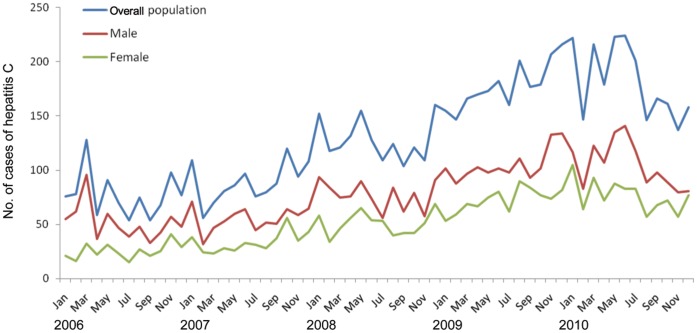
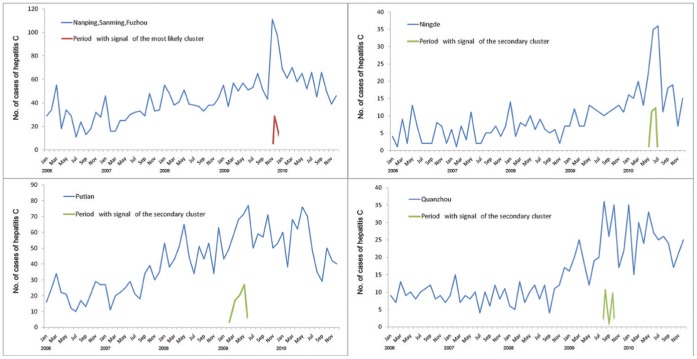
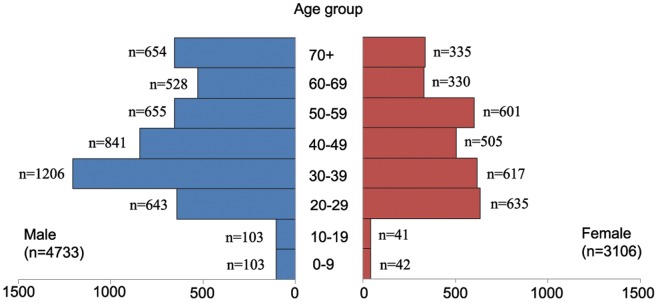
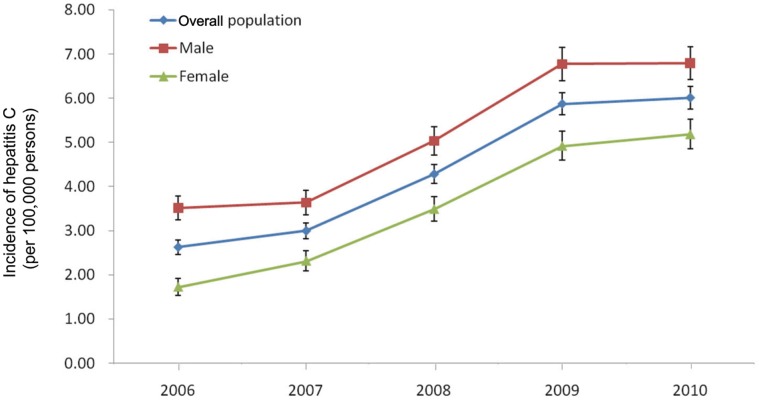
We analyzed the temporal changes and characteristics of incidence of hepatitis C in Fujian Province from 2006 through 2010. The discrete Poisson model of space-time scan statistic was chosen for cluster detection. Data on new cases of hepatitis C were obtained from the Center for Disease Control and Prevention of Fujian Province. Between 2006 and 2010, there was an annualized increase in the incidence of hepatitis C of 23.0 percent, from 928 cases (2.63 per 100,000 persons) to 2,180 cases (6.01 per 100,000 persons). The incidence among women increased more rapidly. The cumulative incidence showed that people who were over 60 years had the highest risk to suffer hepatitis C (52.51 per 100,000 persons), and women had lower risk compared to men (OR=0.69). Putian had the highest cumulative incidence among all the regions (86.95 per 100,000 persons). The most likely cluster was identified in Putian during March to August in 2009 without adjustment, but it shifted to three contiguous cities with a two-month duration after adjustment for temporal trend and relative risk of regions.
CONCLUSIONS/SIGNIFICANCE: The incidence of hepatitis C is increasing in Fujian Province, and women are at a more rapid pace. The space-time scan statistic is useful as a screening tool for clusters of hepatitis C, with adjustment for temporal trend and relative risk of regions recommended.
中国有关丙型肝炎发病率的流行病学信息有限,且鲜有研究应用时空扫描统计来检测丙型肝炎的聚集性,并对时间趋势和区域相对风险进行校正。
我们分析了 2006 年至 2010 年福建省丙型肝炎发病率的时间变化和特征。选择时空扫描统计的离散泊松模型来检测聚集。丙型肝炎新发病例数据来自福建省疾病预防控制中心。2006 年至 2010 年,丙型肝炎发病率呈每年 23.0%的速度增长,从 928 例(每 10 万人 2.63 例)增加至 2180 例(每 10 万人 6.01 例)。女性的增长速度更快。累积发病率显示,60 岁以上人群感染丙型肝炎的风险最高(每 10 万人 52.51 例),女性的风险低于男性(OR=0.69)。所有地区中,莆田的累积发病率最高(每 10 万人 86.95 例)。未经校正时,2009 年 3 月至 8 月间在莆田发现了最有可能的聚集,但校正时间趋势和区域相对风险后,聚集范围转移到了三个连续的城市,持续两个月。
结论/意义:福建省丙型肝炎发病率呈上升趋势,且女性上升速度更快。时空扫描统计是一种检测丙型肝炎聚集性的有用筛查工具,建议校正时间趋势和区域相对风险。