Department of Pharmaceutical Chemistry, Drug Analysis and Drug Information, Center for Neurosciences, Faculty of Medicine and Pharmacy, Vrije Universiteit Brussel, Belgium.
Oxid Med Cell Longev. 2012;2012:624925. doi: 10.1155/2012/624925. Epub 2012 Jul 8.
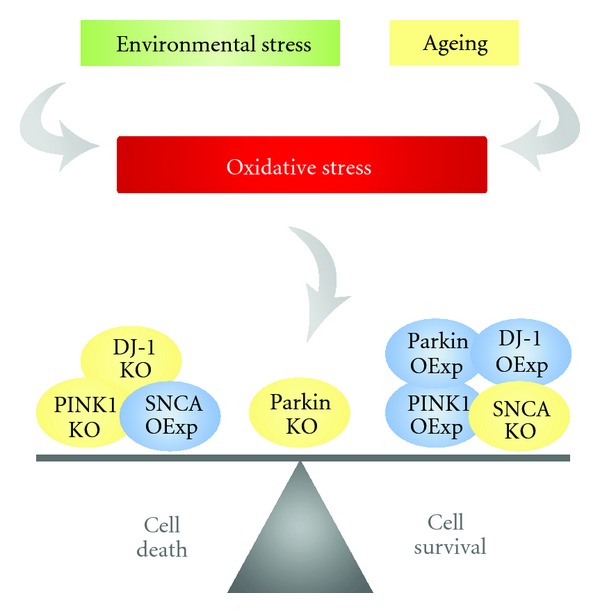
There is extensive evidence in Parkinson's disease of a link between oxidative stress and some of the monogenically inherited Parkinson's disease-associated genes. This paper focuses on the importance of this link and potential impact on neuronal function. Basic mechanisms of oxidative stress, the cellular antioxidant machinery, and the main sources of cellular oxidative stress are reviewed. Moreover, attention is given to the complex interaction between oxidative stress and other prominent pathogenic pathways in Parkinson's disease, such as mitochondrial dysfunction and neuroinflammation. Furthermore, an overview of the existing genetic mouse models of Parkinson's disease is given and the evidence of oxidative stress in these models highlighted. Taken into consideration the importance of ageing and environmental factors as a risk for developing Parkinson's disease, gene-environment interactions in genetically engineered mouse models of Parkinson's disease are also discussed, highlighting the role of oxidative damage in the interplay between genetic makeup, environmental stress, and ageing in Parkinson's disease.
帕金森病中有大量证据表明氧化应激与一些单基因遗传性帕金森病相关基因之间存在关联。本文重点介绍了这种联系的重要性及其对神经元功能的潜在影响。综述了氧化应激的基本机制、细胞抗氧化机制以及细胞氧化应激的主要来源。此外,还关注了氧化应激与帕金森病中其他突出的致病途径(如线粒体功能障碍和神经炎症)之间的复杂相互作用。此外,还概述了现有的帕金森病遗传小鼠模型,并强调了这些模型中氧化应激的证据。考虑到衰老和环境因素作为帕金森病发病的风险因素,本文还讨论了帕金森病基因工程小鼠模型中的基因-环境相互作用,强调了氧化损伤在遗传构成、环境应激和衰老相互作用中在帕金森病中的作用。