The School of Medical Sciences, Edith Cowan University, Joondalup, WA, Australia.
Transl Psychiatry. 2012 May 22;2(5):e118. doi: 10.1038/tp.2012.43.
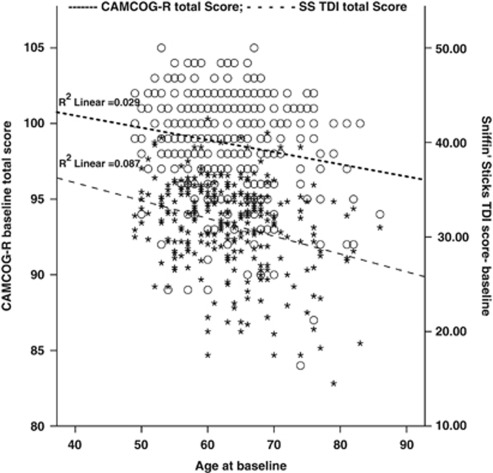
The presence of olfactory dysfunction in individuals at higher risk of Alzheimer's disease has significant diagnostic and screening implications for preventive and ameliorative drug trials. Olfactory threshold, discrimination and identification can be reliably recorded in the early stages of neurodegenerative diseases. The current study has examined the ability of various olfactory functions in predicting cognitive decline in a community-dwelling sample. A group of 308 participants, aged 46-86 years old, were recruited for this study. After 3 years of follow-up, participants were divided into cognitively declined and non-declined groups based on their performance on a neuropsychological battery. Assessment of olfactory functions using the Sniffin' Sticks battery indicated that, contrary to previous findings, olfactory discrimination, but not olfactory identification, significantly predicted subsequent cognitive decline (odds ratio = 0.869; P<0.05; 95% confidence interval = 0.764-0.988). The current study findings confirm previously reported associations between olfactory and cognitive functions, and indicate that impairment in olfactory discrimination can predict future cognitive decline. These findings further our current understanding of the association between cognition and olfaction, and support olfactory assessment in screening those at higher risk of dementia.
嗅觉功能障碍在阿尔茨海默病高危个体中的存在对预防和改善药物试验的诊断和筛查具有重要意义。嗅觉阈值、辨别和识别可以在神经退行性疾病的早期阶段可靠地记录下来。本研究探讨了各种嗅觉功能在预测社区居住样本认知能力下降方面的能力。本研究招募了 308 名年龄在 46-86 岁的参与者。经过 3 年的随访,根据他们在神经心理学测试中的表现,将参与者分为认知下降组和非下降组。使用嗅棒测试评估嗅觉功能表明,与之前的发现相反,嗅觉辨别,而不是嗅觉识别,显著预测了随后的认知下降(优势比=0.869;P<0.05;95%置信区间=0.764-0.988)。本研究的发现证实了先前报道的嗅觉和认知功能之间的关联,并表明嗅觉辨别障碍可以预测未来的认知能力下降。这些发现进一步加深了我们对认知和嗅觉之间关联的理解,并支持嗅觉评估在筛查那些痴呆风险较高的人群中的应用。