Barton Cassie A, McMillian Wesley D, Crookes Bruce A, Osler Turner, Bartlett Craig S
Department of Pharmacy, Fletcher Allen Health Care, Burlington, VT, USA.
Int J Crit Illn Inj Sci. 2012 May;2(2):57-62. doi: 10.4103/2229-5151.97268.
Prophylactic antibiotics, paired with wound care and surgical intervention, is considered the standard of care for patients with open fracture. Guidelines from the Eastern Association for the Surgery of Trauma (EAST) recommend specific prophylactic antimicrobial therapy based on the type of open fracture.
We quantified adherence to EAST guideline recommendations and documented the incidence of infection in patients with open fracture.
A retrospective, observational study of all patients with open fracture admitted to our facility from January 2004 to December 2008 was conducted.
Patients were divided into compliant and noncompliant groups according to the EAST guideline recommendations. Compliance was defined as an appropriate spectrum of therapy for guideline suggested duration. We assessed for surgical and non-surgical site infections, and morbidity outcomes.
Nominal data were explored using summary measures. Continuous variables were compared using the Student t-test or the Mann-Whitney U-test. Dichotomous data were compared using χ(2) statistic or Fisher's exact test.
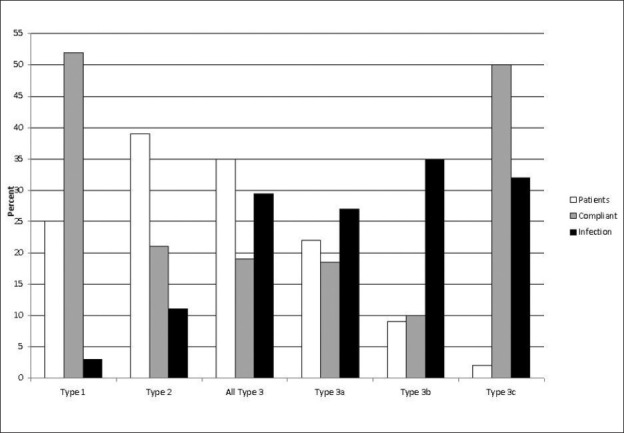
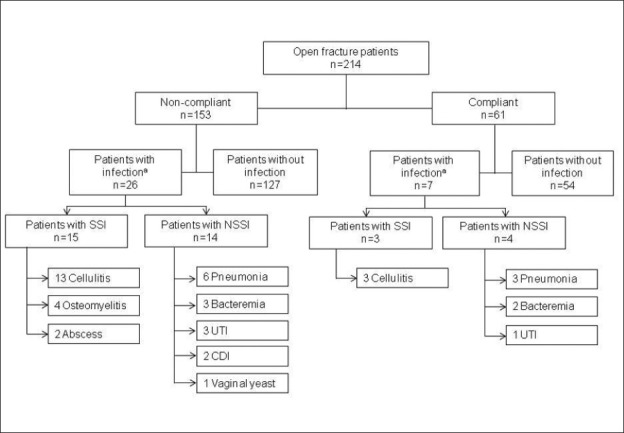
The final analysis included 214 patients. Prophylactic antibiotics were guideline compliant in 28.5% of patients, and ranged from 10.0% in type 3b fractures to 52.7% in type 1 fractures. The most common reason for non-compliance was the use of guideline recommended coverage that exceeded the suggested duration (71.2%). Patients who received non-compliant therapy required prolonged hospital lengths of stay (6 vs. 3 days, P = 0.0001). The overall incidence of infection was similar regardless of guideline compliance (17.0% vs. 11.5%, P = 0.313).
Prophylactic antibiotics for open fracture frequently exceeded guideline recommendations in duration and spectrum of coverage, especially in more severe fracture types. Non-compliance with EAST recommendations was associated with increased in-hospital morbidity.
预防性抗生素联合伤口护理及手术干预被视为开放性骨折患者的标准治疗方案。东部创伤外科学会(EAST)的指南根据开放性骨折的类型推荐了特定的预防性抗菌治疗。
我们对EAST指南建议的依从性进行了量化,并记录了开放性骨折患者的感染发生率。
对2004年1月至2008年12月入住我院的所有开放性骨折患者进行了一项回顾性观察研究。
根据EAST指南建议将患者分为依从组和不依从组。依从性定义为在指南建议的疗程内使用适当的治疗范围。我们评估了手术和非手术部位感染以及发病结果。
使用汇总指标探索名义数据。连续变量使用Student t检验或Mann-Whitney U检验进行比较。二分数据使用χ(2)统计量或Fisher精确检验进行比较。
最终分析纳入214例患者。28.5%的患者预防性抗生素治疗符合指南,范围从3b型骨折的10.0%到1型骨折的52.7%。不依从的最常见原因是使用了超出建议疗程的指南推荐覆盖范围(71.2%)。接受不依从治疗的患者需要延长住院时间(6天对3天,P = 0.0001)。无论指南依从性如何,总体感染发生率相似(17.0%对11.5%,P = 0.313)。
开放性骨折预防性抗生素的疗程和覆盖范围经常超出指南建议,尤其是在更严重的骨折类型中。不遵守EAST建议与住院发病率增加有关。