Department of Experimental Pathology and Oncology, University of Florence, Viale Morgagni 50, Florence 50134, Italy.
J Radiat Res. 2012 Sep;53(5):695-703. doi: 10.1093/jrr/rrs025. Epub 2012 Jul 22.
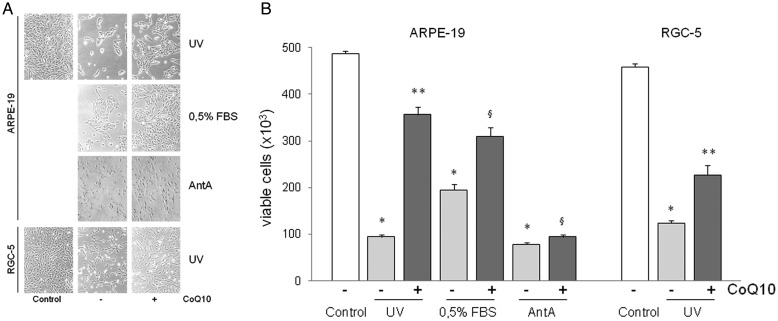
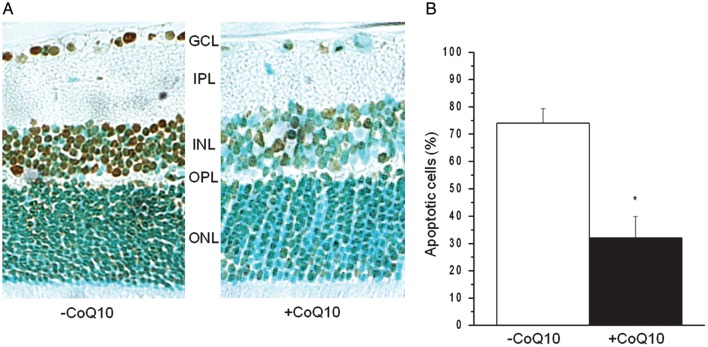
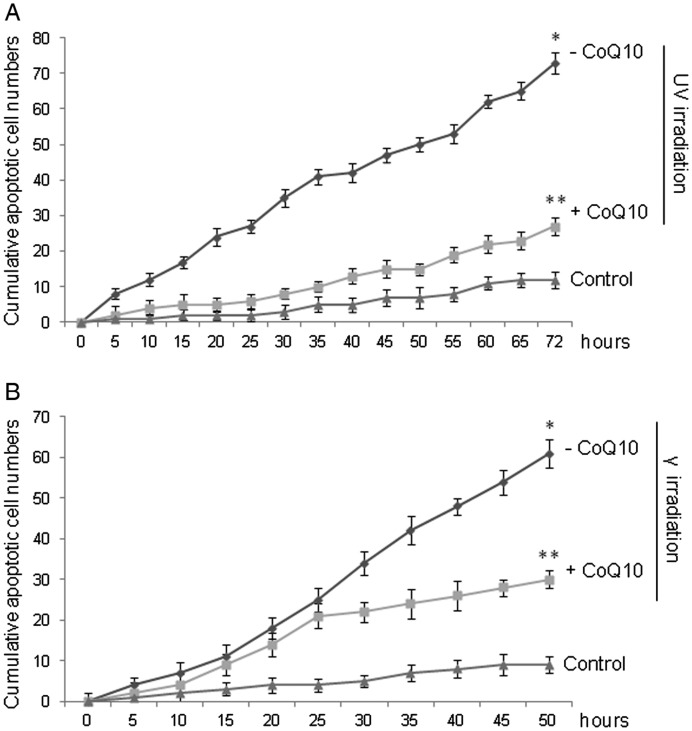
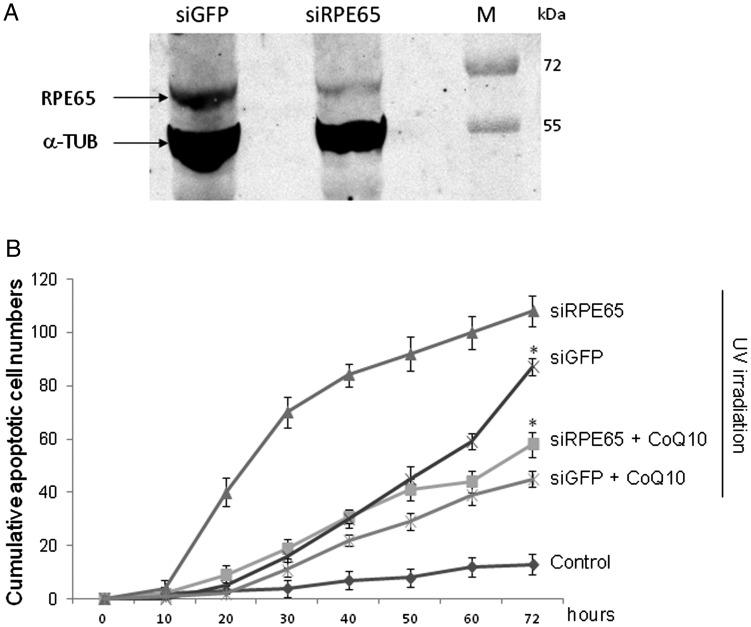
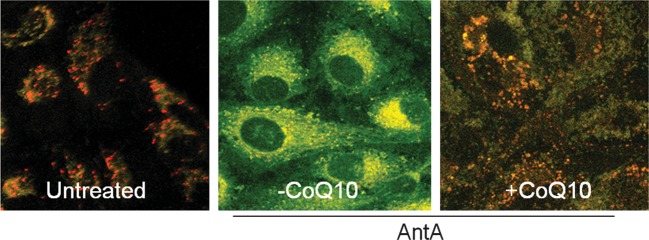
The key pathogenetic event of many retinopathies is apoptosis of retinal cells. Our previous studies have demonstrated that Coenzyme Q10 (CoQ10) prevents apoptosis of corneal keratocytes both in vitro and in vivo, by virtue of its ability to inhibit mitochondrial depolarization, independently of its free radical scavenger role. The aim of this study was to evaluate whether CoQ10 can protect cultured retinal cells and the retinas of rats from radiation-induced apoptosis, if instilled as eye drops in the cornea. In vitro experiments were carried out on cultured ARPE-19 or RGC-5 cells pretreated with CoQ10 before eliciting apoptosis by UV- and γ-radiation, chemical hypoxia (Antimycin A) and serum starvation. Cell viability was evaluated by light microscopy and fluorescence activated cell sorting analysis. Apoptotic events were scored by time-lapse videomicroscopy. Mitochondrial permeability transition was evaluated by JC-1. The anti-apoptotic effectiveness of CoQ10 in retina was also evaluated by an in situ end-labeling assay in Wistar albino rats treated with CoQ10 eye drops prior to UV irradiation of the eye. CoQ10 substantially increased cell viability and lowered retinal cell apoptosis in response both to UV- and γ-radiation and to chemical hypoxia or serum starvation by inhibiting mitochondrion depolarization. In the rat, CoQ10, even when applied as eye drops on the cornea, protected all retina layers from UVR-induced apoptosis. The ability of CoQ10 to protect retinal cells from radiation-induced apoptosis following its instillation on the cornea suggests the possibility for CoQ10 eye drops to become a future therapeutic countermeasure for radiation-induced retinal lesions.
许多视网膜病变的关键发病机制是视网膜细胞的凋亡。我们之前的研究表明,辅酶 Q10(CoQ10)通过抑制线粒体去极化来防止体外和体内角膜成纤维细胞的凋亡,而与自由基清除作用无关。本研究旨在评估 CoQ10 作为滴眼剂滴入角膜是否可以保护培养的视网膜细胞和大鼠视网膜免受辐射诱导的凋亡。体外实验在预先用 CoQ10 预处理的 ARPE-19 或 RGC-5 细胞上进行,然后通过 UV 和γ辐射、化学缺氧(antimycin A)和血清饥饿引发凋亡。通过荧光激活细胞分选分析评估细胞活力。通过延时摄像显微镜评估凋亡事件。通过 JC-1 评估线粒体通透性转换。通过 CoQ10 滴眼剂处理 Wistar 白化大鼠,然后对眼部进行 UV 照射,评估 CoQ10 在视网膜中的抗凋亡效果。CoQ10 显著增加了细胞活力,并通过抑制线粒体去极化,降低了对 UV-和γ辐射以及化学缺氧或血清饥饿的反应中的视网膜细胞凋亡。在大鼠中,CoQ10 即使作为滴眼剂滴入角膜,也能保护所有视网膜层免受 UVR 诱导的凋亡。CoQ10 能够在角膜滴注后保护视网膜细胞免受辐射诱导的凋亡,这表明 CoQ10 滴眼剂有可能成为治疗辐射引起的视网膜损伤的未来治疗措施。