• 文献检索
  • 文档翻译
  • 深度研究
  • 学术资讯
  • Suppr Zotero 插件Zotero 插件
  • 邀请有礼
  • 套餐&价格
  • 历史记录
应用&插件
Suppr Zotero 插件Zotero 插件浏览器插件Mac 客户端Windows 客户端微信小程序
定价
高级版会员购买积分包购买API积分包
服务
文献检索文档翻译深度研究API 文档MCP 服务
关于我们
关于 Suppr公司介绍联系我们用户协议隐私条款
关注我们

Suppr 超能文献

核心技术专利:CN118964589B侵权必究
粤ICP备2023148730 号-1Suppr @ 2026

文献检索

告别复杂PubMed语法,用中文像聊天一样搜索,搜遍4000万医学文献。AI智能推荐,让科研检索更轻松。

立即免费搜索

文件翻译

保留排版,准确专业,支持PDF/Word/PPT等文件格式,支持 12+语言互译。

免费翻译文档

深度研究

AI帮你快速写综述,25分钟生成高质量综述,智能提取关键信息,辅助科研写作。

立即免费体验

登革热发生与媒介检测的幼虫调查、诱卵器和 MosquiTRAP:时空聚类分析。

Dengue fever occurrence and vector detection by larval survey, ovitrap and MosquiTRAP: a space-time clusters analysis.

机构信息

Lab. Ecologia Química de Insetos Vetores, Departamento de Parasitologia, Instituto de Ciências Biológicas, Universidade Federal de Minas Gerais. Av. Presidente Antônio Carlos, Belo Horizonte, MG, Brazil.

出版信息

PLoS One. 2012;7(7):e42125. doi: 10.1371/journal.pone.0042125. Epub 2012 Jul 25.

DOI:10.1371/journal.pone.0042125
PMID:22848729
原文链接:https://pmc.ncbi.nlm.nih.gov/articles/PMC3405049/
Abstract

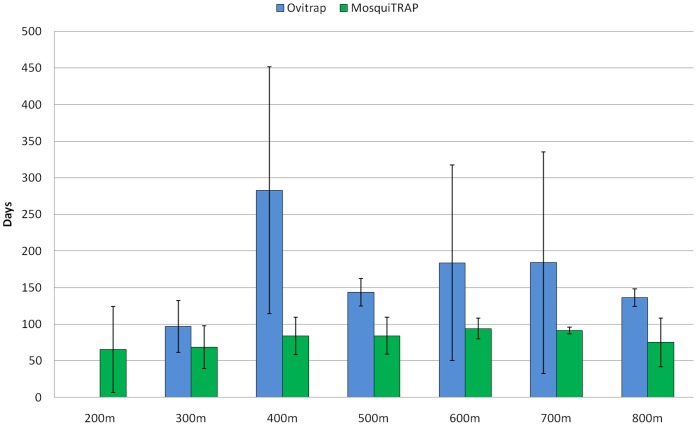
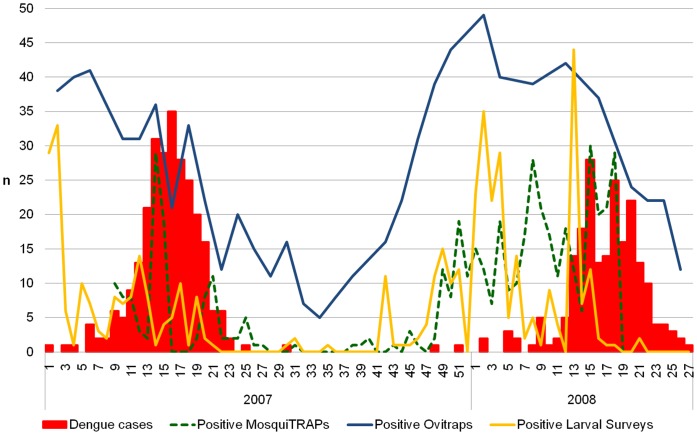
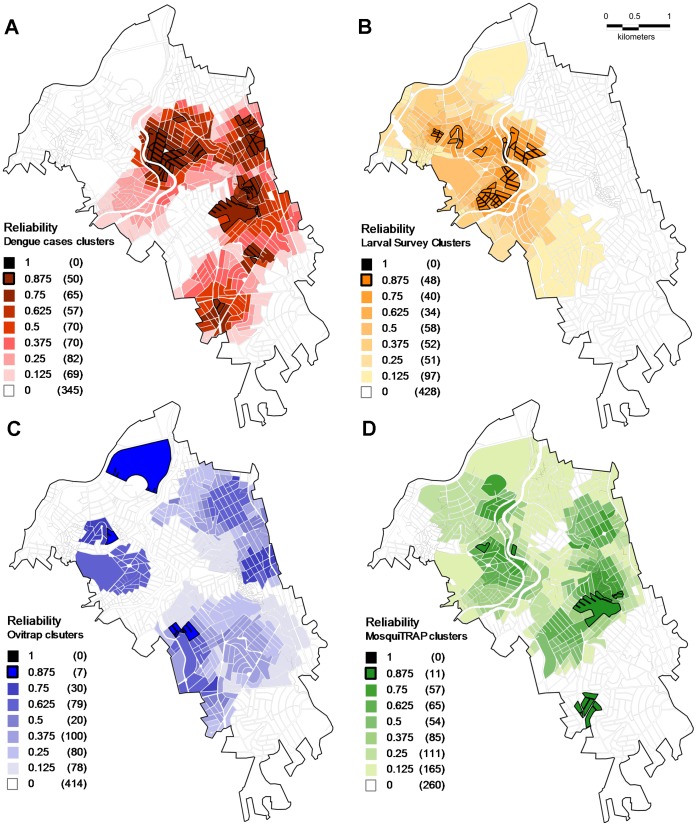
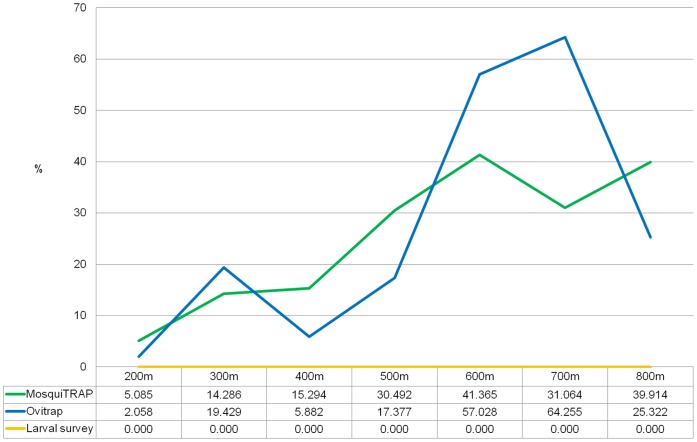
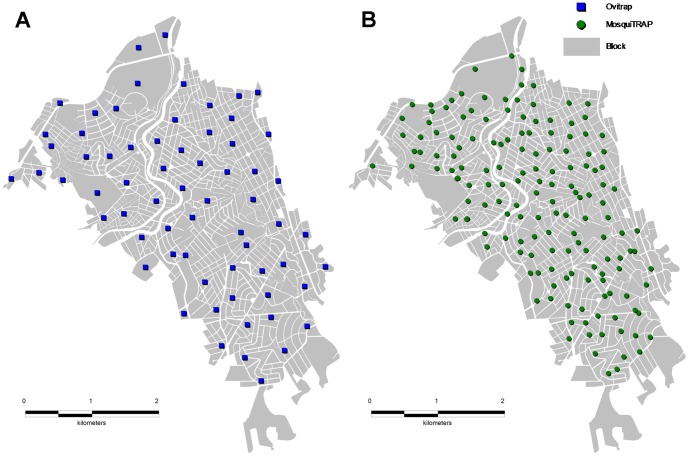
The use of vector surveillance tools for preventing dengue disease requires fine assessment of risk, in order to improve vector control activities. Nevertheless, the thresholds between vector detection and dengue fever occurrence are currently not well established. In Belo Horizonte (Minas Gerais, Brazil), dengue has been endemic for several years. From January 2007 to June 2008, the dengue vector Aedes (Stegomyia) aegypti was monitored by ovitrap, the sticky-trap MosquiTRAP™ and larval surveys in an study area in Belo Horizonte. Using a space-time scan for clusters detection implemented in SaTScan software, the vector presence recorded by the different monitoring methods was evaluated. Clusters of vectors and dengue fever were detected. It was verified that ovitrap and MosquiTRAP vector detection methods predicted dengue occurrence better than larval survey, both spatially and temporally. MosquiTRAP and ovitrap presented similar results of space-time intersections to dengue fever clusters. Nevertheless ovitrap clusters presented longer duration periods than MosquiTRAP ones, less acuratelly signalizing the dengue risk areas, since the detection of vector clusters during most of the study period was not necessarily correlated to dengue fever occurrence. It was verified that ovitrap clusters occurred more than 200 days (values ranged from 97.0±35.35 to 283.0±168.4 days) before dengue fever clusters, whereas MosquiTRAP clusters preceded dengue fever clusters by approximately 80 days (values ranged from 65.5±58.7 to 94.0±14. 3 days), the former showing to be more temporally precise. Thus, in the present cluster analysis study MosquiTRAP presented superior results for signaling dengue transmission risks both geographically and temporally. Since early detection is crucial for planning and deploying effective preventions, MosquiTRAP showed to be a reliable tool and this method provides groundwork for the development of even more precise tools.

摘要

利用病媒监测工具来预防登革热需要对风险进行精细评估,以改进病媒控制活动。然而,目前还没有很好地确定病媒检测与登革热发生之间的阈值。在巴西米纳斯吉拉斯州的贝洛奥里藏特,登革热已经流行了好几年。2007 年 1 月至 2008 年 6 月,在贝洛奥里藏特的一个研究区域,使用诱卵器、粘性诱捕器 MosquiTRAP 和幼虫调查监测登革热媒介埃及伊蚊。使用 SaTScan 软件中的时空扫描聚类检测方法,评估了不同监测方法记录的病媒存在情况。检测到了病媒和登革热的聚类。结果表明,诱卵器和 MosquiTRAP 病媒检测方法在空间和时间上都比幼虫调查更好地预测了登革热的发生。MosquiTRAP 和诱卵器与登革热聚类的时空交叉结果相似。然而,诱卵器聚类的持续时间比 MosquiTRAP 聚类长,因此,在研究期间,病媒聚类的检测并不一定与登革热的发生相关,因此,病媒聚类的检测不能准确地提示登革热风险区域。结果还表明,诱卵器聚类在登革热聚类之前发生的时间超过 200 天(范围从 97.0±35.35 到 283.0±168.4 天),而 MosquiTRAP 聚类在登革热聚类之前发生的时间约为 80 天(范围从 65.5±58.7 到 94.0±14.3 天),前者在时间上更为准确。因此,在本聚类分析研究中,MosquiTRAP 在地理和时间上都能更好地提示登革热传播风险。由于早期检测对于规划和部署有效的预防措施至关重要,因此 MosquiTRAP 显示出是一种可靠的工具,这种方法为开发更精确的工具奠定了基础。
https://cdn.ncbi.nlm.nih.gov/pmc/blobs/8309/3405049/9fb811a8ae69/pone.0042125.g007.jpg
https://cdn.ncbi.nlm.nih.gov/pmc/blobs/8309/3405049/45ed82e28355/pone.0042125.g001.jpg
https://cdn.ncbi.nlm.nih.gov/pmc/blobs/8309/3405049/fee4ddb97ac4/pone.0042125.g002.jpg
https://cdn.ncbi.nlm.nih.gov/pmc/blobs/8309/3405049/bc62a73f0490/pone.0042125.g003.jpg
https://cdn.ncbi.nlm.nih.gov/pmc/blobs/8309/3405049/bf065c33f0d2/pone.0042125.g004.jpg
https://cdn.ncbi.nlm.nih.gov/pmc/blobs/8309/3405049/f7996a0f9f99/pone.0042125.g005.jpg
https://cdn.ncbi.nlm.nih.gov/pmc/blobs/8309/3405049/fb1f278f2613/pone.0042125.g006.jpg
https://cdn.ncbi.nlm.nih.gov/pmc/blobs/8309/3405049/9fb811a8ae69/pone.0042125.g007.jpg
https://cdn.ncbi.nlm.nih.gov/pmc/blobs/8309/3405049/45ed82e28355/pone.0042125.g001.jpg
https://cdn.ncbi.nlm.nih.gov/pmc/blobs/8309/3405049/fee4ddb97ac4/pone.0042125.g002.jpg
https://cdn.ncbi.nlm.nih.gov/pmc/blobs/8309/3405049/bc62a73f0490/pone.0042125.g003.jpg
https://cdn.ncbi.nlm.nih.gov/pmc/blobs/8309/3405049/bf065c33f0d2/pone.0042125.g004.jpg
https://cdn.ncbi.nlm.nih.gov/pmc/blobs/8309/3405049/f7996a0f9f99/pone.0042125.g005.jpg
https://cdn.ncbi.nlm.nih.gov/pmc/blobs/8309/3405049/fb1f278f2613/pone.0042125.g006.jpg
https://cdn.ncbi.nlm.nih.gov/pmc/blobs/8309/3405049/9fb811a8ae69/pone.0042125.g007.jpg

相似文献

1
Dengue fever occurrence and vector detection by larval survey, ovitrap and MosquiTRAP: a space-time clusters analysis.登革热发生与媒介检测的幼虫调查、诱卵器和 MosquiTRAP:时空聚类分析。
PLoS One. 2012;7(7):e42125. doi: 10.1371/journal.pone.0042125. Epub 2012 Jul 25.
2
Spatial analysis of dengue incidence and Aedes aegypti ovitrap surveillance in Belo Horizonte, Brazil.巴西贝洛奥里藏特登革热发病率和埃及伊蚊诱卵器监测的空间分析。
Trop Med Int Health. 2021 Feb;26(2):237-255. doi: 10.1111/tmi.13521. Epub 2020 Nov 27.
3
Evaluation of the sticky MosquiTRAP for detecting Aedes (Stegomyia) aegypti (L.) (Diptera: Culicidae) during the dry season in Belo Horizonte, Minas Gerais, Brazil.在巴西米纳斯吉拉斯州贝洛奥里藏特旱季期间,对用于检测埃及伊蚊(双翅目:蚊科)的粘性MosquiTRAP进行评估。
Neotrop Entomol. 2007 Mar-Apr;36(2):294-302. doi: 10.1590/s1519-566x2007000200018.
4
A comparison of larval, ovitrap and MosquiTRAP surveillance for Aedes (Stegomyia) aegypti.埃及伊蚊(白纹伊蚊)幼虫、诱蚊产卵器和MosquiTRAP监测方法的比较
Mem Inst Oswaldo Cruz. 2013 Dec;108(8):1024-30. doi: 10.1590/0074-0276130128.
5
Risk of dengue occurrence based on the capture of gravid Aedes aegypti females using MosquiTRAP.基于使用 MosquiTRAP 捕获伊蚊雌蚊来预测登革热发生的风险。
Mem Inst Oswaldo Cruz. 2011 May;106(3):365-7. doi: 10.1590/s0074-02762011000300018.
6
Aedes (Stegomyia) aegypti in the continental United States: a vector at the cool margin of its geographic range.美国大陆的埃及伊蚊(Stegomyia aegypti):处于地理分布范围较冷边缘的病媒。
J Med Entomol. 2013 May;50(3):467-78. doi: 10.1603/me12245.
7
Ovitrap surveillance of dengue vector mosquitoes in Bandung City, West Java Province, Indonesia.印度尼西亚西爪哇省万隆市的诱卵器监测登革热媒介蚊子。
PLoS Negl Trop Dis. 2021 Oct 28;15(10):e0009896. doi: 10.1371/journal.pntd.0009896. eCollection 2021 Oct.
8
Field optimisation of MosquiTRAP sampling for monitoring Aedes aegypti Linnaeus (Diptera: Culicidae).诱蚊诱卵器采样监测埃及伊蚊的野外优化。
Mem Inst Oswaldo Cruz. 2012 May;107(3):294-302. doi: 10.1590/s0074-02762012000300002.
9
A high-risk Zika and dengue transmission hub: virus detections in mosquitoes at a Brazilian university campus.一个高风险的寨卡和登革热传播中心:巴西大学校园蚊虫中的病毒检测。
Parasit Vectors. 2018 Jun 22;11(1):359. doi: 10.1186/s13071-018-2883-8.
10
Characterization of the spatial and temporal dynamics of the dengue vector population established in urban areas of Fernando de Noronha, a Brazilian oceanic island.对巴西海洋岛屿费尔南多·迪诺罗尼亚市区登革热媒介种群的时空动态特征进行研究。
Acta Trop. 2014 Sep;137:80-7. doi: 10.1016/j.actatropica.2014.04.010. Epub 2014 May 14.

引用本文的文献

1
Systematic Review of the Ovitrap Surveillance of Mosquitoes in Brazil (2012-2022).巴西蚊子诱蚊产卵器监测的系统评价(2012 - 2022年)
Trop Med Infect Dis. 2025 Jul 28;10(8):212. doi: 10.3390/tropicalmed10080212.
2
Sticky traps for Aedes aegypti surveillance and targeted vector control in Sincelejo, Colombia.用于哥伦比亚辛塞莱霍埃及伊蚊监测和目标性病媒控制的粘性诱捕器。
Biomedica. 2025 Mar 28;45(1):118-132. doi: 10.7705/biomedica.7290.
3
Spatiotemporal Modeling of Risk: Enhancing Dengue Virus Control through Meteorological and Remote Sensing Data in French Guiana.

本文引用的文献

1
The spatial-temporal clustering of Plasmodium falciparum infection over eleven years in Gezira State, The Sudan.十一年间在苏丹杰济拉州疟疾感染的时空聚集性。
Malar J. 2010 Jun 18;9:172. doi: 10.1186/1475-2875-9-172.
2
[Dengue fever in three sanitary districts in the city of Belo Horizonte, Brazil: a population-based seroepidemiological survey, 2006 to 2007].[巴西贝洛奥里藏特市三个卫生区的登革热:2006年至2007年基于人群的血清流行病学调查]
Rev Panam Salud Publica. 2010 Apr;27(4):252-8. doi: 10.1590/s1020-49892010000400003.
3
Spatial evaluation and modeling of Dengue seroprevalence and vector density in Rio de Janeiro, Brazil.
风险的时空建模:通过法属圭亚那的气象和遥感数据加强登革热病毒控制
Pathogens. 2024 Aug 29;13(9):738. doi: 10.3390/pathogens13090738.
4
Potential Way to Develop Dengue Virus Detection in Larvae as an Alternative for Dengue Active Surveillance: A Literature Review.开发登革病毒幼虫检测作为登革热主动监测替代方法的潜在途径:文献综述
Trop Med Infect Dis. 2024 Mar 11;9(3):60. doi: 10.3390/tropicalmed9030060.
5
Complexity in the dengue spreading: A network analysis approach.登革热传播的复杂性:网络分析方法。
PLoS One. 2023 Aug 7;18(8):e0289690. doi: 10.1371/journal.pone.0289690. eCollection 2023.
6
A Systematic Review on Modeling Methods and Influential Factors for Mapping Dengue-Related Risk in Urban Settings.基于城市环境的登革热相关风险制图模型方法及影响因素的系统评价
Int J Environ Res Public Health. 2022 Nov 18;19(22):15265. doi: 10.3390/ijerph192215265.
7
The MosHouse Trap: Evaluation of the Efficiency in Trapping Sterile Males in Semi-Field Conditions.莫斯屋诱捕器:半田间条件下诱捕不育雄虫效率的评估
Insects. 2022 Nov 14;13(11):1050. doi: 10.3390/insects13111050.
8
Applicability of the Mexican ovitrap system for Aedes vector surveillance in Colombia.墨西哥诱卵器系统在哥伦比亚登革热媒介监测中的适用性。
Pathog Glob Health. 2023 Sep;117(6):554-564. doi: 10.1080/20477724.2022.2146049. Epub 2022 Nov 16.
9
Use of Aedes aegypti Oviposition Surveillance and a Geographic Information System for Planning Anti-Vectorial Measures.利用埃及伊蚊产卵监测和地理信息系统规划病媒控制措施。
Am J Trop Med Hyg. 2022 Aug 29;107(4):916-924. doi: 10.4269/ajtmh.21-0364. Print 2022 Oct 12.
10
Mosquito Attractants.蚊虫引诱剂。
J Chem Ecol. 2021 May;47(4-5):351-393. doi: 10.1007/s10886-021-01261-2. Epub 2021 Mar 16.
巴西里约热内卢登革热血清流行率和病媒密度的空间评估和建模。
PLoS Negl Trop Dis. 2009 Nov 10;3(11):e545. doi: 10.1371/journal.pntd.0000545.
4
Temporal distribution of Aedes aegypti in different districts of Rio de Janeiro, Brazil, measured by two types of traps.采用两种诱捕器对巴西里约热内卢不同地区埃及伊蚊的时间分布进行测量。
J Med Entomol. 2009 Sep;46(5):1001-14. doi: 10.1603/033.046.0505.
5
Are transient environmental agents involved in the cause of primary biliary cirrhosis? Evidence from space-time clustering analysis.原发性胆汁性肝硬化的病因涉及短暂环境因素吗?来自时空聚类分析的证据。
Hepatology. 2009 Oct;50(4):1169-74. doi: 10.1002/hep.23139.
6
Spatio-temporal cluster analysis of county-based human West Nile virus incidence in the continental United States.美国大陆县际人类西尼罗河病毒发病率的时空聚集性分析。
Int J Health Geogr. 2009 Jul 13;8:43. doi: 10.1186/1476-072X-8-43.
7
Using the SaTScan method to detect local malaria clusters for guiding malaria control programmes.使用时空扫描统计方法检测局部疟疾聚集区以指导疟疾防控项目。
Malar J. 2009 Apr 17;8:68. doi: 10.1186/1475-2875-8-68.
8
Preliminary evaluation of the 'Dengue-MI' technology for Aedes aegypti monitoring and control.用于埃及伊蚊监测与控制的“登革热-微流控免疫分析”技术的初步评估
Cad Saude Publica. 2009;25 Suppl 1:S45-58. doi: 10.1590/s0102-311x2009001300005.
9
Assessing the effects of temperature on the population of Aedes aegypti, the vector of dengue.评估温度对登革热传播媒介埃及伊蚊种群的影响。
Epidemiol Infect. 2009 Aug;137(8):1188-202. doi: 10.1017/S0950268809002040. Epub 2009 Feb 4.
10
Calculating the survival rate and estimated population density of gravid Aedes aegypti (Diptera, Culicidae) in Rio de Janeiro, Brazil.计算巴西里约热内卢妊娠埃及伊蚊(双翅目,蚊科)的存活率和估计种群密度。
Cad Saude Publica. 2008 Dec;24(12):2747-54. doi: 10.1590/s0102-311x2008001200003.