Department of Epidemiology, University of Michigan, Ann Arbor, Michigan, USA.
PLoS Negl Trop Dis. 2012;6(7):e1723. doi: 10.1371/journal.pntd.0001723. Epub 2012 Jul 24.
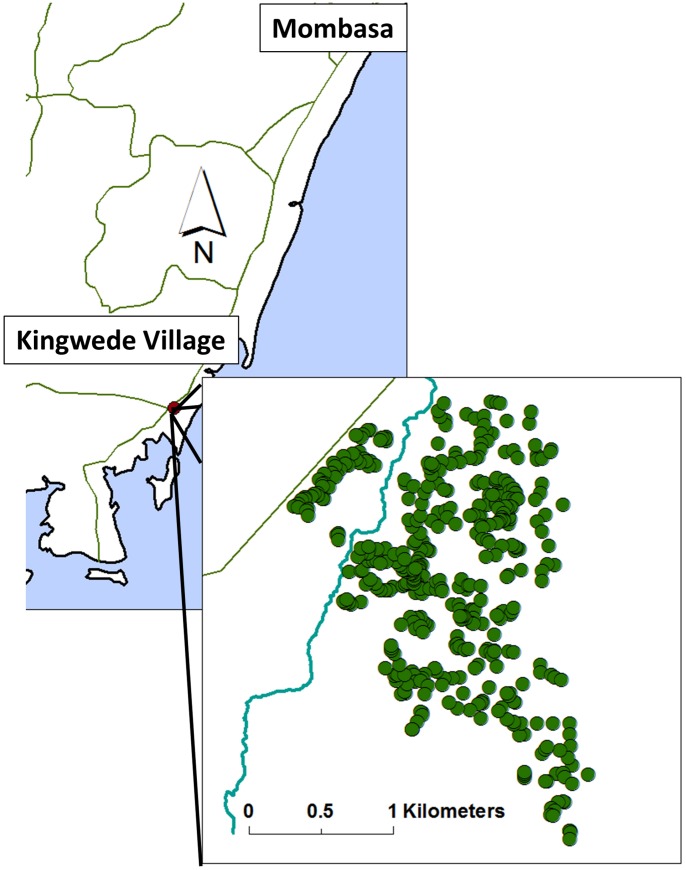
Residents of resource-poor tropical countries carry heavy burdens of concurrent parasitic infections, leading to high rates of morbidity and mortality. This study was undertaken to help identify the social and environmental determinants of multiple parasite infection in one such community.
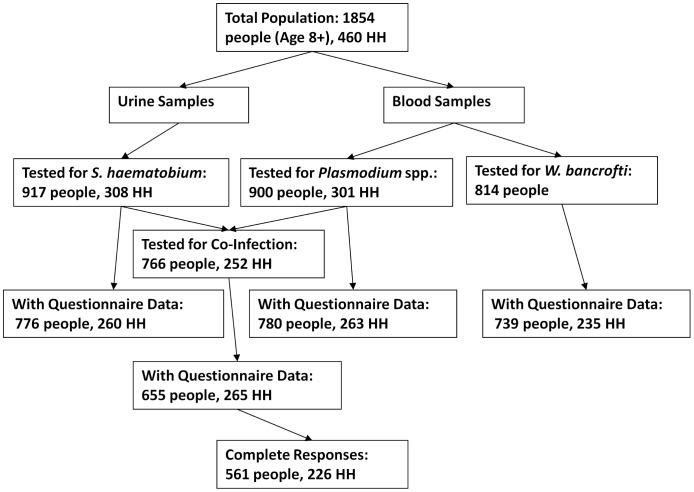
METHODOLOGY/PRINCIPAL FINDINGS: Residents of Kingwede, Kenya aged 8 years and older were tested for presence and intensity of S. haematobium and Plasmodium spp. infections in a cross-sectional, household-based, community survey. Using General Estimating Equation (GEE) models, social and environmental determinants associated with patterns of co-infection were identified, with age being one of the most important factors. Children had 9.3 times the odds of co-infection compared to adults (95%CI=5.3-16.3). Even after controlling for age, socio-economic position, and other correlates of co-infection, intense concomitant infections with the two parasites were found to cluster in a subset of individuals: the odds of heavy vs. light S. haematobium infection increased with increasing Plasmodium infection intensity suggesting the importance of unmeasured biological factors in determining intensity of co-infection.
CONCLUSIONS/SIGNIFICANCE: Children in this community are more likely to be infected with multiple parasites than are adults and should therefore be targeted for prevention and control interventions. More importantly, heavy infections with multiple parasite species appear to cluster within a subset of individuals. Further studies focusing on these most vulnerable people are warranted.
资源匮乏的热带国家的居民同时感染多种寄生虫的负担很重,导致发病率和死亡率居高不下。本研究旨在帮助确定一个这样的社区中多种寄生虫感染的社会和环境决定因素。
方法/主要发现:肯尼亚金威德的居民年龄在 8 岁及以上,在一项横断面、家庭为基础的社区调查中接受了 S. haematobium 和疟原虫感染的存在和强度检测。使用广义估计方程(GEE)模型,确定了与合并感染模式相关的社会和环境决定因素,年龄是最重要的因素之一。与成年人相比,儿童合并感染的几率高出 9.3 倍(95%CI=5.3-16.3)。即使在控制了年龄、社会经济地位和其他合并感染的相关因素后,仍发现两种寄生虫同时严重感染的个体存在聚集现象:与轻度 S. haematobium 感染相比,重度感染的几率随着疟原虫感染强度的增加而增加,这表明在确定合并感染的强度时,未测量的生物学因素很重要。
结论/意义:该社区的儿童比成年人更容易感染多种寄生虫,因此应成为预防和控制干预的目标。更重要的是,多种寄生虫物种的重度感染似乎在一部分个体中聚集。有必要进一步针对这些最脆弱的人群进行研究。