Sonenblum Sharon Eve, Sprigle Stephen, Lopez Ricardo A
Rehabilitation Engineering and Applied Research Laboratory, Georgia Institute of Technology, 490 10th Street NW, Atlanta, GA 30318, USA.
Rehabil Res Pract. 2012;2012:753165. doi: 10.1155/2012/753165. Epub 2012 Jul 15.
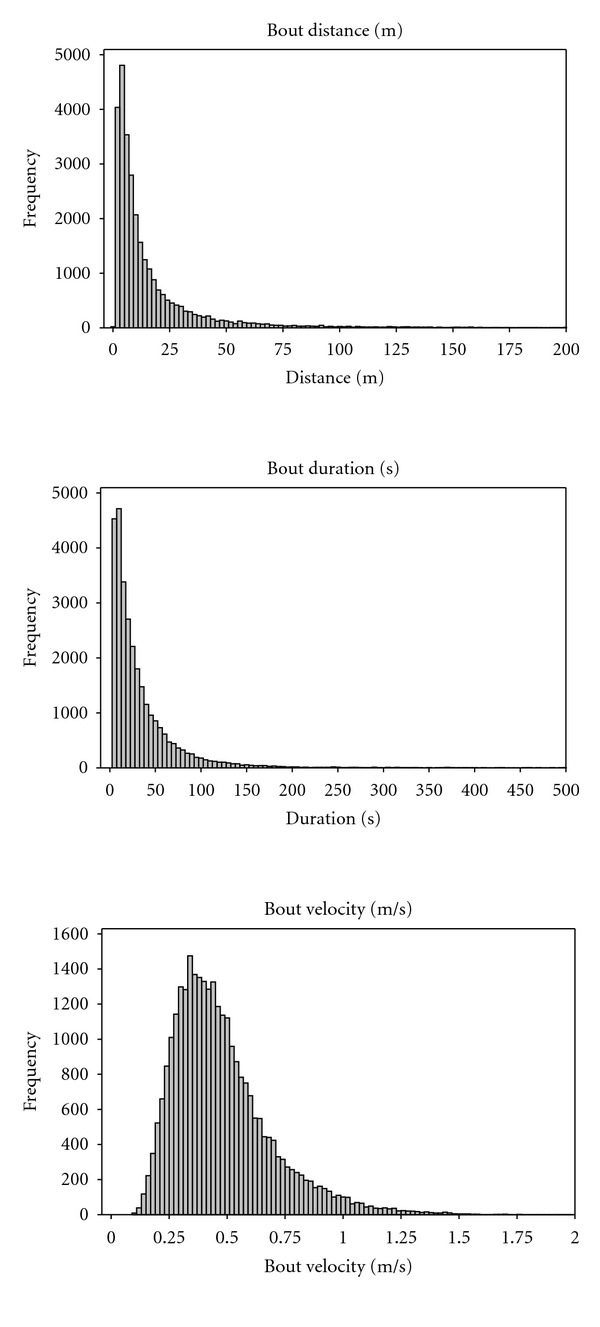
Background. This study aimed to describe how people move about in manual wheelchairs (MWCs) during everyday life by evaluating bouts of mobility or continuous periods of movement. Methods. A convenience sample of 28 MWC users was recruited. Participants' everyday mobility was measured using a wheel-mounted accelerometer and seat occupancy switch for 1-2 weeks. Bouts of mobility were recorded and characterized. Results. Across 29,200 bouts, the median bout lasted 21 seconds and traveled 8.6 m at 0.43 m/s. 85% of recorded bouts lasted less than 1 minute and traveled less than 30 meters. Participants' daily wheelchair activity included 90 bouts and 1.6 km over 54 minutes. Average daily occupancy time was 11 hours during which participants wheeled 10 bouts/hour and spent 10% of their time wheeling. Spearman-Brown Prophecy analysis suggested that 7 days were sufficient to achieve a reliability of 0.8 for all bout variables. Conclusions. Short, slow bouts dominate wheelchair usage in a natural environment. Therefore, clinical evaluations and biomechanical research should reflect this by concentrating on initiating movement, maneuvering wheelchairs, and stopping. Bouts of mobility provide greater depth to our understanding of wheelchair use and are a more stable metric (day-to-day) than distance or time wheeled.
背景。本研究旨在通过评估移动发作或连续运动时间段来描述人们在日常生活中如何使用手动轮椅(MWC)移动。方法。招募了28名MWC使用者的便利样本。使用安装在轮子上的加速度计和座位占用开关对参与者的日常移动进行1至2周的测量。记录并描述移动发作情况。结果。在29200次移动发作中,中位发作持续21秒,以0.43米/秒的速度行进8.6米。85%的记录发作持续时间不到1分钟,行进距离不到30米。参与者的日常轮椅活动包括54分钟内的90次发作和1.6公里。平均每日占用时间为11小时,在此期间参与者每小时轮椅移动10次,花费10%的时间进行轮椅移动。斯皮尔曼 - 布朗预测分析表明,7天足以使所有发作变量的信度达到0.8。结论。在自然环境中,短时间、缓慢的移动发作主导着轮椅的使用。因此,临床评估和生物力学研究应通过关注启动移动、操纵轮椅和停止来反映这一点。移动发作能让我们对轮椅使用有更深入的理解,并且是比轮椅移动距离或时间更稳定的(日常)指标。