García-Caldentey Juan, Alonso de Leciñana María, Simal Patricia, Fuentes Blanca, Reig Gemma, Díaz-Otero Fernando, Guillán Marta, García Ana, Martínez Patricia, García-Pastor Andrés, Egido José Antonio, Díez-Tejedor Exuperio, Gil-Núñez Antonio, Vivancos José, Masjuan Jaime
Stroke Center, Department of Neurology, University Hospital Ramon y Cajal, IRYCIS, Health Research Institute, University of Alcalá de Henares, 28034 Madrid, Spain.
Stroke Res Treat. 2012;2012:923676. doi: 10.1155/2012/923676. Epub 2012 Jul 16.
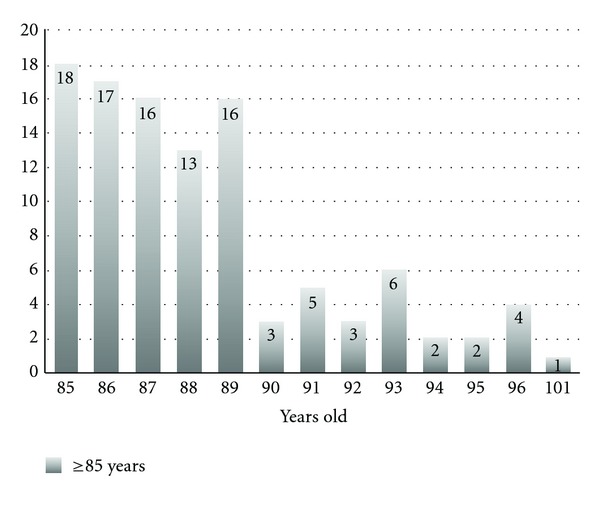
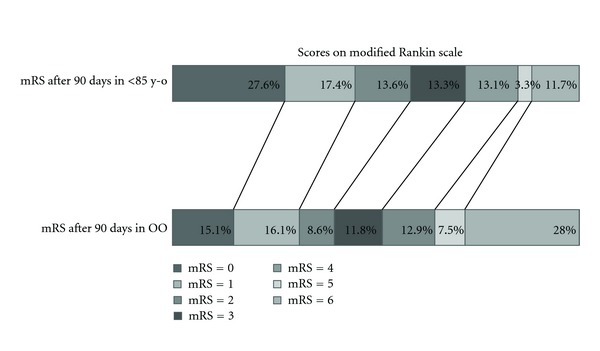
Background and Purpose. Intravenous thrombolysis using tissue plasminogen activator is safe and probably effective in patients >80 years old. Nevertheless, its safety has not been specifically addressed for the oldest old patients (≥85 years old, OO). We assessed the safety and effectiveness of thrombolysis in this group of age. Methods. A prospective registry of patients treated with intravenous thrombolysis. Patients were divided in two groups (<85 years and the OO). Demographic data, stroke aetiology and baseline National Institute Health Stroke Scale (NIHSS) score were recorded. The primary outcome measures were the percentage of symptomatic intracranial haemorrhage (SICH) and functional outcome at 3 months (modified Rankin Scale, mRS). Results. A total of 1,505 patients were registered. 106 patients were OO [median 88, range 85-101]. Female sex, hypertension, elevated blood pressure at admission, cardioembolic strokes and higher basal NIHSS score were more frequent in the OO. SICH transformation rates were similar (3.1% versus 3.7%, P = 1.00). The probability of independence at 3 months (mRS 0-2) was lower in the OO (40.2% versus 58.7%, P = 0.001) but not after adjustment for confounding factors (adjusted OR, 0.82; 95% CI, 0.50 to 1.37; P = 0.455). Three-month mortality was higher in the OO (28.0% versus 11.5%, P < 0.001). Conclusion. Intravenous thrombolysis for stroke in OO patients did not increase the risk of SICH although mortality was higher in this group.
背景与目的。对于80岁以上的患者,使用组织型纤溶酶原激活剂进行静脉溶栓是安全的,且可能有效。然而,对于高龄患者(≥85岁,超高龄),其安全性尚未得到专门研究。我们评估了该年龄组患者溶栓治疗的安全性和有效性。方法。对接受静脉溶栓治疗的患者进行前瞻性登记。患者分为两组(<85岁和超高龄组)。记录人口统计学数据、卒中病因和基线美国国立卫生研究院卒中量表(NIHSS)评分。主要结局指标为症状性颅内出血(SICH)的发生率和3个月时的功能结局(改良Rankin量表,mRS)。结果。共登记了1505例患者。106例为超高龄患者[中位数88岁,范围85 - 101岁]。超高龄组女性、高血压、入院时血压升高、心源性栓塞性卒中以及更高的基础NIHSS评分更为常见。SICH转化率相似(3.1%对3.7%,P = 1.00)。超高龄组3个月时独立的概率(mRS 0 - 2)较低(40.2%对58.7%,P = 0.001),但在调整混杂因素后并非如此(调整后的OR,0.82;95%CI,0.50至1.37;P = 0.455)。超高龄组3个月死亡率更高(28.0%对11.5%,P < 0.001)。结论。超高龄患者静脉溶栓治疗虽死亡率较高,但并未增加SICH风险。