Departamento de Diagnóstico Oral, Área Microbiologia e Imunologia, Faculdade de Odontologia de Piracicaba, Universidade de Campinas, Piracicaba, SP, Brasil.
Braz J Med Biol Res. 2012 Nov;45(11):1017-24. doi: 10.1590/s0100-879x2012007500123. Epub 2012 Aug 2.
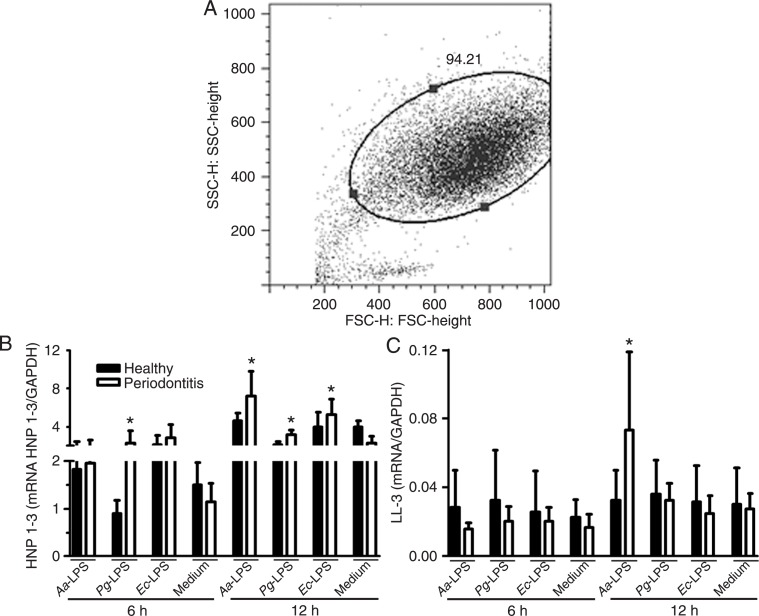
Neutrophils play an important role in periodontitis by producing nitric oxide (NO) and antimicrobial peptides, molecules with microbicidal activity via oxygen-dependent and -independent mechanisms, respectively. It is unknown whether variation in the production of antimicrobial peptides such as LL-37, human neutrophil peptides (HNP) 1-3, and NO by neutrophils influences the pathogenesis of periodontal diseases. We compared the production of these peptides and NO by lipopolysaccharide (LPS)-stimulated neutrophils isolated from healthy subjects and from patients with periodontitis. Peripheral blood neutrophils were cultured with or without Aggregatibacter actinomycetemcomitans-LPS (Aa-LPS), Porphyromonas gingivalis-LPS (Pg-LPS) and Escherichia coli-LPS (Ec-LPS). qRT-PCR was used to determine quantities of HNP 1-3 and LL-37 mRNA in neutrophils. Amounts of HNP 1-3 and LL-37 proteins in the cell culture supernatants were also determined by ELISA. In addition, NO levels in neutrophil culture supernatants were quantitated by the Griess reaction. Neutrophils from periodontitis patients cultured with Aa-LPS, Pg-LPS and Ec-LPS expressed higher HNP 1-3 mRNA than neutrophils from healthy subjects. LL-37 mRNA expression was higher in neutrophils from patients stimulated with Aa-LPS. Neutrophils from periodontitis patients produced significantly higher LL-37 protein levels than neutrophils from healthy subjects when stimulated with Pg-LPS and Ec-LPS, but no difference was observed in HNP 1-3 production. Neutrophils from periodontitis patients cultured or not with Pg-LPS and Ec-LPS produced significantly lower NO levels than neutrophils from healthy subjects. The significant differences in the production of LL-37 and NO between neutrophils from healthy and periodontitis subjects indicate that production of these molecules might influence individual susceptibility to important periodontal pathogens.
中性粒细胞通过产生一氧化氮 (NO) 和抗菌肽发挥重要作用,这些分子分别通过氧依赖和非依赖机制具有杀菌活性。目前尚不清楚中性粒细胞产生的抗菌肽(如 LL-37、人中性粒细胞肽 (HNP) 1-3 和 NO)的变异是否会影响牙周病的发病机制。我们比较了来自健康受试者和牙周炎患者的脂多糖 (LPS) 刺激的中性粒细胞产生这些肽和 NO 的情况。将外周血中性粒细胞在有或没有伴放线放线杆菌 LPS (Aa-LPS)、牙龈卟啉单胞菌 LPS (Pg-LPS) 和大肠杆菌 LPS (Ec-LPS) 的情况下进行培养。使用 qRT-PCR 测定中性粒细胞中 HNP 1-3 和 LL-37 mRNA 的量。还通过 ELISA 测定细胞培养上清液中 HNP 1-3 和 LL-37 蛋白的量。此外,通过格里斯反应定量中性粒细胞培养上清液中的 NO 水平。与健康受试者相比,来自牙周炎患者的经 Aa-LPS、Pg-LPS 和 Ec-LPS 培养的中性粒细胞表达更高水平的 HNP 1-3 mRNA。用 Aa-LPS 刺激时,来自牙周炎患者的中性粒细胞的 LL-37 mRNA 表达更高。当用 Pg-LPS 和 Ec-LPS 刺激时,来自牙周炎患者的中性粒细胞产生的 LL-37 蛋白水平明显高于健康受试者的中性粒细胞,但 HNP 1-3 产生没有差异。与健康受试者相比,用 Pg-LPS 和 Ec-LPS 培养或不培养的牙周炎患者的中性粒细胞产生的 NO 水平明显较低。来自健康和牙周炎受试者的中性粒细胞在 LL-37 和 NO 产生方面的显著差异表明,这些分子的产生可能会影响个体对重要牙周病原体的易感性。