Almansa Raquel, Socias Lorenzo, Sanchez-Garcia Monica, Martín-Loeches Ignacio, del Olmo Milagros, Andaluz-Ojeda David, Bobillo Felipe, Rico Lucia, Herrero Agueda, Roig Vicente, San-Jose C Alicia, Rosich Sara, Barbado Julia, Disdier Carlos, de Lejarazu Raúl Ortiz, Gallegos Maria C, Fernandez Victoria, Bermejo-Martin Jesus F
Investigación Biomédica del Clínico (ibC), Hospital Clínico Universitario de Valladolid, Avda Ramón y Cajal 3, 47005 Valladolid, Spain.
BMC Res Notes. 2012 Aug 2;5:401. doi: 10.1186/1756-0500-5-401.
Gene expression profiling (GEP) in cells obtained from peripheral blood has shown that this is a very useful approach for biomarker discovery and for studying molecular pathogenesis of prevalent diseases. While there is limited literature available on gene expression markers associated with Chronic Obstructive Pulmonary Disease (COPD), the transcriptomic picture associated with critical respiratory illness in this disease is not known at the present moment.
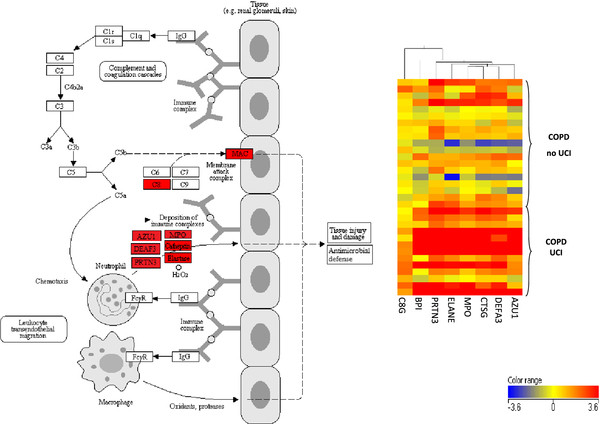
By using Agilent microarray chips, we have profiled gene expression signatures in the whole blood of 28 COPD patients hospitalized with different degrees of respiratory compromise.12 of them needed of admission to the ICU, whilst 16 were admitted to the Respiratory Medicine Service. GeneSpring GX 11.0 software was used for performing statistical comparisons of transcript levels between ICU and non-ICU patients. Ingenuity pathway analysis 8.5 (IPA) and the Kyoto Encyclopedia of Genes and Genomes (KEGG) were used to select, annotate and visualize genes by function and pathway (gene ontology). T-test showed evidence of 1501 genes differentially expressed between ICU and non-ICU patients. IPA and KEGG analysis of the most representative biological functions revealed that ICU patients had increased levels of neutrophil gene transcripts, being [cathepsin G (CTSG)], [elastase, neutrophil expressed (ELANE)], [proteinase 3 (PRTN3)], [myeloperoxidase (MPO)], [cathepsin D (CTSD)], [defensin, alpha 3, neutrophil-specific (DEFA3)], azurocidin 1 (AZU1)], and [bactericidal/permeability-increasing protein (BPI)] the most representative ones. Proteins codified by these genes form part of the azurophilic granules of neutrophils and are involved in both antimicrobial defence and tissue damage. This "neutrophil signature" was paralleled by the necessity of advanced respiratory and vital support, and the presence of bacterial infection.
Study of transcriptomic signatures in blood suggests an essential role of neutrophil proteases in COPD patients with critical respiratory illness. Measurement and modulation of the expression of these genes could present an option for clinical monitoring and treatment of severe COPD exacerbations.
从外周血获取的细胞中的基因表达谱分析表明,这是一种用于生物标志物发现和研究常见疾病分子发病机制的非常有用的方法。虽然关于慢性阻塞性肺疾病(COPD)相关基因表达标志物的文献有限,但目前尚不清楚该疾病中与严重呼吸系统疾病相关的转录组情况。
通过使用安捷伦微阵列芯片,我们对28例因不同程度呼吸功能不全而住院的COPD患者的全血基因表达特征进行了分析。其中12例需要入住重症监护病房(ICU),而16例入住呼吸内科。使用GeneSpring GX 11.0软件对ICU患者和非ICU患者的转录水平进行统计比较。使用Ingenuity pathway analysis 8.5(IPA)和京都基因与基因组百科全书(KEGG)按功能和途径(基因本体)选择、注释和可视化基因。t检验显示有证据表明ICU患者和非ICU患者之间有1501个基因差异表达。对最具代表性的生物学功能进行IPA和KEGG分析表明,ICU患者中性粒细胞基因转录本水平升高,其中[组织蛋白酶G(CTSG)]、[中性粒细胞弹性蛋白酶(ELANE)]、[蛋白酶3(PRTN3)]、[髓过氧化物酶(MPO)]、[组织蛋白酶D(CTSD)]、[中性粒细胞特异性α-防御素3(DEFA3)]、天青杀素1(AZU1)]和[杀菌/通透性增加蛋白(BPI)]最为典型。这些基因编码的蛋白质是中性粒细胞嗜天青颗粒的一部分,参与抗菌防御和组织损伤。这种“中性粒细胞特征”与高级呼吸和生命支持的必要性以及细菌感染的存在平行。
血液转录组特征研究表明中性粒细胞蛋白酶在患有严重呼吸系统疾病的COPD患者中起重要作用。这些基因表达的测量和调节可能为严重COPD加重的临床监测和治疗提供一种选择。