Kreitmann Louis, Bodinier Maxime, Fleurie Aurore, Imhoff Katia, Cazalis Marie-Angelique, Peronnet Estelle, Cerrato Elisabeth, Tardiveau Claire, Conti Filippo, Llitjos Jean-François, Textoris Julien, Monneret Guillaume, Blein Sophie, Brengel-Pesce Karen
EA 7426 "Pathophysiology of Injury-Induced Immunosuppression", Joint Research Unit Université Claude Bernard Lyon 1 - Hospices Civils de Lyon - bioMérieux, Lyon, France.
Open Innovation and Partnerships (OIP), bioMérieux S.A., Marcy-l'Étoile, France.
Front Med (Lausanne). 2022 Jun 30;9:930043. doi: 10.3389/fmed.2022.930043. eCollection 2022.
Novel biomarkers are needed to progress toward individualized patient care in sepsis. The immune profiling panel (IPP) prototype has been designed as a fully-automated multiplex tool measuring expression levels of 26 genes in sepsis patients to explore immune functions, determine sepsis endotypes and guide personalized clinical management. The performance of the IPP gene set to predict 30-day mortality has not been extensively characterized in heterogeneous cohorts of sepsis patients.
Publicly available microarray data of sepsis patients with widely variable demographics, clinical characteristics and ethnical background were co-normalized, and the performance of the IPP gene set to predict 30-day mortality was assessed using a combination of machine learning algorithms.
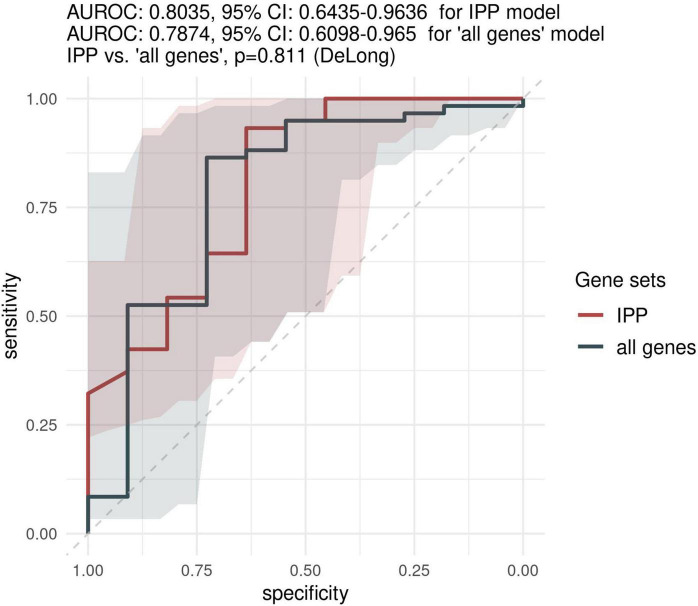
We collected data from 1,801 arrays sampled on sepsis patients and 598 sampled on controls in 17 studies. When gene expression was assayed at day 1 following admission (1,437 arrays sampled on sepsis patients, of whom 1,161 were alive and 276 (19.2%) were dead at day 30), the IPP gene set showed good performance to predict 30-day mortality, with an area under the receiving operating characteristics curve (AUROC) of 0.710 (CI 0.652-0.768). Importantly, there was no statistically significant improvement in predictive performance when training the same models with all genes common to the 17 microarray studies ( = 7,122 genes), with an AUROC = 0.755 (CI 0.697-0.813, = 0.286). In patients with gene expression data sampled at day 3 following admission or later, the IPP gene set had higher performance, with an AUROC = 0.804 (CI 0.643-0.964), while the total gene pool had an AUROC = 0.787 (CI 0.610-0.965, = 0.811).
Using pooled publicly-available gene expression data from multiple cohorts, we showed that the IPP gene set, an immune-related transcriptomics signature conveys relevant information to predict 30-day mortality when sampled at day 1 following admission. Our data also suggests that higher predictive performance could be obtained when assaying gene expression at later time points during the course of sepsis. Prospective studies are needed to confirm these findings using the IPP gene set on its dedicated measurement platform.
在脓毒症患者的个体化治疗方面取得进展需要新的生物标志物。免疫谱分析面板(IPP)原型被设计为一种全自动多重工具,用于测量脓毒症患者中26个基因的表达水平,以探索免疫功能、确定脓毒症内型并指导个性化临床管理。在脓毒症患者的异质性队列中,IPP基因集预测30天死亡率的性能尚未得到广泛表征。
对具有广泛不同人口统计学、临床特征和种族背景的脓毒症患者的公开可用微阵列数据进行共同标准化,并使用机器学习算法组合评估IPP基因集预测30天死亡率的性能。
我们从17项研究中的1801个脓毒症患者样本阵列和598个对照样本阵列中收集了数据。当在入院后第1天检测基因表达时(1437个脓毒症患者样本阵列,其中1161人存活,276人(19.2%)在第30天死亡),IPP基因集在预测30天死亡率方面表现良好,受试者工作特征曲线下面积(AUROC)为0.710(95%置信区间0.652 - 0.768)。重要的是,使用17项微阵列研究共有的所有基因(n = 7122个基因)训练相同模型时,预测性能没有统计学上的显著改善,AUROC = 0.755(95%置信区间0.697 - 0.813,p = 0.286)。在入院后第3天或更晚采集基因表达数据的患者中,IPP基因集表现更好,AUROC = 0.804(95%置信区间0.643 - 0.964),而总基因库的AUROC = 0.787(95%置信区间0.610 - 0.965,p = 0.811)。
使用来自多个队列的汇总公开可用基因表达数据,我们表明IPP基因集,一种免疫相关的转录组学特征,在入院后第1天采样时传达了预测30天死亡率的相关信息。我们的数据还表明,在脓毒症病程后期检测基因表达时可以获得更高的预测性能。需要进行前瞻性研究,以在其专用测量平台上使用IPP基因集来证实这些发现。