Department of Ecology Evolution and Behavior, University of Minnesota, Saint Paul, MN 55108, USA.
BMC Evol Biol. 2012 Aug 2;12:135. doi: 10.1186/1471-2148-12-135.
Adaptation of pathogens to their hosts depends critically on factors affecting pathogen reproductive rate. While pathogen reproduction is the end result of an intricate interaction between host and pathogen, the relative contributions of host and pathogen genotype to variation in pathogen life history within the host are not well understood. Untangling these contributions allows us to identify traits with sufficient genetic variation for selection to act and to identify mechanisms of coevolution between pathogens and their hosts. We investigated the effects of pathogen and host genotype on three life-history components of pathogen fitness; infection efficiency, latent period, and sporulation capacity, in the oat crown rust fungus, Puccinia coronata f.sp. avenae, as it infects oats (Avena sativa).
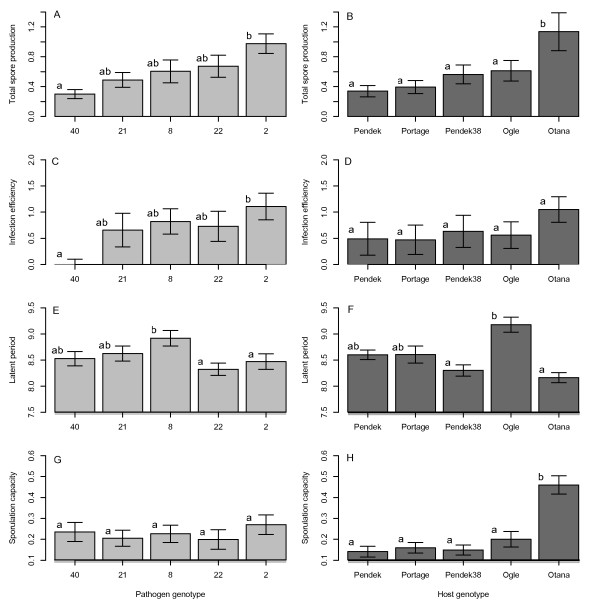
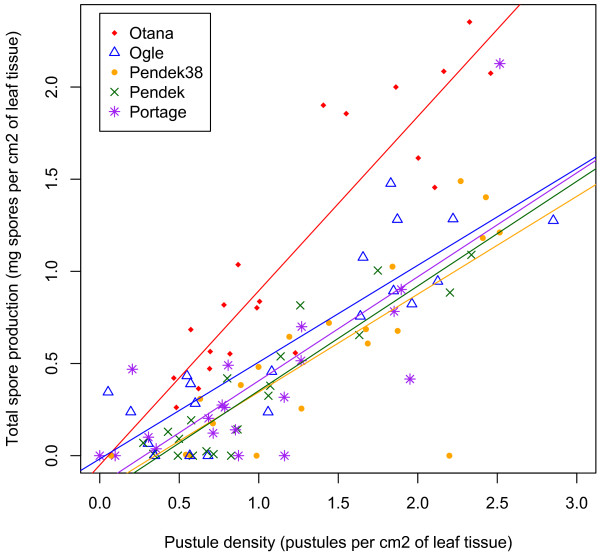
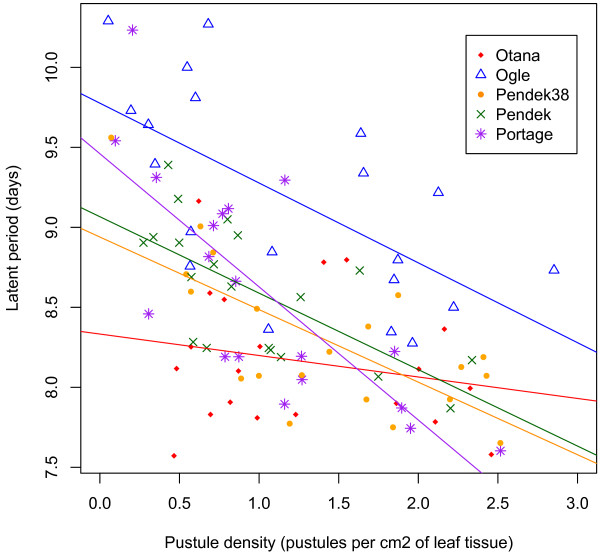
We show that both pathogen and host genotype significantly affect total spore production but do so through their effects on different life-history stages. Pathogen genotype has the strongest effect on the early stage of infection efficiency, while host genotype most strongly affects the later life-history stages of latent period and sporulation capacity. In addition, host genotype affected the relationship between pathogen density and the later life-history traits of latent period and sporulation capacity. We did not find evidence of pathogen-by-host genotypic (GxG) interactions.
Our results illustrate mechanisms by which variation in host populations will affect the evolution of pathogen life history. Results show that different pathogen life-history stages have the potential to respond differently to selection by host or pathogen genotype and suggest mechanisms of antagonistic coevolution. Pathogen populations may adapt to host genotypes through increased infection efficiency while their plant hosts may adapt by limiting the later stages of pathogen growth and spore production within the host.
病原体对宿主的适应取决于影响病原体繁殖率的因素。虽然病原体繁殖是宿主和病原体之间复杂相互作用的最终结果,但宿主和病原体基因型对病原体在宿主内生活史变异的相对贡献尚不清楚。理清这些贡献可以使我们能够识别具有足够遗传变异的特征,以便选择发挥作用,并识别病原体与其宿主之间共同进化的机制。我们研究了病原体和宿主基因型对燕麦冠锈菌(Puccinia coronata f.sp.avenae)感染燕麦(Avena sativa)时病原体适应性的三个生活史组成部分的影响;感染效率、潜伏期和产孢能力。
我们表明,病原体和宿主基因型都显著影响总孢子产量,但通过对不同生活史阶段的影响来实现。病原体基因型对感染效率的早期阶段影响最大,而宿主基因型对潜伏期和产孢能力等后期生活史阶段影响最大。此外,宿主基因型影响了病原体密度与潜伏期和产孢能力等后期生活史特征之间的关系。我们没有发现病原体与宿主基因型(GxG)相互作用的证据。
我们的结果说明了宿主群体的变异将如何影响病原体生活史的进化。结果表明,不同的病原体生活史阶段有可能对宿主或病原体基因型的选择做出不同的反应,并提出了拮抗共同进化的机制。病原体种群可能通过增加感染效率来适应宿主基因型,而其植物宿主可能通过限制病原体在宿主内的生长和产孢的后期阶段来适应。