Paul F Lazarsfeld Center for the Social Sciences, Columbia University, New York, New York, United States of America.
PLoS One. 2012;7(7):e41265. doi: 10.1371/journal.pone.0041265. Epub 2012 Jul 30.
Autism incidence and prevalence have increased dramatically in the last two decades. The autism caseload in California increased 600% between 1992 and 2006, yet there is little consensus as to the cause. Studying the seasonality of conceptions of children later diagnosed with autism may yield clues to potential etiological drivers.
To assess if the conceptions of children later diagnosed with autism cluster temporally in a systematic manner and whether any pattern of temporal clustering persists over time.
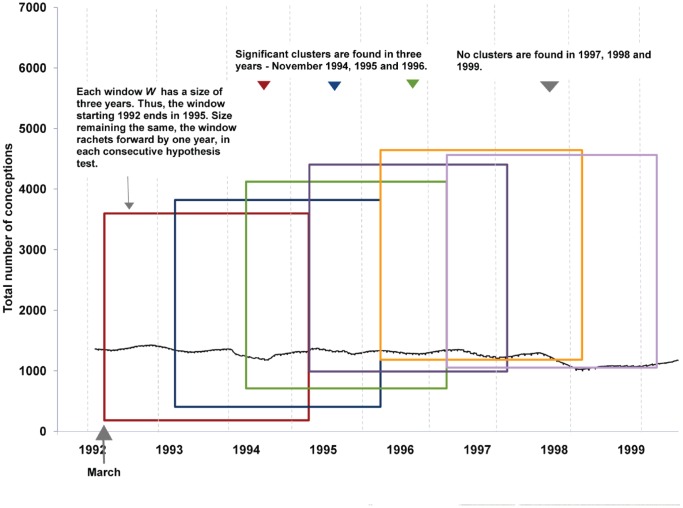
We searched for seasonality in conceptions of children later diagnosed with autism by applying a one-dimensional scan statistic with adaptive temporal windows on case and control population data from California for 1992 through 2000. We tested for potential confounding effects from known risk factors using logistic regression models.
There is a consistent but decreasing seasonal pattern in the risk of conceiving a child later diagnosed with autism in November for the first half of the study period. Temporal clustering of autism conceptions is not an artifact of composition with respect to known risk factors for autism such as socio-economic status.
There is some evidence of seasonality in the risk of conceiving a child later diagnosed with autism. Searches for environmental factors related to autism should allow for the possibility of risk factors or etiological drivers that are seasonally patterned and that appear and remain salient for a discrete number of years.
在过去的二十年中,自闭症的发病率和患病率显著增加。1992 年至 2006 年间,加利福尼亚州的自闭症患者增加了 600%,但对于病因仍缺乏共识。研究后来被诊断为自闭症的儿童的受孕季节性可能为潜在的病因驱动因素提供线索。
评估后来被诊断为自闭症的儿童的受孕是否会以系统的方式在时间上聚集,以及任何时间聚类模式是否会随着时间的推移而持续存在。
我们通过在加利福尼亚州的病例和对照人群数据上应用一维扫描统计量和自适应时间窗口,来搜索后来被诊断为自闭症的儿童的受孕是否具有季节性。我们使用逻辑回归模型测试了已知风险因素的潜在混杂效应。
在研究期间的前半段,11 月受孕后孩子被诊断为自闭症的风险存在一致但逐渐降低的季节性模式。自闭症受孕的时间聚类不是与自闭症相关的已知风险因素(如社会经济地位)组成的假象。
有一些证据表明自闭症的风险存在季节性。与自闭症相关的环境因素的搜索应该考虑到可能存在季节性模式的风险因素或病因驱动因素,这些因素会在离散的几年内出现并保持明显。