Institut National de Recherche en Santé Publique, BP 1771, Bamako, Mali.
PLoS Negl Trop Dis. 2012;6(7):e1774. doi: 10.1371/journal.pntd.0001774. Epub 2012 Jul 31.
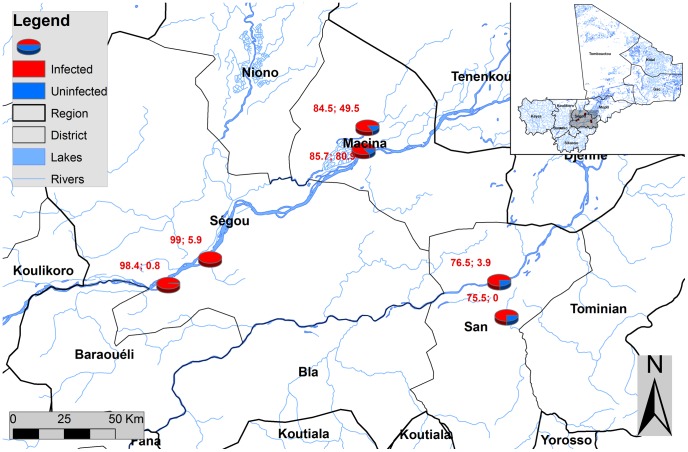
Preventive chemotherapy against schistosomiasis has been implemented since 2005 in Mali, targeting school-age children and adults at high risk. A cross-sectional survey was conducted in 2010 to evaluate the impact of repeated treatment among school-age children in the highly-endemic region of Segou.
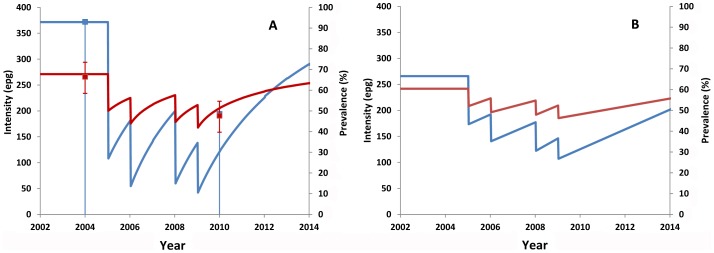
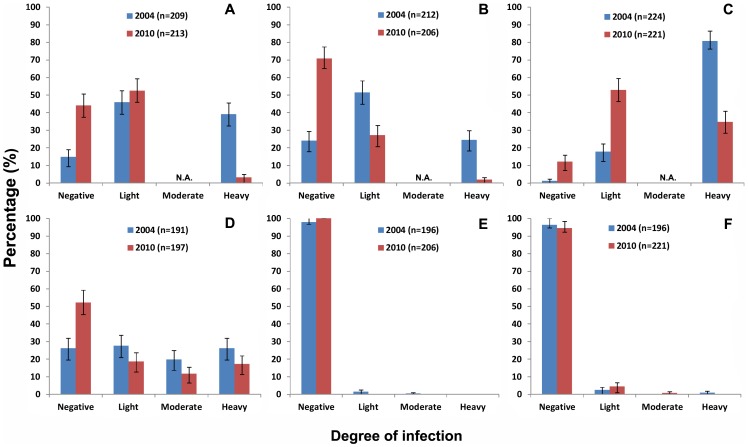
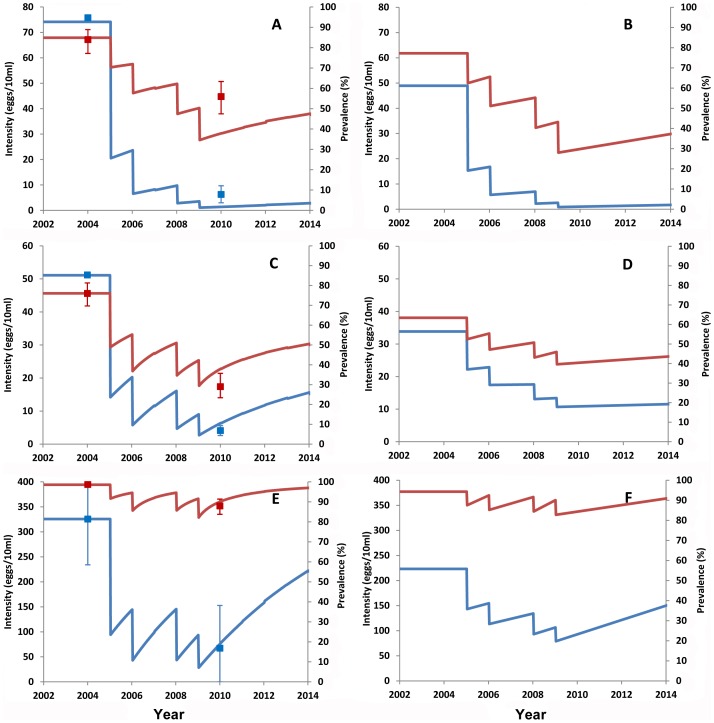
METHODOLOGY/PRINCIPAL FINDINGS: The survey was conducted in six sentinel schools in three highly-endemic districts, and 640 school children aged 7-14 years were examined. Infections with Schistosoma haematobium and S. mansoni were diagnosed with the urine filtration and the Kato-Katz method respectively. Overall prevalence of S. haematobium infection was 61.7%, a significant reduction of 30% from the baseline in 2004 (p<0.01), while overall prevalence of S. mansoni infection was 12.7% which was not significantly different from the baseline. Overall mean intensity of S. haematobium and S. mansoni infection was 180.4 eggs/10 ml of urine and 88.2 epg in 2004 respectively. These were reduced to 33.2 eggs/10 ml of urine and 43.2 epg in 2010 respectively, a significant reduction of 81.6% and 51% (p<0.001). The proportion of heavy S. haematobium infections was reduced from 48.8% in 2004 to 13.8% in 2010, and the proportion of moderate and heavy S. mansoni infection was reduced from 15.6% in 2004 to 9.4% in 2010, both significantly (p<0.01). Mathematical modelling suggests that the observed results were in line with the expected changes.
CONCLUSIONS/SIGNIFICANCE: Significant reduction in intensity of infection on both infections and modest but significant reduction in S. haematobium prevalence were achieved in highly-endemic Segou region after repeated chemotherapy. However, persistent prevalence of both infections and relatively high level of intensity of S. mansoni infection suggest that more intensified control measures be implemented in order to achieve the goal of schistosomiasis elimination. In addition, closer monitoring and evaluation activities are needed in the programme to monitor the drug tolerance and to adjust treatment focus.
自 2005 年以来,马里一直在实施针对血吸虫病的预防性化疗,目标人群是学龄儿童和高危成年人。2010 年进行了一项横断面调查,以评估在塞古高度流行地区重复治疗对学龄儿童的影响。
方法/主要发现:该调查在三个高度流行区的六个哨点学校进行,共检查了 640 名 7-14 岁的在校儿童。用尿过滤法和加藤厚涂片法分别诊断感染了埃及血吸虫和曼氏血吸虫。埃及血吸虫感染的总流行率为 61.7%,与 2004 年基线相比下降了 30%(p<0.01),而曼氏血吸虫感染的总流行率为 12.7%,与基线相比无显著差异。2004 年,埃及血吸虫和曼氏血吸虫的平均感染强度分别为每 10 毫升尿液 180.4 个虫卵和 88.2 个 epg。2010 年,这两个数值分别降至每 10 毫升尿液 33.2 个虫卵和 43.2 epg,下降幅度分别为 81.6%和 51%(p<0.001)。2004 年重度埃及血吸虫感染的比例为 48.8%,2010 年降至 13.8%,2004 年中度和重度曼氏血吸虫感染的比例为 15.6%,2010 年降至 9.4%,均有显著下降(p<0.01)。数学建模表明,观察到的结果与预期的变化一致。
结论/意义:在塞古高度流行地区,经过反复化疗,两种感染的感染强度均显著降低,埃及血吸虫的流行率也有所降低,但两种感染的持续流行率和曼氏血吸虫感染的较高强度表明,需要实施更强化的控制措施,以实现消除血吸虫病的目标。此外,在该规划中需要进行更密切的监测和评估活动,以监测药物耐受性并调整治疗重点。