Woldeyohannes Demelash, Sahiledengle Biniaym, Tekalegn Yohannes, Hailemariam Zeleke
Department of Public Health, College of Medicine and Health Science, Wachemo University, Hossana, Ethiopia.
Department of Public Health, School of Health Science, Goba Referral Hospital, Madda Walabu University, Bale Goba, Ethiopia.
Parasite Epidemiol Control. 2021 Mar 13;13:e00210. doi: 10.1016/j.parepi.2021.e00210. eCollection 2021 May.
Schistosomiasis (S. mansoni and S. haematobium) is an important neglected tropical disease in sub-Saharan Africa including Ethiopia. In Ethiopia, Schistosomiasis has been prioritized as neglected tropical disease and remained among major public health burden on school age children of the country. Few studies conducted on the association between prevalence of Schistosomiasis and gender of school age children have inconclusive finding about the association between these two variables. Therefore, this systematic review and meta-analysis was done to determine the pooled prevalence of Schistosomiasis and its association with gender of school age children in Ethiopia.
In this systematic review and meta-analysis, databases such as: Medline/PubMed, EMBASE, CINAHL, Cochrane Central library, Google Scholar, and HINARI were systematically searched. STATA version 14 was used to estimate pooled prevalence of Schistosomiasis using random effects model with 95% confidence interval. The results were presented by using forest plot and statistical heterogeneity was checked by using the Cochran Q test (chi-squared statistic), I test statistic and by visual examination of the forest plot.
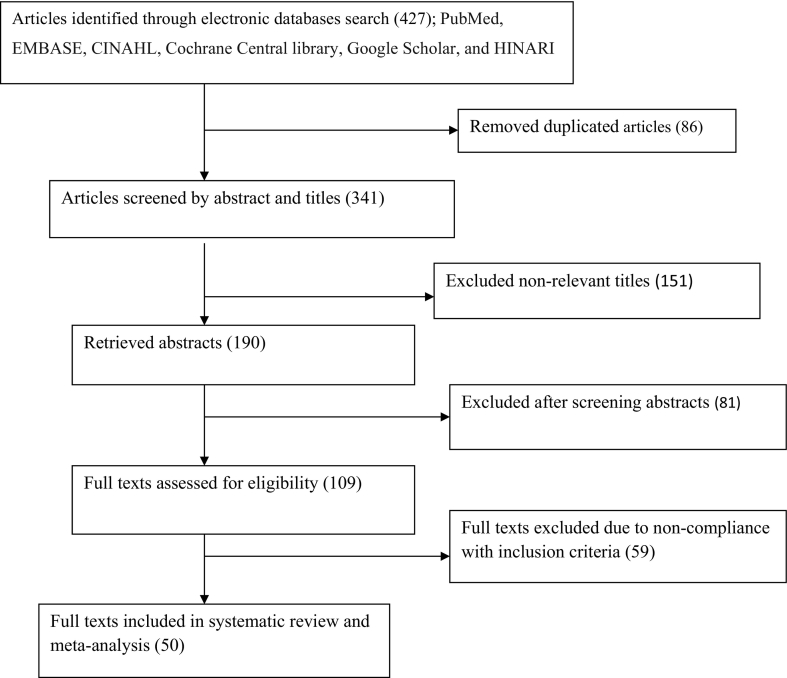
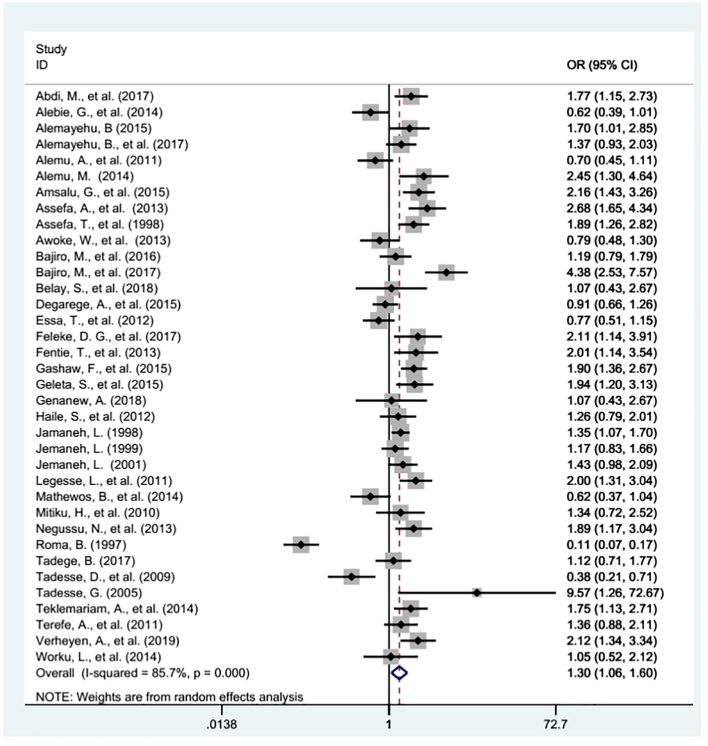
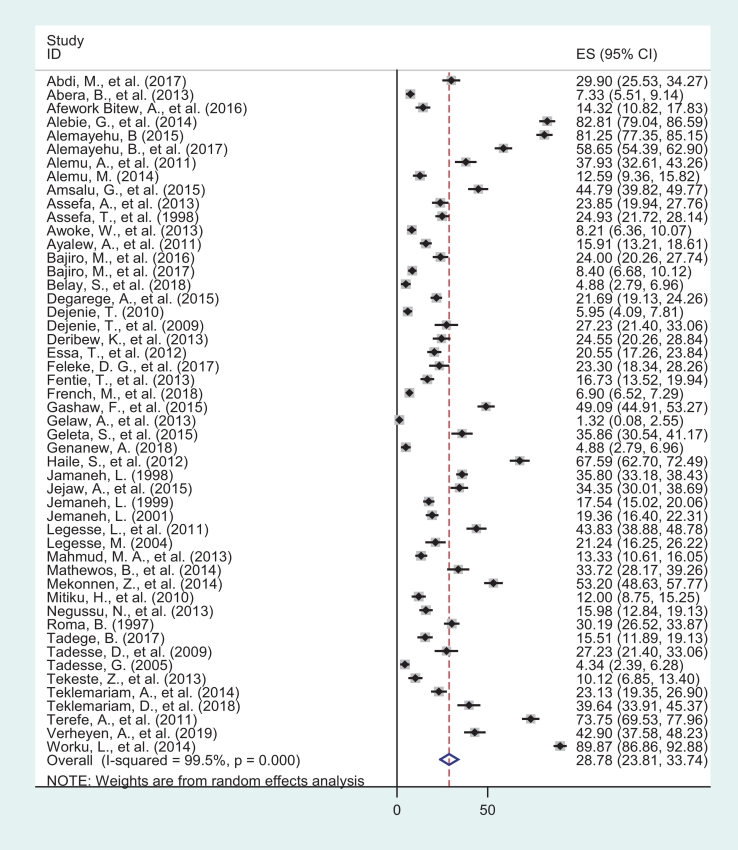
From the total of 427 studies identified for this review, 50 studies were included in the final analysis. The analysis noted that pooled prevalence of Schistosomiasis in Ethiopia was 28.78% (95% CI: 23.81, 33.74). The subgroup analysis indicated that extreme variability was observed in the prevalence of Schistosomiasis across the regions of the country. The highest (39.77%) prevalence of Schistosomiasis was reported from the southern region, whereas the lowest (14.95%) prevalence of Schistosomiasis was reported from Afar region. Male school age children were 58% more likely infected with Schistosomiasis than female school age children in Ethiopia (OR: 1.58, 95% CI: 1.33, 1.83).
The Prevalence of Schistosomiasis was higher than the 2018 report of the Ethiopian federal ministry of health. The prevalence of Schistosomiasis was predominant among male gender of the school age children. Therefore, sustainable control of Schistosomiasis requires the approaches that must go beyond current deworming program. Complementary prevention strategies including health education, safe water and adequate sanitary facilities provision should be simultaneously implemented. The underlining causes of variation in risk factors of Schistosomiasis among males and females should be further studied.
血吸虫病(曼氏血吸虫病和埃及血吸虫病)是包括埃塞俄比亚在内的撒哈拉以南非洲一种重要的被忽视的热带病。在埃塞俄比亚,血吸虫病已被列为被忽视的热带病,并仍然是该国学龄儿童主要的公共卫生负担之一。关于血吸虫病患病率与学龄儿童性别的关联的少数研究,在这两个变量之间的关联方面没有得出结论性的结果。因此,进行了这项系统评价和荟萃分析,以确定埃塞俄比亚血吸虫病的合并患病率及其与学龄儿童性别的关联。
在这项系统评价和荟萃分析中,对以下数据库进行了系统检索:Medline/PubMed、EMBASE、CINAHL、Cochrane 中央图书馆、谷歌学术和 HINARI。使用 STATA 14 版软件,采用随机效应模型估计血吸虫病的合并患病率,并给出 95%置信区间。结果通过森林图呈现,并使用 Cochran Q 检验(卡方统计量)、I²检验统计量以及通过对森林图的直观检查来检验统计异质性。
在本次评价中确定的总共 427 项研究中,有 50 项研究纳入了最终分析。分析指出,埃塞俄比亚血吸虫病的合并患病率为 28.78%(95%置信区间:23.81,33.74)。亚组分析表明,该国各地区血吸虫病的患病率存在极大差异。血吸虫病患病率最高(39.77%)的报告来自南部地区,而患病率最低(14.95%)的报告来自阿法尔地区。在埃塞俄比亚,男性学龄儿童感染血吸虫病的可能性比女性学龄儿童高 58%(比值比:1.58,95%置信区间:1.33,1.83)。
血吸虫病的患病率高于埃塞俄比亚联邦卫生部 2018 年的报告。血吸虫病的患病率在学龄儿童的男性中占主导地位。因此,血吸虫病的可持续控制需要超越当前驱虫计划的方法。应同时实施包括健康教育、提供安全饮用水和充足卫生设施在内的补充预防策略。应进一步研究血吸虫病在男性和女性中危险因素差异的潜在原因。