National Public Health Laboratories, Ministry of Health and Social Welfare, Banjul, The Gambia.
School of Life Sciences, University of Nottingham, Nottingham, United Kingdom.
PLoS Negl Trop Dis. 2021 May 11;15(5):e0009380. doi: 10.1371/journal.pntd.0009380. eCollection 2021 May.
The Gambia initiated a control programme for schistosomiasis in 2015. In light of this, recent and comprehensive data on schistosomiasis is required to effectively guide the control programme. This study aimed to evaluate the prevalence and associated risk factors of schistosomiasis among primary school children in The Gambia.
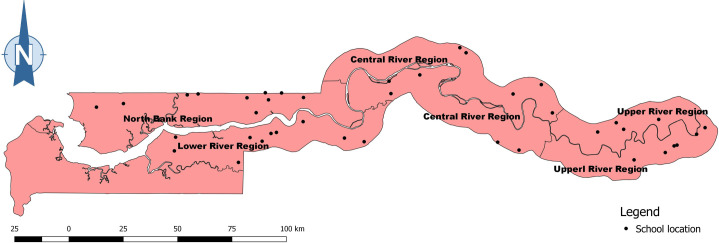
We utilised data from a previous study conducted in 2015 in 4 regions of The Gambia: North Bank Region (NBR), Lower River Region (LRR), Central River Region (CRR) and Upper River Region (URR). In the parent study, ten schools were selected randomly from each region. Urine and stool samples collected from 25 boys and 25 girls (7-14 years) in each school were examined for urinary schistosomiasis (Schistosoma haematobium infection) and intestinal schistosomiasis (Schistosoma mansoni infection) using urine filtration, dipstick and Kato-Katz methods.
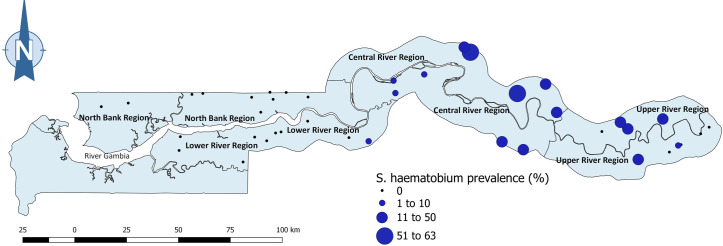
Urinary schistosomiasis had an overall prevalence of 10.2% while intestinal schistosomiasis had a prevalence of 0.3% among the sampled school children. Prevalence of urinary schistosomiasis was significantly different among regions (χ 2 = 279.958, df = 3, p < 0.001), with CRR (27.6%) being the most endemic region, followed by URR (12.0%), then LRR (0.6%), and NBR (0.0%). Prevalence of intestinal schistosomiasis was also significantly variable among regions, with 4 of the 5 positive cases detected in CRR and 1 case in URR. Every school sampled in CRR had at least one student infected with S. haematobium, 50% of schools in URR had S. haematobium infection, and just one school in LRR had S. haematobium infection. While S. haematobium infection was significantly higher in boys (χ 2 = 4.440, df = 1, p = 0.035), no significant difference in infection rate was observed among age groups (χ 2 = 0.882, df = 2, p = 0.643). Two of the 5 students infected with S. mansoni were boys and 3 were girls. Four of these 5 students were in the 10-12 years age group and 1 was in the 7-9 years age group. Macrohaematuria and microhaematuria were found to be statistically associated with presence of S. haematobium eggs in urine. Being a male was a risk factor of S. haematobium infection. Bathing, playing and swimming in water bodies were found to pose less risk for S. haematobium infection, indicating that the true water contact behaviour of children was possibly underrepresented.
The findings of this study provide invaluable information on the prevalence of schistosomiasis in The Gambia. This was useful for the schistosomiasis control efforts of the country, as it guided mass drug administration campaigns in eligible districts in the study area. More studies on S. mansoni and its intermediate snail hosts are required to establish its true status in The Gambia. As children sometimes tend to provide responses that potentially please the research or their teacher, data collection frameworks and approaches that ensure true responses in studies involving children should be devised and used.
冈比亚于 2015 年启动了血吸虫病控制计划。鉴于此,需要最近和全面的血吸虫病数据来有效指导控制计划。本研究旨在评估冈比亚小学生血吸虫病的流行情况和相关危险因素。
我们利用了 2015 年在冈比亚 4 个地区(北岸地区、下河区、中河区和上河区)进行的先前研究的数据。在母研究中,从每个地区随机选择 10 所学校。从每所学校的 25 名男孩和 25 名女孩(7-14 岁)中收集尿液和粪便样本,使用尿液过滤、尿试纸和加藤氏法检查尿中血吸虫病(埃及血吸虫感染)和肠道血吸虫病(曼氏血吸虫感染)。
在所抽样的学龄儿童中,尿中血吸虫病的总患病率为 10.2%,而肠道血吸虫病的患病率为 0.3%。血吸虫病的患病率在各地区之间存在显著差异(χ 2 = 279.958,df = 3,p < 0.001),其中中河区(27.6%)是最流行的地区,其次是上河区(12.0%),然后是下河区(0.6%),北岸地区(0.0%)。肠道血吸虫病的患病率在各地区之间也存在显著差异,5 例阳性病例中有 4 例在中河区,1 例在上河区。在被抽样的每所学校中,至少有一名学生感染了埃及血吸虫,上河区有 50%的学校感染了埃及血吸虫,下河区只有一所学校感染了埃及血吸虫。虽然男孩的埃及血吸虫感染率显著更高(χ 2 = 4.440,df = 1,p = 0.035),但各年龄组之间的感染率没有显著差异(χ 2 = 0.882,df = 2,p = 0.643)。感染曼氏血吸虫的 5 名学生中有 2 名是男生,3 名是女生。这 5 名学生中有 4 名在 10-12 岁年龄组,1 名在 7-9 岁年龄组。发现镜下血尿和肉眼血尿与尿液中存在埃及血吸虫卵有统计学关联。男性是埃及血吸虫感染的危险因素。洗澡、玩耍和在水体中游泳被发现感染埃及血吸虫的风险较低,表明儿童的真实水接触行为可能被低估了。
本研究的结果提供了冈比亚血吸虫病流行情况的宝贵信息。这对该国的血吸虫病控制工作很有用,因为它指导了研究地区合格地区的大规模药物治疗运动。需要更多关于曼氏血吸虫及其中间螺宿主的研究,以确定其在冈比亚的真实情况。由于儿童有时可能会提供可能取悦研究人员或他们的老师的回答,因此应该设计和使用确保儿童研究中真实回答的数据收集框架和方法。