Sheri-Kashmir Institute of Medical Sciences, Srinagar, Kashmir, India.
Influenza Other Respir Viruses. 2013 Jul;7(4):540-5. doi: 10.1111/j.1750-2659.2012.00416.x. Epub 2012 Aug 2.
Healthcare workers (HCWs) universally have a poor uptake of influenza vaccination. However, no data are available from India.
To explore knowledge, attitudes, and practices associated with influenza vaccination in HCWs in a temperate climate area in northern India.
A self-administered questionnaire was offered to all HCWs in three major hospitals of Srinagar and information sought on motivations, perceptions, preferences and practices regarding influenza vaccination.
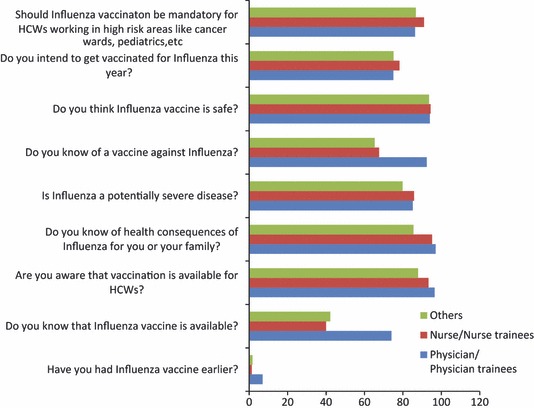
Of the 1750 questionnaires received, 1421 (81%) were returned. Only 62 (4·4%) HCWs had ever received influenza vaccination even as 1348 (95%) believed that influenza poses adverse potential consequences for themselves or their contacts; 1144 (81%) were aware of a vaccine against influenza and 830 (58%) of its local availability. Reasons cited by 1359 participants for not being vaccinated included ignorance about vaccine availability (435; 32%), skepticism about efficacy (248; 18%), busy schedule (166; 12%), fear of side effects (70; 4%), and a perception of not being-at-risk (82; 6%). Sixty-one percent (865) believed that vaccine programs are motivated by profit. Eighty-eight percent opined for mandatory vaccination for HCWs caring for the high-risk patients, as a part of 'employee health program'. Most of the participants intended to get vaccinated in the current year even as 684 (48%) held that vaccines could cause unknown illness and 444 (31%) believed their adverse effects to be underreported.
Influenza vaccination coverage among HCWs is dismally low in Srinagar; poor knowledge of vaccine availability and misperceptions about vaccine effectiveness, fear of adverse effects and obliviousness to being-at-risk being important barriers. Multifaceted, adaptable measures need to be invoked urgently to increase the coverage.
医疗工作者(HCWs)普遍对流感疫苗接种的接受程度较低。然而,印度目前尚无相关数据。
探索在印度北部温带地区,与 HCWs 接种流感疫苗相关的知识、态度和实践。
向斯利那加的三家主要医院的所有 HCWs 提供了一份自我管理问卷,并就流感疫苗接种的动机、认知、偏好和实践寻求信息。
共收到 1750 份问卷,其中 1421 份(81%)被退回。尽管 1348 名(95%)HCWs 认为流感可能对他们自己或他们的接触者产生不利的潜在后果,但只有 62 名(4.4%)HCWs 曾接种过流感疫苗;1144 名(81%)知道有流感疫苗,830 名(58%)知道其在当地可获得。1359 名参与者未接种疫苗的原因包括对疫苗供应的无知(435;32%)、对疗效的怀疑(248;18%)、繁忙的日程安排(166;12%)、对副作用的恐惧(70;4%)和认为自己没有风险(82;6%)。61%(865)的人认为疫苗接种计划是出于盈利动机。88%的人认为,作为“员工健康计划”的一部分,照顾高危患者的 HCWs 应强制接种疫苗。大多数参与者打算在今年接种疫苗,尽管 684 人(48%)认为疫苗可能会导致未知疾病,444 人(31%)认为其副作用报告不足。
斯利那加 HCWs 接种流感疫苗的覆盖率非常低;对疫苗供应的知识匮乏,对疫苗有效性的误解、对不良反应的恐惧以及对自身处于风险之中的忽视是重要的障碍。需要紧急采取多方面、适应性强的措施来提高覆盖率。