Schmidl Daniel, Hug Sabine, Li Wei Bo, Greiter Matthias B, Theis Fabian J
Institute of Bioinformatics and Systems Biology, Helmholtz Zentrum München German Research Center for Environmental Health, Neuherberg, Germany.
BMC Syst Biol. 2012 Aug 5;6:95. doi: 10.1186/1752-0509-6-95.
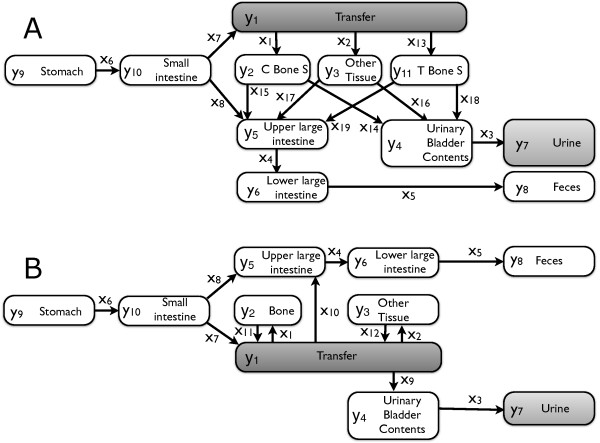
In radiation protection, biokinetic models for zirconium processing are of crucial importance in dose estimation and further risk analysis for humans exposed to this radioactive substance. They provide limiting values of detrimental effects and build the basis for applications in internal dosimetry, the prediction for radioactive zirconium retention in various organs as well as retrospective dosimetry. Multi-compartmental models are the tool of choice for simulating the processing of zirconium. Although easily interpretable, determining the exact compartment structure and interaction mechanisms is generally daunting. In the context of observing the dynamics of multiple compartments, Bayesian methods provide efficient tools for model inference and selection.
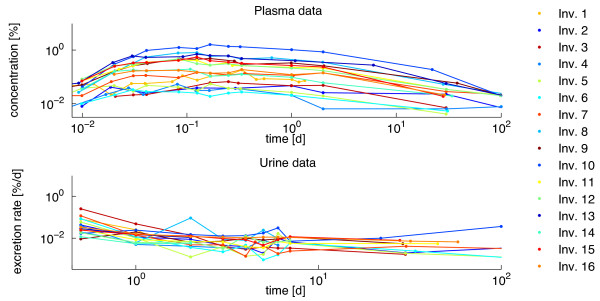
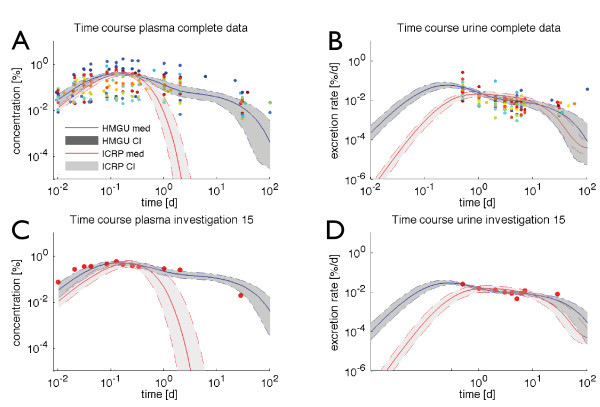
We are the first to apply a Markov chain Monte Carlo approach to compute Bayes factors for the evaluation of two competing models for zirconium processing in the human body after ingestion. Based on in vivo measurements of human plasma and urine levels we were able to show that a recently published model is superior to the standard model of the International Commission on Radiological Protection. The Bayes factors were estimated by means of the numerically stable thermodynamic integration in combination with a recently developed copula-based Metropolis-Hastings sampler.
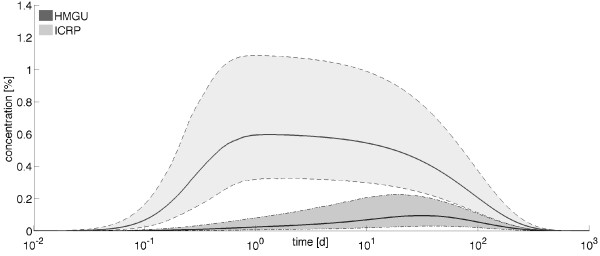
In contrast to the standard model the novel model predicts lower accretion of zirconium in bones. This results in lower levels of noxious doses for exposed individuals. Moreover, the Bayesian approach allows for retrospective dose assessment, including credible intervals for the initially ingested zirconium, in a significantly more reliable fashion than previously possible. All methods presented here are readily applicable to many modeling tasks in systems biology.
在辐射防护中,锆处理的生物动力学模型对于估算剂量以及对接触这种放射性物质的人类进行进一步风险分析至关重要。它们提供有害效应的限值,并为体内剂量测定、预测锆在各个器官中的滞留情况以及回顾性剂量测定奠定基础。多室模型是模拟锆处理过程的首选工具。尽管易于解释,但确定确切的室结构和相互作用机制通常具有挑战性。在观察多个室的动态过程中,贝叶斯方法为模型推断和选择提供了有效的工具。
我们首次应用马尔可夫链蒙特卡罗方法来计算贝叶斯因子,以评估摄入后人体中锆处理的两种竞争模型。基于人体血浆和尿液水平的体内测量,我们能够证明最近发表的模型优于国际放射防护委员会的标准模型。贝叶斯因子通过数值稳定的热力学积分结合最近开发的基于copula的Metropolis-Hastings采样器进行估计。
与标准模型相比,新模型预测骨骼中锆的积累较低。这导致接触个体的有害剂量水平较低。此外,贝叶斯方法允许以比以前更可靠的方式进行回顾性剂量评估,包括初始摄入锆的可信区间。这里介绍的所有方法都很容易应用于系统生物学中的许多建模任务。