Institute for Bioinformatics and Systems Biology, Helmholtz Zentrum München, Ingolstädter Landstrasse 1, 85764 Munich-Neuherberg, Germany.
BMC Bioinformatics. 2010 May 7;11:233. doi: 10.1186/1471-2105-11-233.
Phenomenological information about regulatory interactions is frequently available and can be readily converted to Boolean models. Fully quantitative models, on the other hand, provide detailed insights into the precise dynamics of the underlying system. In order to connect discrete and continuous modeling approaches, methods for the conversion of Boolean systems into systems of ordinary differential equations have been developed recently. As biological interaction networks have steadily grown in size and complexity, a fully automated framework for the conversion process is desirable.
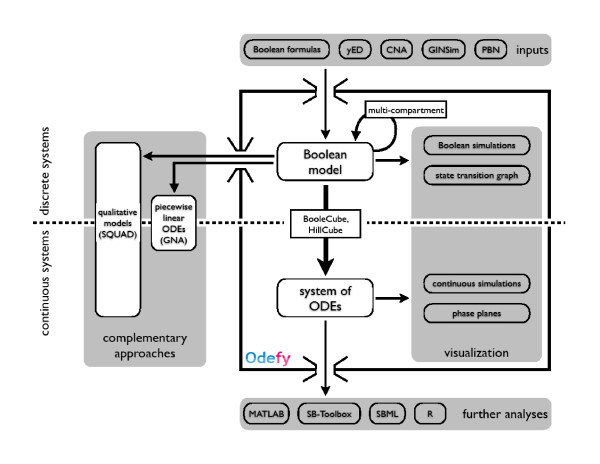
We present Odefy, a MATLAB- and Octave-compatible toolbox for the automated transformation of Boolean models into systems of ordinary differential equations. Models can be created from sets of Boolean equations or graph representations of Boolean networks. Alternatively, the user can import Boolean models from the CellNetAnalyzer toolbox, GINSim and the PBN toolbox. The Boolean models are transformed to systems of ordinary differential equations by multivariate polynomial interpolation and optional application of sigmoidal Hill functions. Our toolbox contains basic simulation and visualization functionalities for both, the Boolean as well as the continuous models. For further analyses, models can be exported to SQUAD, GNA, MATLAB script files, the SB toolbox, SBML and R script files. Odefy contains a user-friendly graphical user interface for convenient access to the simulation and exporting functionalities. We illustrate the validity of our transformation approach as well as the usage and benefit of the Odefy toolbox for two biological systems: a mutual inhibitory switch known from stem cell differentiation and a regulatory network giving rise to a specific spatial expression pattern at the mid-hindbrain boundary.
Odefy provides an easy-to-use toolbox for the automatic conversion of Boolean models to systems of ordinary differential equations. It can be efficiently connected to a variety of input and output formats for further analysis and investigations. The toolbox is open-source and can be downloaded at http://cmb.helmholtz-muenchen.de/odefy.
调控相互作用的现象学信息经常可用,并且可以很容易地转换为布尔模型。另一方面,全定量模型提供了对基础系统精确动态的详细了解。为了连接离散和连续建模方法,最近已经开发了将布尔系统转换为常微分方程系统的方法。由于生物相互作用网络的规模和复杂性稳步增长,因此需要一个完全自动化的转换过程框架。
我们提出了 Odefy,这是一个用于将布尔模型自动转换为常微分方程系统的 MATLAB 和 Octave 兼容的工具箱。模型可以从布尔方程组或布尔网络的图形表示创建。或者,用户可以从 CellNetAnalyzer 工具箱、GINSim 和 PBN 工具箱导入布尔模型。通过多元多项式插值和可选应用 sigmoidal Hill 函数将布尔模型转换为常微分方程系统。我们的工具箱包含布尔模型和连续模型的基本模拟和可视化功能。对于进一步的分析,可以将模型导出到 SQUAD、GNA、MATLAB 脚本文件、SB 工具箱、SBML 和 R 脚本文件。Odefy 包含一个用户友好的图形用户界面,方便访问模拟和导出功能。我们说明了我们的转换方法的有效性,以及 Odefy 工具箱在两个生物学系统中的使用和好处:一个来自干细胞分化的互抑制开关和一个产生特定的中后脑边界空间表达模式的调控网络。
Odefy 提供了一个易于使用的工具箱,用于将布尔模型自动转换为常微分方程系统。它可以与各种输入和输出格式高效连接,以进行进一步的分析和研究。该工具箱是开源的,可以从 http://cmb.helmholtz-muenchen.de/odefy 下载。