The University of Texas Health Science Center, School of Public Health, Dallas, TX 75390-9128, USA.
BMC Public Health. 2012 Aug 5;12:611. doi: 10.1186/1471-2458-12-611.
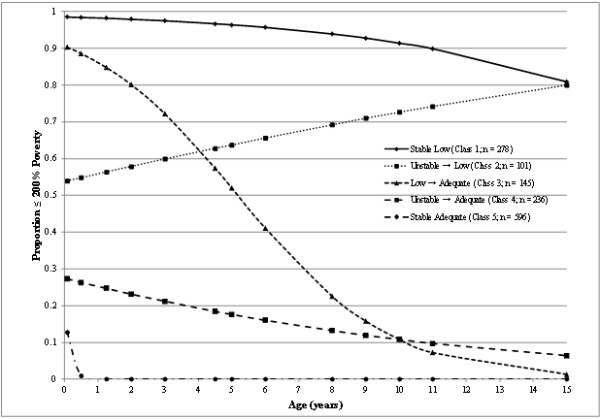
Childhood socioeconomic disadvantage has been linked with obesity in cross-sectional research, although less is known about how changes in socioeconomic status influence the development of obesity. Researchers have hypothesized that upward socioeconomic mobility may attenuate the health effects of earlier socioeconomic disadvantage; while downward socioeconomic mobility might have a negative influence on health despite relative socioeconomic advantages at earlier stages. The purpose of the current study was to characterize trajectories of family income during childhood, and to evaluate the influence of these trajectories on adiposity at age 15.
Data were collected as part of the Study of Early Child Care and Youth Development (SECCYD) between 1991 and 2007 at 10 sites across the United States. A latent class growth analysis (LCGA) was conducted to identify trajectories of family income from birth to 15 years of age. Analyses of covariance (ANCOVAs) were conducted to determine whether measures of adiposity differed by trajectory, while controlling for relevant covariates.
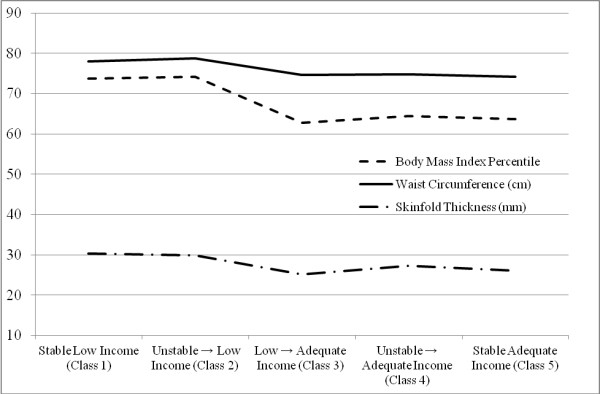
The LCGA supported a 5-class trajectory model, which included two stable, one downward, and two upward trajectories. ANCOVAs indicated that BMI percentile, waist circumference, and skinfold thicknesses at age 15 differed significantly by trajectory, such that those who experienced downward mobility or stable low income had greater adiposity relative to the more advantaged trajectories. Conversely, upwardly mobile children and those with consistently adequate incomes had similar and more positive outcomes relative to the most disadvantaged trajectories.
Findings suggest that promoting upward socioeconomic mobility among disadvantaged families may have a positive impact on obesity-related outcomes in adolescence.
横断面研究表明,儿童时期的社会经济劣势与肥胖有关,尽管人们对社会经济地位的变化如何影响肥胖的发展知之甚少。研究人员假设,向上的社会经济流动可能会减轻早期社会经济劣势对健康的影响;而向下的社会经济流动可能会对健康产生负面影响,尽管在早期阶段相对的社会经济优势。本研究的目的是描述儿童时期家庭收入的轨迹,并评估这些轨迹对 15 岁时肥胖的影响。
数据是作为早期儿童保育和青年发展研究(SECCYD)的一部分,于 1991 年至 2007 年期间在美国 10 个地点收集的。采用潜在类别增长分析(LCGA)来确定从出生到 15 岁的家庭收入轨迹。协方差分析(ANCOVA)用于确定肥胖指标是否因轨迹而异,同时控制相关协变量。
LCGA 支持 5 类轨迹模型,包括两个稳定的、一个下降的和两个上升的轨迹。ANCOVA 表明,15 岁时 BMI 百分位数、腰围和皮褶厚度差异显著,与下降的流动性或稳定的低收入相比,下降的流动性或稳定的低收入轨迹的肥胖程度更高。相反,向上流动的儿童和那些收入持续充足的儿童与最不利的轨迹相比,具有相似且更积极的结果。
研究结果表明,促进弱势家庭的向上社会经济流动可能对青春期肥胖相关结果产生积极影响。