Department of Preventive Medicine, Feinberg School of Medicine, Northwestern University, 680 N Lake Shore Dr, Ste 1400, Chicago, IL 60611, USA.
JAMA. 2010 Dec 15;304(23):2603-10. doi: 10.1001/jama.2010.1843.
Data supporting physical activity guidelines to prevent long-term weight gain are sparse, particularly during the period when the highest risk of weight gain occurs.
To evaluate the relationship between habitual activity levels and changes in body mass index (BMI) and waist circumference over 20 years.
DESIGN, SETTING, AND PARTICIPANTS: The Coronary Artery Risk Development in Young Adults (CARDIA) study is a prospective longitudinal study with 20 years of follow-up, 1985-1986 to 2005-2006. Habitual activity was defined as maintaining high, moderate, and low activity levels based on sex-specific tertiles of activity scores at baseline. Participants comprised a population-based multicenter cohort (Chicago, Illinois; Birmingham, Alabama; Minneapolis, Minnesota; and Oakland, California) of 3554 men and women aged 18 to 30 years at baseline.
Average annual changes in BMI and waist circumference.
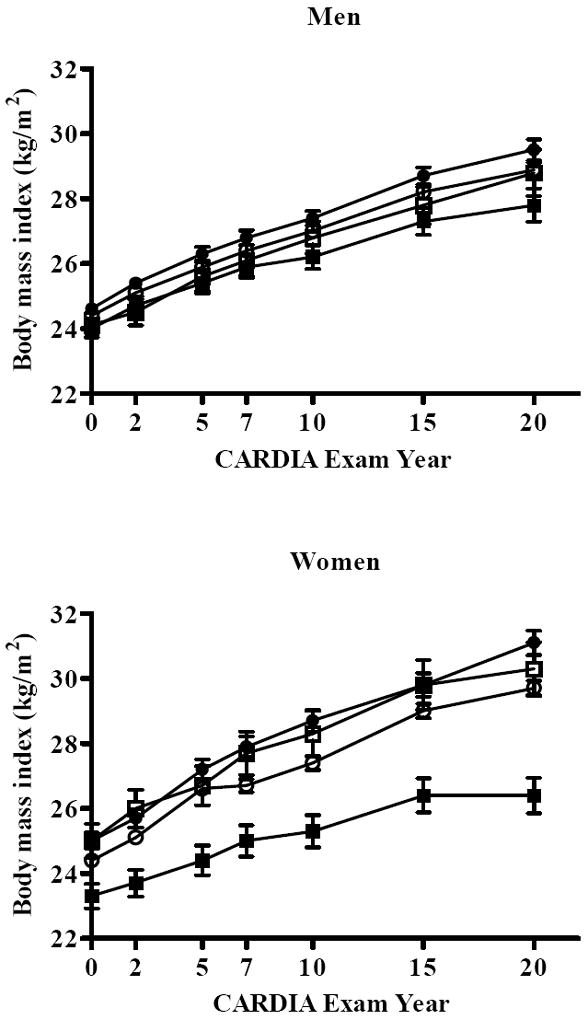
Over 20 years, maintaining high levels of activity was associated with smaller gains in BMI and waist circumference compared with low activity levels after adjustment for race, baseline BMI, age, education, cigarette smoking status, alcohol use, and energy intake. Men maintaining high activity gained 2.6 fewer kilograms (0.15 BMI units per year; 95% confidence interval [CI], 0.11-0.18 vs 0.20 in the lower activity group; 95% CI, 0.17-0.23), and women maintaining higher activity gained 6.1 fewer kilograms (0.17 BMI units per year; 95% CI, 0.12-0.21 vs 0.30 in the lower activity group; 95% CI, 0.25-0.34). Men maintaining high activity gained 3.1 fewer centimeters in waist circumference (0.52 cm per year; 95% CI, 0.43-0.61 cm vs 0.67 cm in the lower activity group; 95% CI,0.60-0.75 cm) and women maintaining higher activity gained 3.8 fewer centimeters(0.49 cm per year; 95% CI, 0.39-0.58 cm vs 0.67 cm in the lower activity group; 95% CI, 0.60-0.75 cm) [corrected].
Maintaining high activity levels through young adulthood may lessen weight gain as young adults transition to middle age, particularly in women.
支持体力活动指南以预防长期体重增加的数据很少,尤其是在体重增加风险最高的时候。
评估 20 年来习惯性活动水平与体重指数 (BMI) 和腰围变化之间的关系。
设计、地点和参与者:冠状动脉风险发展在年轻人 (CARDIA) 研究是一项前瞻性纵向研究,随访 20 年,1985-1986 年至 2005-2006 年。根据基线时活动评分的性别特异性三分位,习惯性活动被定义为保持高、中、低活动水平。参与者包括一个基于人群的多中心队列(伊利诺伊州芝加哥、阿拉巴马州伯明翰、明尼苏达州明尼阿波利斯和加利福尼亚州奥克兰),由 3554 名年龄在 18 至 30 岁的男性和女性组成。
BMI 和腰围的平均年变化。
在 20 年期间,与低活动水平相比,保持高水平的活动与 BMI 和腰围的较小增加有关,调整种族、基线 BMI、年龄、教育、吸烟状况、饮酒和能量摄入后。保持高活动的男性体重增加 2.6 公斤(每年 0.15 BMI 单位;95%置信区间 [CI],0.11-0.18 与较低活动组的 0.20 公斤;95%CI,0.17-0.23),女性保持较高活动的体重增加 6.1 公斤(每年 0.17 BMI 单位;95%CI,0.12-0.21 与较低活动组的 0.30 公斤;95%CI,0.25-0.34)。保持高活动的男性腰围减少 3.1 厘米(每年 0.52 厘米;95%CI,0.43-0.61 厘米与较低活动组的 0.67 厘米;95%CI,0.60-0.75 厘米),女性保持较高活动的腰围减少 3.8 厘米(每年 0.49 厘米;95%CI,0.39-0.58 厘米与较低活动组的 0.67 厘米;95%CI,0.60-0.75 厘米)[纠正]。
在年轻人向中年过渡期间保持高水平的活动可能会减轻体重增加,尤其是在女性中。