Kao Ya-Ting, Zhu Xinxin, Xu Fang, Min Wei
Department of Chemistry, Columbia University, New York, NY 10027, USA.
Biomed Opt Express. 2012 Aug 1;3(8):1955-63. doi: 10.1364/BOE.3.001955. Epub 2012 Jul 27.
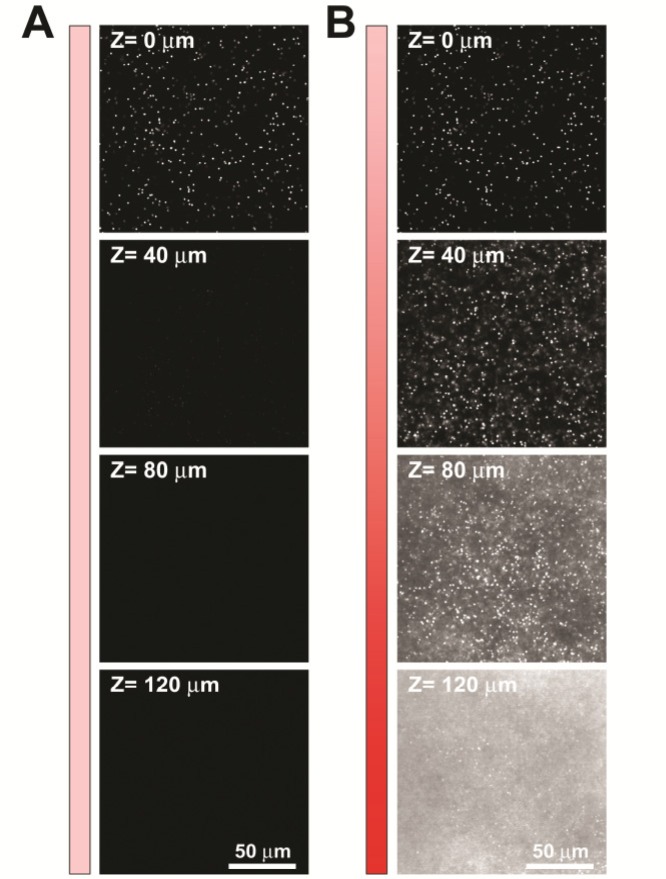
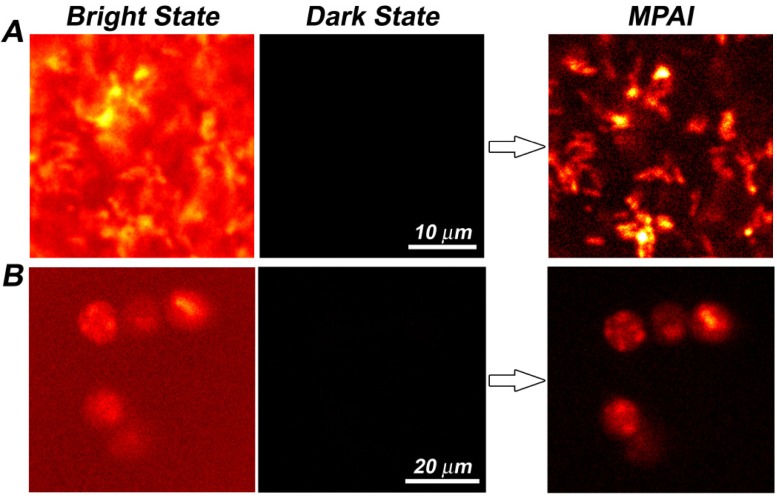
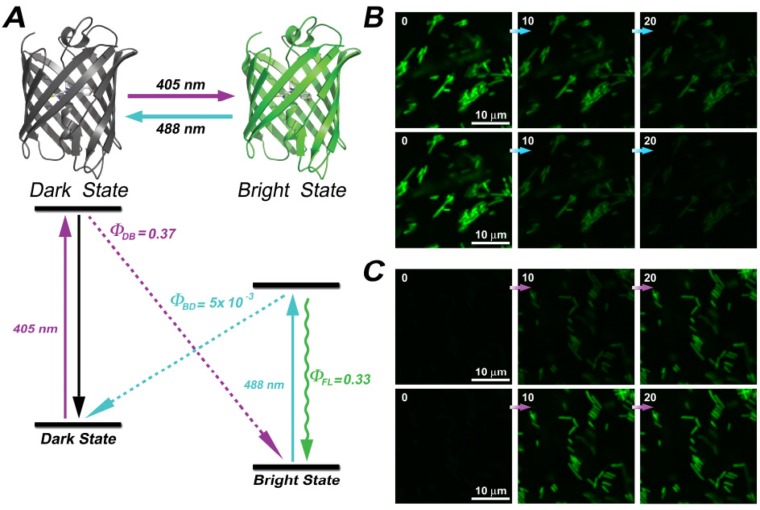
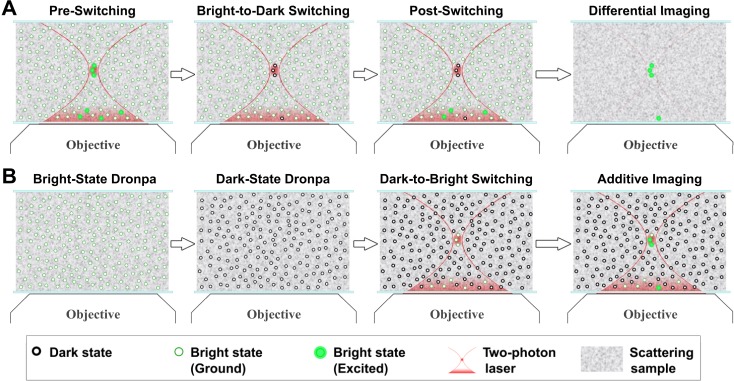
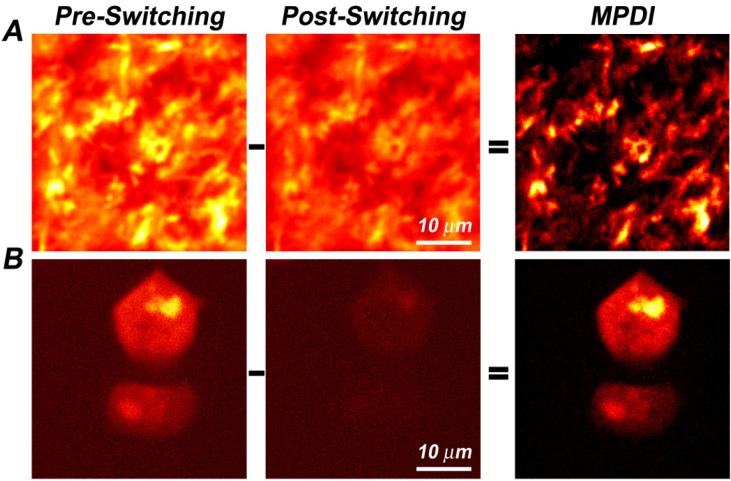
Probing biological structures and functions deep inside live organisms with light is highly desirable. Among the current optical imaging modalities, multiphoton fluorescence microscopy exhibits the best contrast for imaging scattering samples by employing a spatially confined nonlinear excitation. However, as the incident laser power drops exponentially with imaging depth into the sample due to the scattering loss, the out-of-focus background eventually overwhelms the in-focus signal, which defines a fundamental imaging-depth limit. Herein we significantly improve the image contrast for deep scattering samples by harnessing reversibly switchable fluorescent proteins (RSFPs) which can be cycled between bright and dark states upon light illumination. Two distinct techniques, multiphoton deactivation and imaging (MPDI) and multiphoton activation and imaging (MPAI), are demonstrated on tissue phantoms labeled with Dronpa protein. Such a focal switch approach can generate pseudo background-free images. Conceptually different from wave-based approaches that try to reduce light scattering in turbid samples, our work represents a molecule-based strategy that focused on imaging probes.
利用光深入探测活生物体内部的生物结构和功能是非常有必要的。在当前的光学成像方式中,多光子荧光显微镜通过采用空间受限的非线性激发,在对散射样本成像时展现出最佳的对比度。然而,由于散射损耗,入射激光功率随成像深度呈指数下降,离焦背景最终会淹没聚焦信号,这就定义了一个基本的成像深度极限。在此,我们通过利用可逆开关荧光蛋白(RSFP)显著提高了对深度散射样本的图像对比度,该蛋白在光照下可在明亮和黑暗状态之间循环。在标记有Dronpa蛋白的组织模型上展示了两种不同的技术,即多光子失活与成像(MPDI)和多光子激活与成像(MPAI)。这种焦点切换方法可以生成伪无背景图像。与试图减少浑浊样本中光散射的基于波的方法在概念上不同,我们的工作代表了一种基于分子的策略,专注于成像探针。