Department of Dermatology, University of Luebeck, Luebeck, Germany.
Orphanet J Rare Dis. 2012 Aug 9;7:49. doi: 10.1186/1750-1172-7-49.
Various antigen-specific immunoassays are available for the serological diagnosis of autoimmune bullous diseases. However, a spectrum of different tissue-based and monovalent antigen-specific assays is required to establish the diagnosis. BIOCHIP mosaics consisting of different antigen substrates allow polyvalent immunofluorescence (IF) tests and provide antibody profiles in a single incubation.
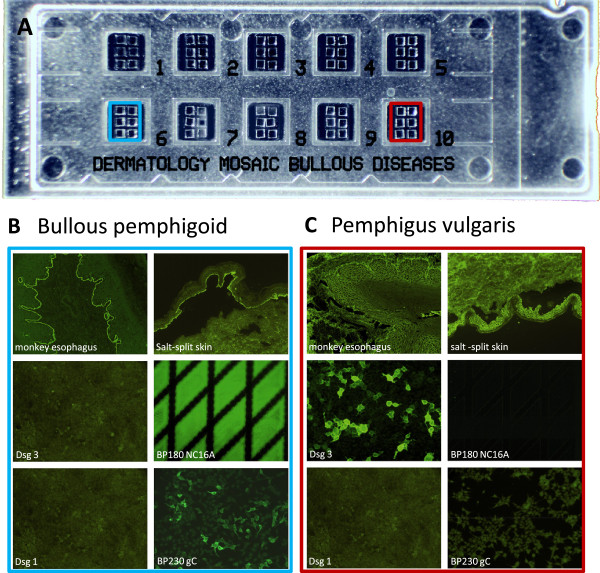
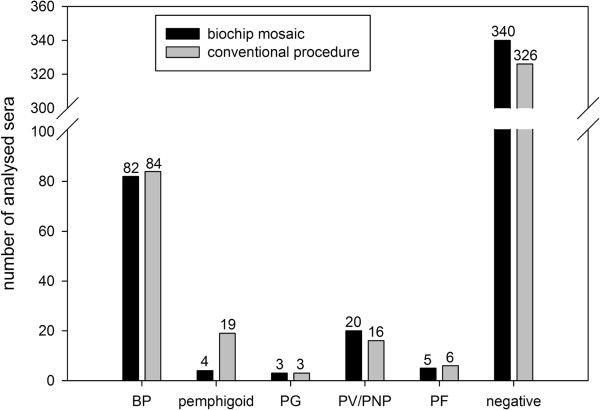
Slides for indirect IF were prepared, containing BIOCHIPS with the following test substrates in each reaction field: monkey esophagus, primate salt-split skin, antigen dots of tetrameric BP180-NC16A as well as desmoglein 1-, desmoglein 3-, and BP230gC-expressing human HEK293 cells. This BIOCHIP mosaic was probed using a large panel of sera from patients with pemphigus vulgaris (PV, n=65), pemphigus foliaceus (PF, n=50), bullous pemphigoid (BP, n=42), and non-inflammatory skin diseases (n=97) as well as from healthy blood donors (n=100). Furthermore, to evaluate the usability in routine diagnostics, 454 consecutive sera from patients with suspected immunobullous disorders were prospectively analyzed in parallel using a) the IF BIOCHIP mosaic and b) a panel of single antibody assays as commonly used by specialized centers.
Using the BIOCHIP mosaic, sensitivities of the desmoglein 1-, desmoglein 3-, and NC16A-specific substrates were 90%, 98.5% and 100%, respectively. BP230 was recognized by 54% of the BP sera. Specificities ranged from 98.2% to 100% for all substrates. In the prospective study, a high agreement was found between the results obtained by the BIOCHIP mosaic and the single test panel for the diagnosis of BP, PV, PF, and sera without serum autoantibodies (Cohen's κ between 0.88 and 0.97).
The BIOCHIP mosaic contains sensitive and specific substrates for the indirect IF diagnosis of BP, PF, and PV. Its diagnostic accuracy is comparable with the conventional multi-step approach. The highly standardized and practical BIOCHIP mosaic will facilitate the serological diagnosis of autoimmune blistering diseases.
有多种针对自身免疫性大疱性疾病的抗原特异性免疫检测方法。然而,为了明确诊断,还需要一系列不同的基于组织和单价抗原特异性检测方法。由不同抗原底物组成的 BIOCHIP 嵌合体可进行多价免疫荧光(IF)检测,并在单次孵育中提供抗体谱。
制备间接 IF 载玻片,在每个反应场中包含带有以下测试底物的 BIOCHIPS:猴食管、灵长类盐裂皮肤、四聚体 BP180-NC16A 抗原点以及表达人 HEK293 细胞的桥粒芯糖蛋白 1、桥粒芯糖蛋白 3 和 BP230gC。使用来自寻常性天疱疮(PV,n=65)、落叶型天疱疮(PF,n=50)、大疱性类天疱疮(BP,n=42)和非炎症性皮肤病患者(n=97)以及健康献血者(n=100)的大样本血清面板对这种 BIOCHIP 嵌合体进行了探测。此外,为了评估其在常规诊断中的可用性,前瞻性地分析了 454 例疑似免疫性大疱性疾病患者的连续血清,使用 a)IF BIOCHIP 嵌合体和 b)专门中心常用的一组单抗体检测方法进行平行分析。
使用 BIOCHIP 嵌合体,桥粒芯糖蛋白 1、桥粒芯糖蛋白 3 和 NC16A 特异性底物的灵敏度分别为 90%、98.5%和 100%。BP230 被 54%的 BP 血清识别。所有底物的特异性均为 98.2%至 100%。在前瞻性研究中,BIOCHIP 嵌合体和单抗体检测面板获得的结果在 BP、PV、PF 和无血清自身抗体的血清的诊断中具有高度一致性(Cohen's κ 值在 0.88 至 0.97 之间)。
BIOCHIP 嵌合体包含用于 BP、PF 和 PV 的间接 IF 诊断的敏感和特异性底物。其诊断准确性与传统的多步骤方法相当。这种高度标准化和实用的 BIOCHIP 嵌合体将有助于自身免疫性大疱性疾病的血清学诊断。