Centre for Cardiovascular Imaging, UCL Institute of Cardiovascular Science, and Great Ormond Street Hospital for Children, NHS Trust, London, UK.
J Cardiovasc Magn Reson. 2012 Aug 9;14(1):57. doi: 10.1186/1532-429X-14-57.
Wave intensity analysis, traditionally derived from pressure and velocity data, can be formulated using velocity and area. Flow-velocity and area can both be derived from high-resolution phase-contrast cardiovascular magnetic resonance (PC-CMR). In this study, very high temporal resolution PC-CMR data is processed using an integrated and semi-automatic technique to derive wave intensity.
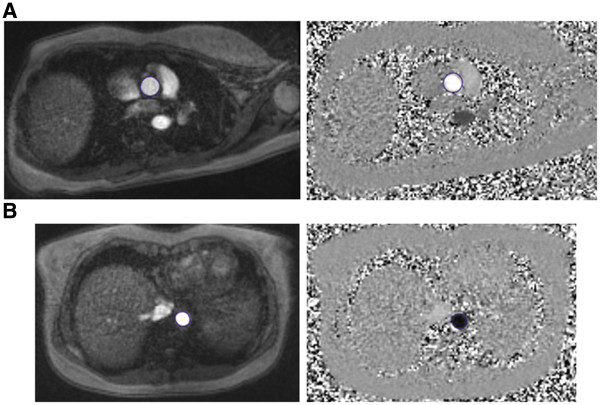
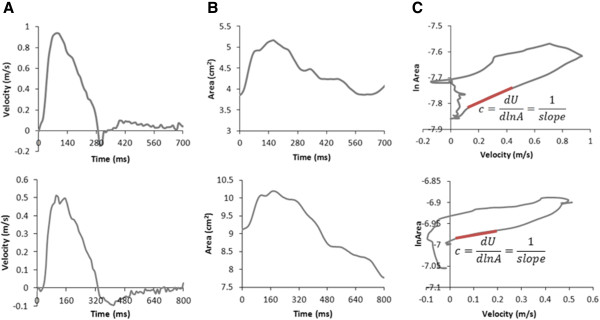
Wave intensity was derived in terms of area and velocity changes. These data were directly derived from PC-CMR using a breath-hold spiral sequence accelerated with sensitivity encoding (SENSE). Image processing was integrated in a plug-in for the DICOM viewer OsiriX, including calculations of wave speed and wave intensity. Ascending and descending aortic data from 15 healthy volunteers (30 ± 6 years) data were used to test the method for feasibility, and intra- and inter-observer variability. Ascending aortic data were also compared with results from 15 patients with coronary heart disease (61 ± 13 years) to assess the clinical usefulness of the method.
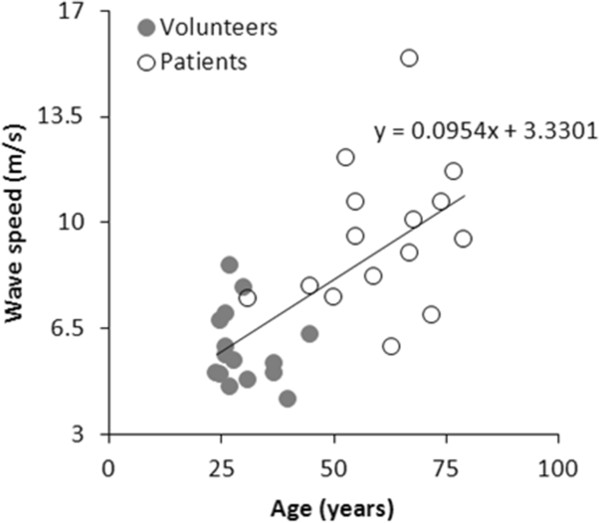
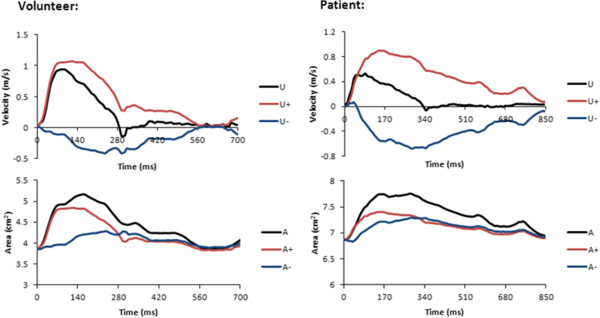
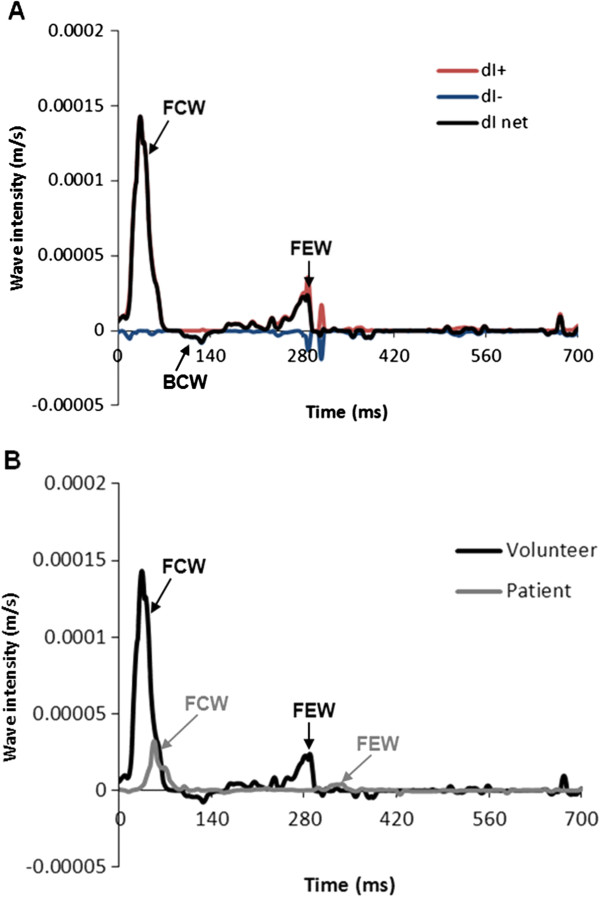
Rapid image acquisition (11 s breath-hold) and image processing was feasible in all volunteers. Wave speed was physiological (5.8 ± 1.3 m/s ascending aorta, 5.0 ± 0.7 m/s descending aorta) and the wave intensity pattern was consistent with traditionally formulated wave intensity. Wave speed, peak forward compression wave in early systole and peak forward expansion wave in late systole at both locations exhibited overall good intra- and inter-observer variability. Patients with coronary heart disease had higher wave speed (p <0.0001), and lower forward compression wave (p <0.0001) and forward expansion wave (p <0.0005) peaks. This difference is likely related to the older age of the patients' cohort, indicating stiffer aortas, as well as compromised ventricular function due to their underlying condition.
A non-invasive, semi-automated and reproducible method for performing wave intensity analysis is presented. Its application is facilitated by the use of a very high temporal resolution spiral sequence. A formulation of wave intensity based on area change has also been proposed, involving no assumptions about the cross-sectional shape of the vessel.
传统的波强分析是基于压力和速度数据推导出来的,也可以基于速度和面积来构建。流速和面积都可以从高分辨率相位对比心血管磁共振(PC-CMR)中得到。在本研究中,使用集成和半自动技术处理超高时间分辨率 PC-CMR 数据,以推导波强。
波强是根据面积和速度变化推导出来的。这些数据是直接从使用呼吸门控螺旋序列加速灵敏度编码(SENSE)的 PC-CMR 中获得的。图像处理集成在 DICOM 查看器 OsiriX 的插件中,包括波速和波强的计算。15 名健康志愿者(30±6 岁)的升主动脉和降主动脉数据用于测试该方法的可行性和观察者内及观察者间的可变性。还将升主动脉数据与 15 名冠心病患者(61±13 岁)的结果进行比较,以评估该方法的临床应用价值。
所有志愿者都可以快速采集图像(11s 屏气)和进行图像处理。波速是生理性的(升主动脉 5.8±1.3m/s,降主动脉 5.0±0.7m/s),波强模式与传统的波强一致。两个部位的波速、早期收缩期正向压缩波峰值和晚期收缩期正向扩张波峰值都具有较好的观察者内和观察者间的可变性。冠心病患者的波速较高(p<0.0001),正向压缩波峰值和正向扩张波峰值较低(p<0.0001 和 p<0.0005)。这种差异可能与患者年龄较大有关,表明主动脉僵硬,以及由于基础疾病导致心室功能受损。
本文提出了一种非侵入性、半自动和可重复的波强分析方法。该方法通过使用超高时间分辨率的螺旋序列来简化其应用。还提出了一种基于面积变化的波强公式,该公式不涉及对血管横截面形状的任何假设。