Department of Orthopaedics, Second Affiliated Hospital, Xi'an Jiaotong University School of Medicine, Xi'an, Shaanxi, 710004, People's Republic of China.
BMC Musculoskelet Disord. 2012 Aug 9;13:142. doi: 10.1186/1471-2474-13-142.
To investigate the efficacy of the sole core decompression surgery for the treatment of steroid-induced femoral head osteonecrosis.
The model was established by administration of steroids in combination with horse serum. The rabbits with bilateral femoral head osteonecrosis were randomly selected to do the one side of core decompression. The other side was used as the sham. Quantitative RT-PCR and western blot techniques were used to measure the local expression of BMP-2 and PPAR-γ. Bone tissues from control and operation groups were histologically analyzed by H&E staining. The comparisons of the local expression of BMP-2 and PPAR-γ and the bone regeneration were further analyzed between different groups at each time point.
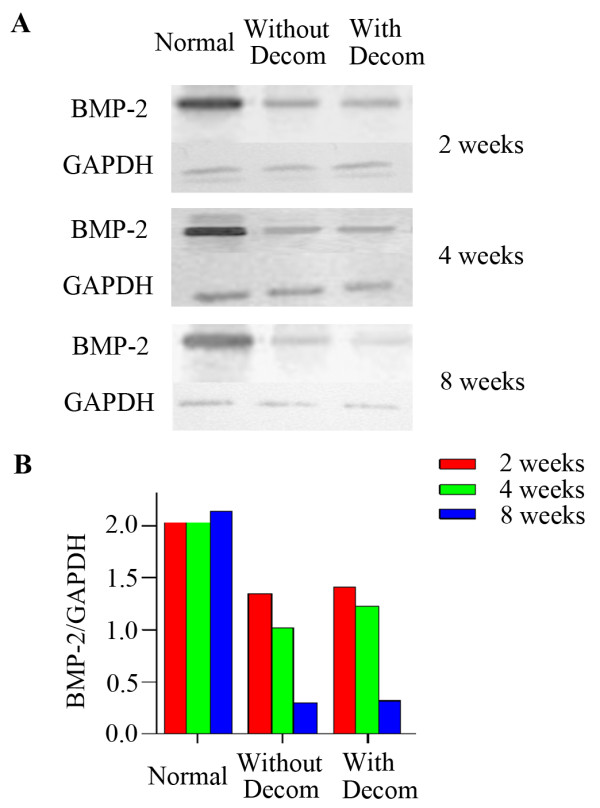
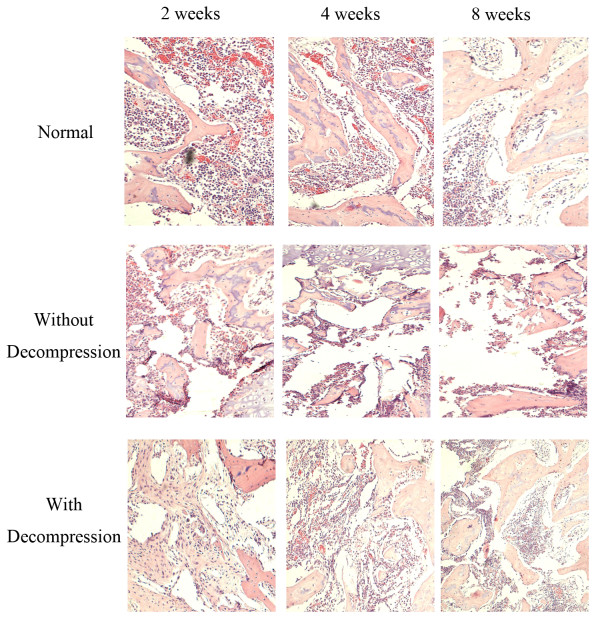
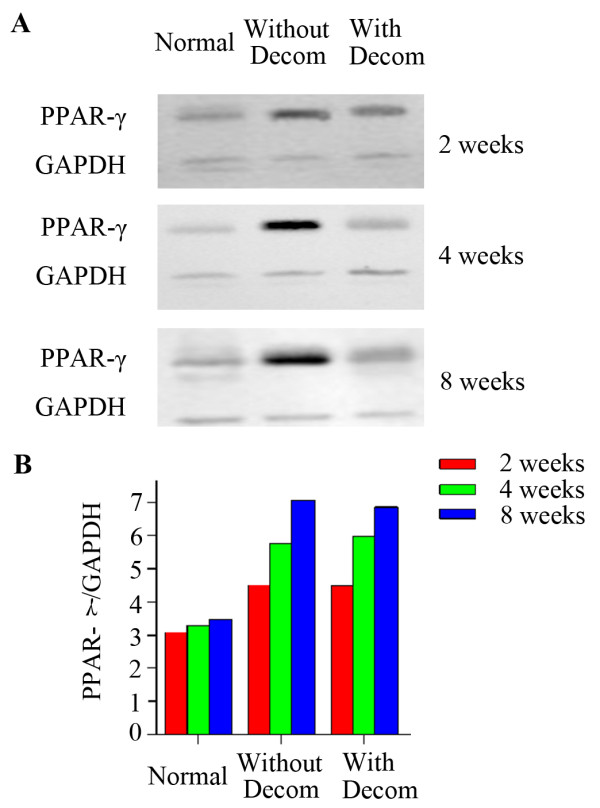
The expression of BMP-2 in the osteonecrosis femoral head with or without decompression was significantly lower than that in normal animals. BMP-2 expression both showed the decreasing trend with the increased post-operation time. No significant difference of BMP-2 expression occurred between femoral head osteonecrosis with and without decompression. The PPAR-γ expression in the femoral head osteonecrosis with and without core decompression both was significantly higher than that in control. Its expression pattern showed a significantly increased trend with increased the post-operation time. However, there was no significant difference of PPAR-γ expression between the femoral head osteonecrosis with and without decompression at each time point. Histopathological analysis revealed that new trabecular bone and a large number of osteoblasts were observed in the steroid-induced femoral head osteonecrosis with lateral decompression at 8 weeks after surgery, but there still existed trabecular bone fractures and bone necrosis.
Although decompression takes partial effect in promoting bone regeneration in the early treatment of femoral head osteonecrosis, such an effect does not significantly improve or reverse the pathological changes of femoral head necrosis. Thus, the long-term effect of core decompression in the treatment of steroid-induced femoral head osteonecrosis is not satisfactory.
探讨单纯核心减压术治疗激素诱导性股骨头坏死的疗效。
采用激素联合马血清建立模型,随机选择双侧股骨头坏死兔进行一侧核心减压,另一侧作为假手术。采用定量 RT-PCR 和 Western blot 技术测量局部 BMP-2 和 PPAR-γ 的表达。通过 H&E 染色对对照组和手术组的骨组织进行组织学分析。进一步分析不同时间点各组之间局部 BMP-2 和 PPAR-γ 表达和骨再生的差异。
无论是否减压,坏死股骨头中的 BMP-2 表达均明显低于正常动物。BMP-2 表达随术后时间的延长呈下降趋势。股骨头坏死伴或不伴减压的 BMP-2 表达无明显差异。无论是否进行核心减压,股骨头坏死中 PPAR-γ 的表达均明显高于对照组。其表达模式随术后时间的增加呈显著增加趋势。然而,在每个时间点,股骨头坏死伴或不伴减压的 PPAR-γ 表达均无显著差异。组织病理学分析显示,术后 8 周,激素诱导性股骨头坏死侧减压后可见新的小梁骨和大量成骨细胞,但仍存在小梁骨骨折和骨坏死。
尽管减压术在早期治疗股骨头坏死中对促进骨再生有一定作用,但这种作用并不能显著改善或逆转股骨头坏死的病理变化。因此,核心减压术治疗激素诱导性股骨头坏死的长期效果并不理想。