Grantham Institute for Climate Change, Department of Infectious Disease Epidemiology, Imperial College, London W2 1PG, UK.
Malar J. 2012 Aug 9;11:271. doi: 10.1186/1475-2875-11-271.
The impact of weather and climate on malaria transmission has attracted considerable attention in recent years, yet uncertainties around future disease trends under climate change remain. Mathematical models provide powerful tools for addressing such questions and understanding the implications for interventions and eradication strategies, but these require realistic modeling of the vector population dynamics and its response to environmental variables.
Published and unpublished field and experimental data are used to develop new formulations for modeling the relationships between key aspects of vector ecology and environmental variables. These relationships are integrated within a validated deterministic model of Anopheles gambiae s.s. population dynamics to provide a valuable tool for understanding vector response to biotic and abiotic variables.
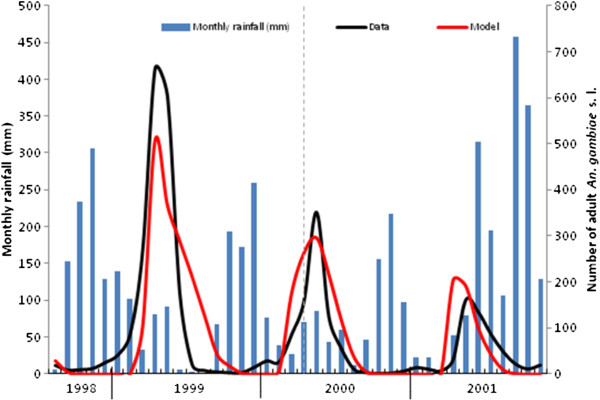
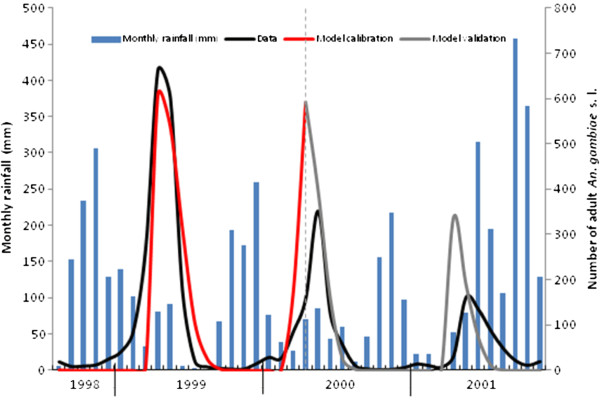
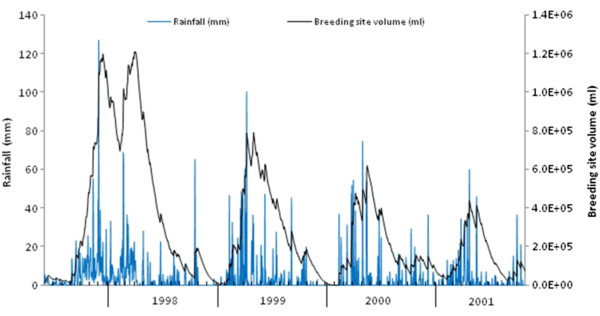
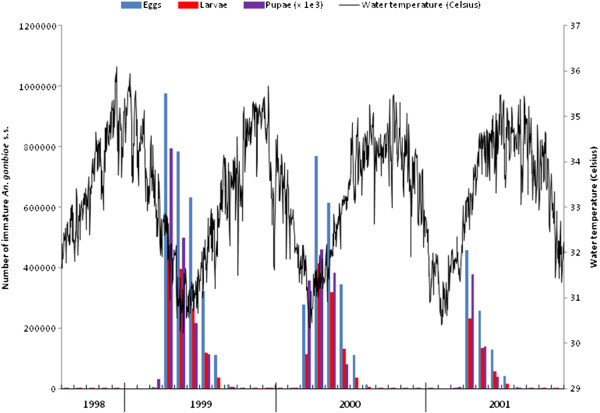
A novel, parsimonious framework for assessing the effects of rainfall, cloudiness, wind speed, desiccation, temperature, relative humidity and density-dependence on vector abundance is developed, allowing ease of construction, analysis, and integration into malaria transmission models. Model validation shows good agreement with longitudinal vector abundance data from Tanzania, suggesting that recent malaria reductions in certain areas of Africa could be due to changing environmental conditions affecting vector populations.
Mathematical models provide a powerful, explanatory means of understanding the role of environmental variables on mosquito populations and hence for predicting future malaria transmission under global change. The framework developed provides a valuable advance in this respect, but also highlights key research gaps that need to be resolved if we are to better understand future malaria risk in vulnerable communities.
近年来,天气和气候对疟疾传播的影响引起了相当大的关注,但气候变化下未来疾病趋势的不确定性仍然存在。数学模型为解决这些问题提供了强有力的工具,并有助于理解干预和根除策略的影响,但这些模型需要对媒介种群动态及其对环境变量的反应进行现实建模。
利用已发表和未发表的现场和实验数据,开发了新的公式来模拟媒介生态学和环境变量之间的关键关系。这些关系被整合到一个经过验证的冈比亚按蚊种群动态确定性模型中,为理解媒介对生物和非生物变量的反应提供了有价值的工具。
开发了一种新颖的、简约的框架,用于评估降雨量、云量、风速、干燥、温度、相对湿度和密度依赖性对媒介丰度的影响,使模型的构建、分析和整合变得更加容易。模型验证表明,与来自坦桑尼亚的纵向媒介丰度数据具有良好的一致性,这表明非洲某些地区最近疟疾的减少可能是由于环境条件的变化影响了媒介种群。
数学模型为理解环境变量对蚊子种群的作用以及预测全球变化下未来疟疾传播提供了一种强大的、解释性的手段。所开发的框架在这方面提供了一个有价值的进展,但也突出了需要解决的关键研究空白,如果我们要更好地理解脆弱社区未来的疟疾风险。