Department of Infectious Disease Epidemiology, Grantham Institute for Climate Change, Imperial College London, London, United Kingdom.
Environ Health Perspect. 2010 May;118(5):620-6. doi: 10.1289/ehp.0901256.
In recent years, the impact of climate change on human health has attracted considerable attention; the effects on malaria have been of particular interest because of its disease burden and its transmission sensitivity to environmental conditions.
We investigated and illustrated the role that dynamic process-based mathematical models can play in providing strategic insights into the effects of climate change on malaria transmission.
We evaluated a relatively simple model that permitted valuable and novel insights into the simultaneous effects of rainfall and temperature on mosquito population dynamics, malaria invasion, persistence and local seasonal extinction, and the impact of seasonality on transmission. We illustrated how large-scale climate simulations and infectious disease systems may be modeled and analyzed and how these methods may be applied to predicting changes in the basic reproduction number of malaria across Tanzania.
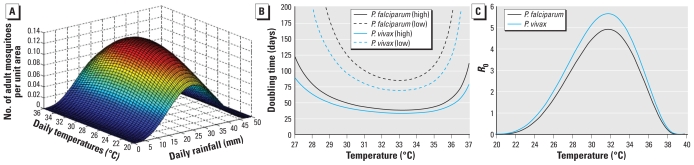
We found extinction to be more strongly dependent on rainfall than on temperature and identified a temperature window of around 32-33 degrees C where endemic transmission and the rate of spread in disease-free regions is optimized. This window was the same for Plasmodium falciparum and P. vivax, but mosquito density played a stronger role in driving the rate of malaria spread than did the Plasmodium species. The results improved our understanding of how temperature shifts affect the global distribution of at-risk regions, as well as how rapidly malaria outbreaks take off within vulnerable populations.
Disease emergence, extinction, and transmission all depend strongly on climate. Mathematical models offer powerful tools for understanding geographic shifts in incidence as climate changes. Nonlinear dependences of transmission on climate necessitates consideration of both changing climate trends and variability across time scales of interest.
近年来,气候变化对人类健康的影响引起了相当大的关注;由于疟疾的疾病负担及其对环境条件的传播敏感性,其对疟疾的影响尤其受到关注。
我们研究并说明了动态过程为基础的数学模型在提供气候变化对疟疾传播影响的战略见解方面可以发挥的作用。
我们评估了一个相对简单的模型,该模型对降雨和温度对蚊子种群动态、疟疾入侵、持续存在和局部季节性灭绝的同时影响,以及季节性对传播的影响提供了有价值的新见解。我们说明了如何对大规模气候模拟和传染病系统进行建模和分析,以及如何将这些方法应用于预测坦桑尼亚疟疾基本繁殖数的变化。
我们发现灭绝更多地依赖于降雨量而不是温度,并确定了一个约 32-33 摄氏度的温度窗口,在这个窗口内,地方性传播和无病地区疾病传播的速度得到优化。这个窗口对恶性疟原虫和间日疟原虫都是相同的,但蚊子密度在驱动疟疾传播速度方面比疟原虫种类发挥了更强的作用。研究结果提高了我们对温度变化如何影响高危地区全球分布的理解,以及疟疾在脆弱人群中迅速爆发的速度。
疾病的出现、灭绝和传播都强烈依赖于气候。数学模型为了解气候变化时发病率的地理变化提供了有力的工具。由于传播对气候的非线性依赖,需要考虑气候变化趋势和时间尺度变化的可变性。