Institute of Geophysics and Meteorology, University of Cologne, Cologne, Germany.
Malar J. 2011 Feb 11;10:35. doi: 10.1186/1475-2875-10-35.
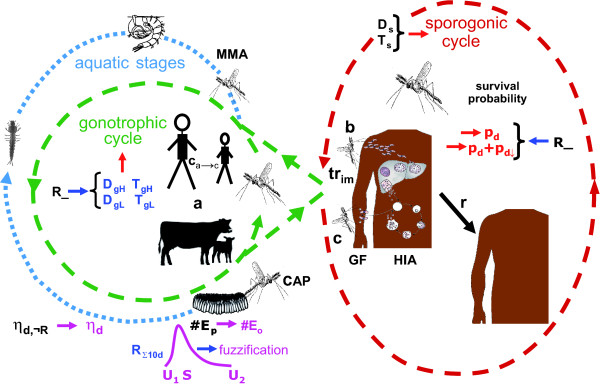
A warm and humid climate triggers several water-associated diseases such as malaria. Climate- or weather-driven malaria models, therefore, allow for a better understanding of malaria transmission dynamics. The Liverpool Malaria Model (LMM) is a mathematical-biological model of malaria parasite dynamics using daily temperature and precipitation data. In this study, the parameter settings of the LMM are refined and a new mathematical formulation of key processes related to the growth and size of the vector population are developed.
One of the most comprehensive studies to date in terms of gathering entomological and parasitological information from the literature was undertaken for the development of a new version of an existing malaria model. The knowledge was needed to allow the justification of new settings of various model parameters and motivated changes of the mathematical formulation of the LMM.
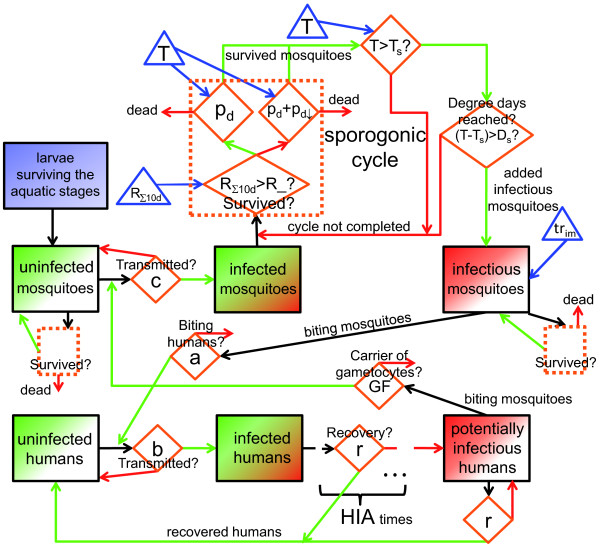
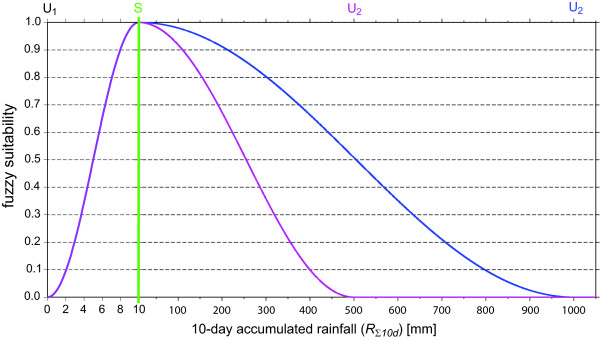
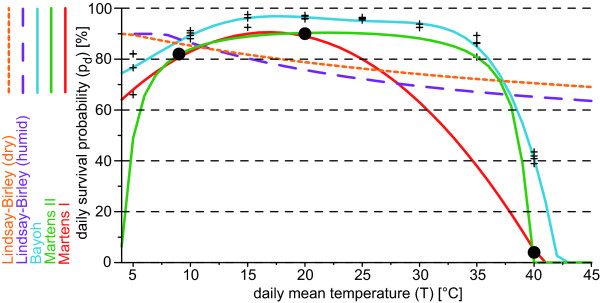
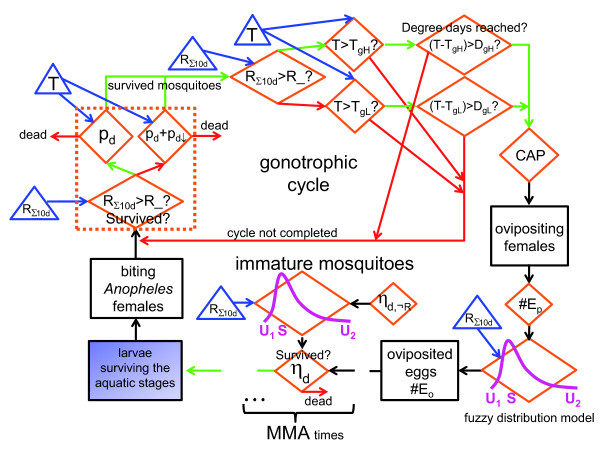
The first part of the present study developed an improved set of parameter settings and mathematical formulation of the LMM. Important modules of the original LMM version were enhanced in order to achieve a higher biological and physical accuracy. The oviposition as well as the survival of immature mosquitoes were adjusted to field conditions via the application of a fuzzy distribution model. Key model parameters, including the mature age of mosquitoes, the survival probability of adult mosquitoes, the human blood index, the mosquito-to-human (human-to-mosquito) transmission efficiency, the human infectious age, the recovery rate, as well as the gametocyte prevalence, were reassessed by means of entomological and parasitological observations. This paper also revealed that various malaria variables lack information from field studies to be set properly in a malaria modelling approach.
Due to the multitude of model parameters and the uncertainty involved in the setting of parameters, an extensive literature survey was carried out, in order to produce a refined set of settings of various model parameters. This approach limits the degrees of freedom of the parameter space of the model, simplifying the final calibration of undetermined parameters (see the second part of this study). In addition, new mathematical formulations of important processes have improved the model in terms of the growth of the vector population.
温暖潮湿的气候会引发多种与水有关的疾病,例如疟疾。因此,气候或天气驱动的疟疾模型可以更好地了解疟疾传播动态。利物浦疟疾模型(LMM)是一种疟疾寄生虫动态的数学-生物学模型,使用每日温度和降水数据。在这项研究中,对 LMM 的参数设置进行了细化,并开发了一种与媒介种群生长和大小相关的关键过程的新数学公式。
为了开发现有疟疾模型的新版本,进行了迄今为止最全面的收集文献中的昆虫学和寄生虫学信息的研究之一。这项研究需要了解新的模型参数设置的合理性,并促使对 LMM 的数学公式进行更改。
本研究的第一部分开发了一种改进的 LMM 参数设置和数学公式。对原始 LMM 版本的重要模块进行了增强,以提高生物学和物理准确性。通过应用模糊分布模型,对未成熟蚊子的产卵和生存进行了调整,以适应野外条件。关键模型参数,包括蚊子的成熟年龄、成蚊的存活率、人类血液指数、蚊到人(人到蚊)传播效率、人类感染年龄、恢复率以及配子体流行率,都通过昆虫学和寄生虫学观察进行了重新评估。本文还表明,各种疟疾变量缺乏适当设置疟疾模型所需的现场研究信息。
由于模型参数众多且参数设置存在不确定性,因此进行了广泛的文献调查,以产生各种模型参数的细化设置。这种方法限制了模型参数空间的自由度,简化了未确定参数的最终校准(见本研究的第二部分)。此外,重要过程的新数学公式提高了模型对媒介种群增长的模拟能力。