Center for Cognitive and Neural Studies, Romanian Institute of Science and Technology, Cluj-Napoca, Romania.
PLoS One. 2012;7(8):e40233. doi: 10.1371/journal.pone.0040233. Epub 2012 Aug 6.
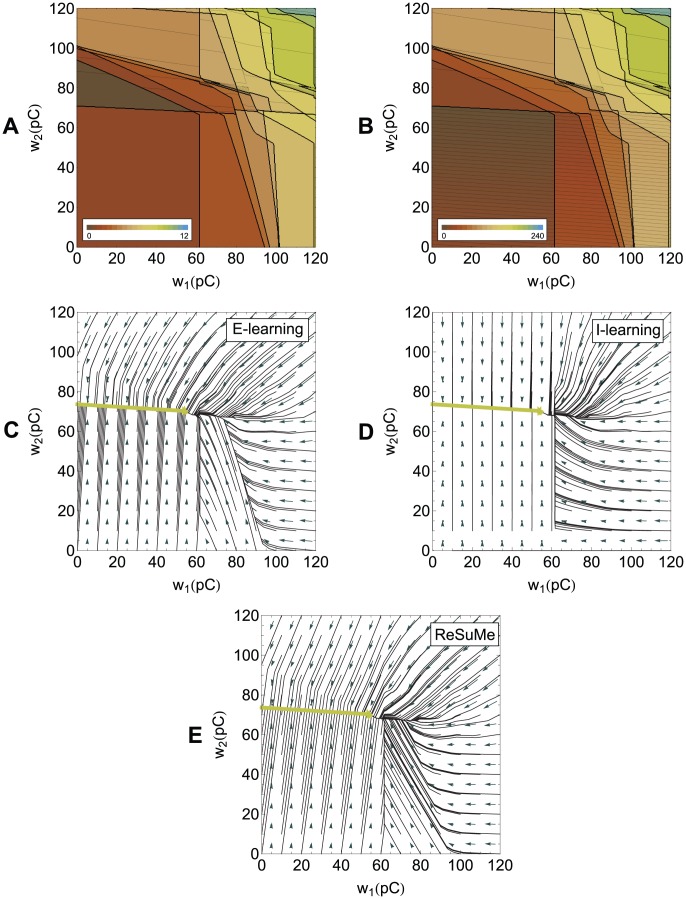
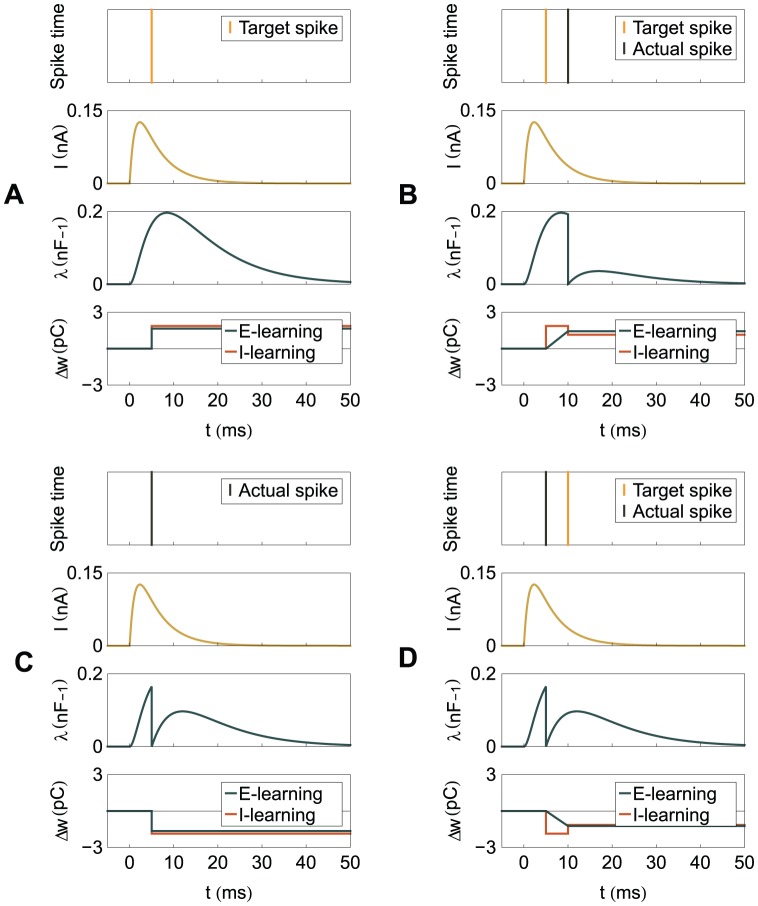
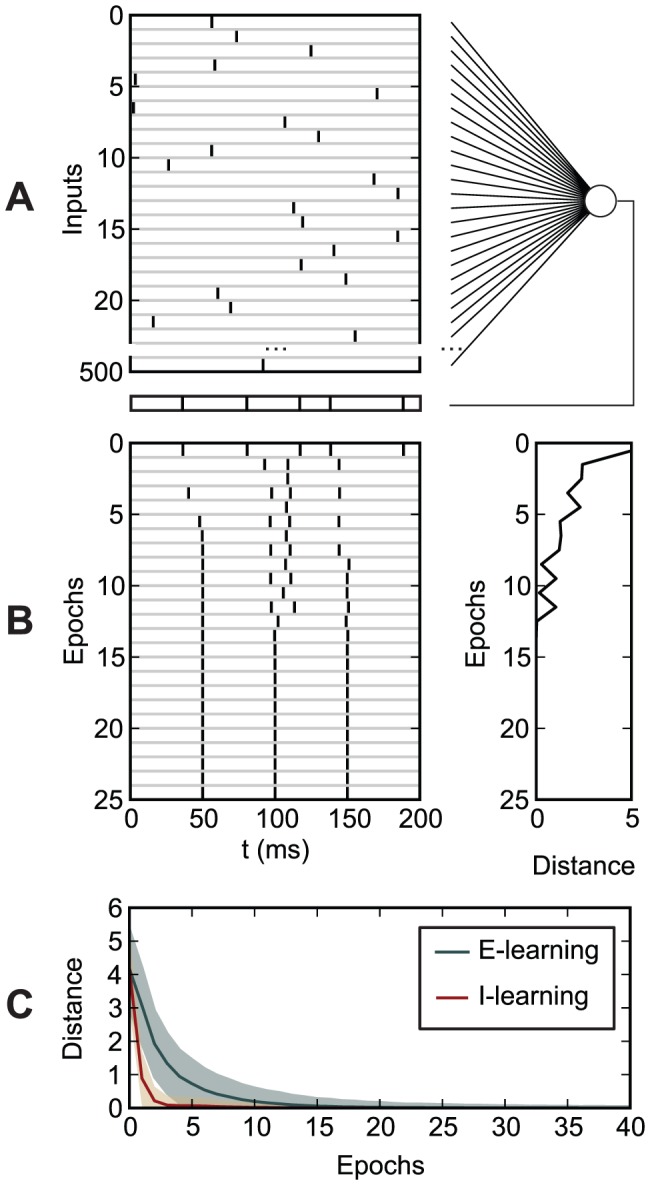
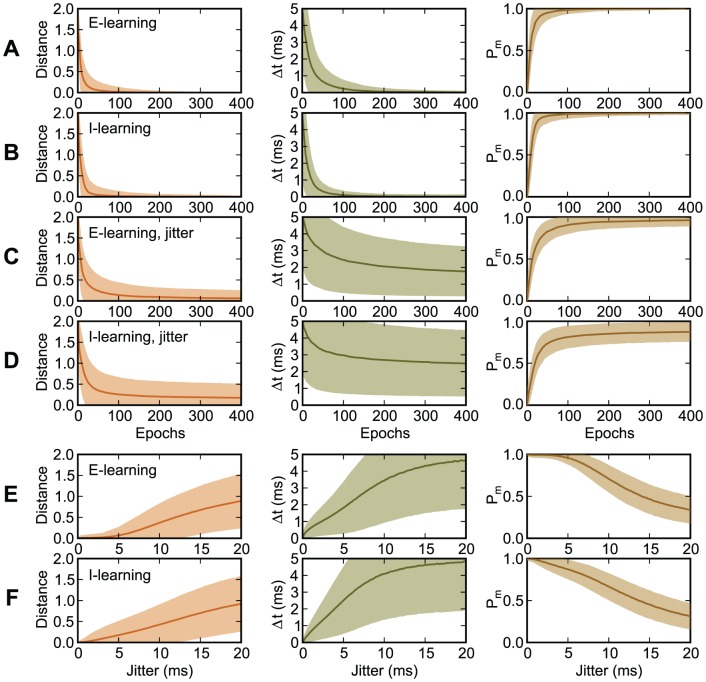
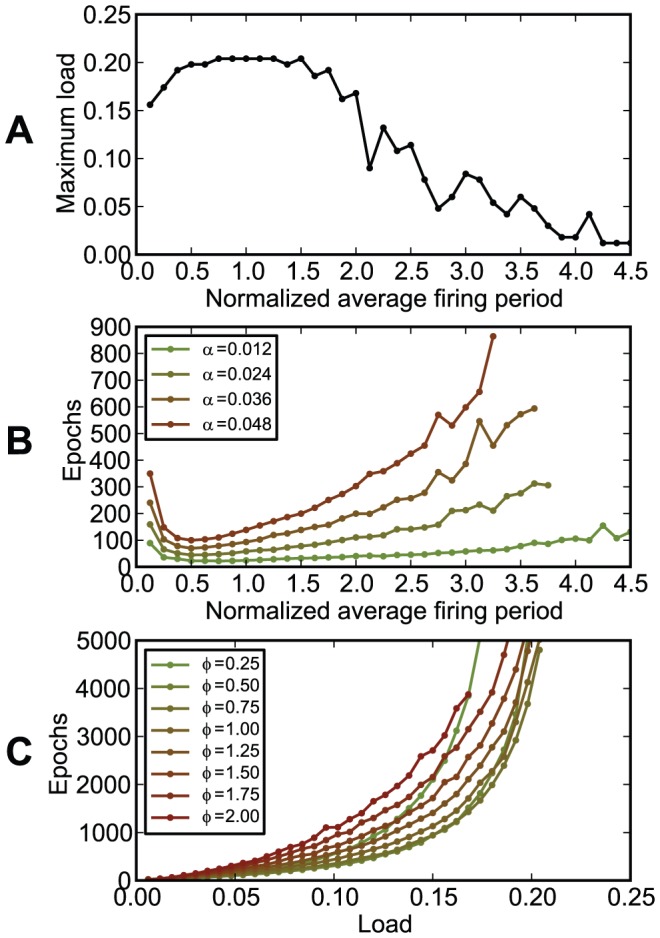
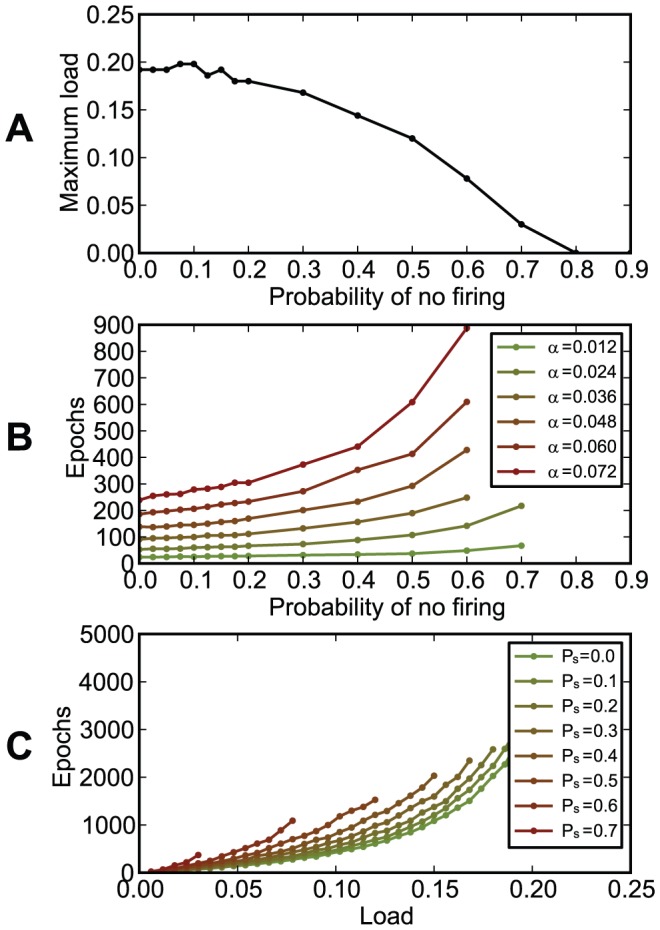
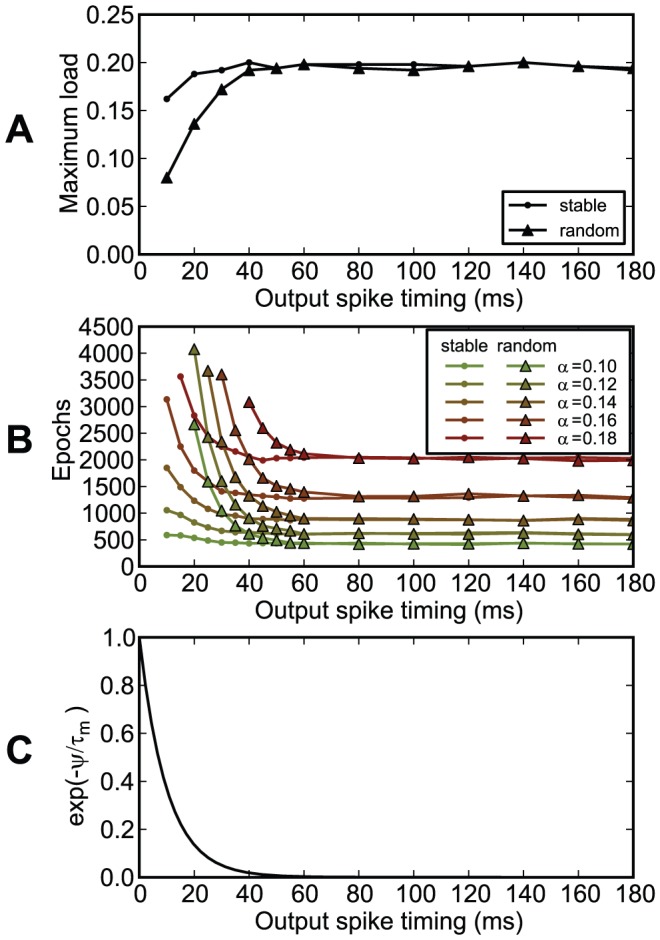
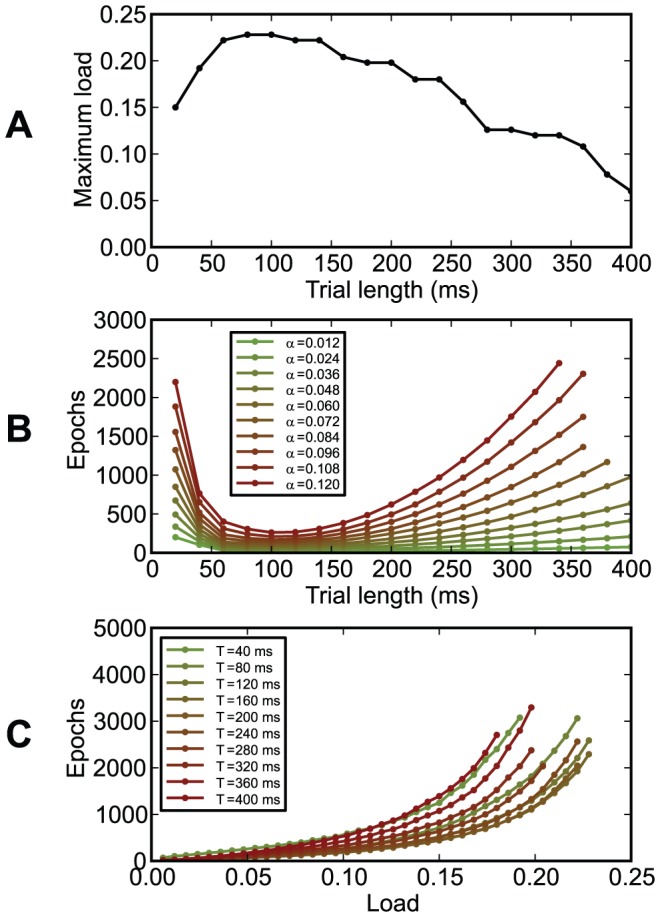
In many cases, neurons process information carried by the precise timings of spikes. Here we show how neurons can learn to generate specific temporally precise output spikes in response to input patterns of spikes having precise timings, thus processing and memorizing information that is entirely temporally coded, both as input and as output. We introduce two new supervised learning rules for spiking neurons with temporal coding of information (chronotrons), one that provides high memory capacity (E-learning), and one that has a higher biological plausibility (I-learning). With I-learning, the neuron learns to fire the target spike trains through synaptic changes that are proportional to the synaptic currents at the timings of real and target output spikes. We study these learning rules in computer simulations where we train integrate-and-fire neurons. Both learning rules allow neurons to fire at the desired timings, with sub-millisecond precision. We show how chronotrons can learn to classify their inputs, by firing identical, temporally precise spike trains for different inputs belonging to the same class. When the input is noisy, the classification also leads to noise reduction. We compute lower bounds for the memory capacity of chronotrons and explore the influence of various parameters on chronotrons' performance. The chronotrons can model neurons that encode information in the time of the first spike relative to the onset of salient stimuli or neurons in oscillatory networks that encode information in the phases of spikes relative to the background oscillation. Our results show that firing one spike per cycle optimizes memory capacity in neurons encoding information in the phase of firing relative to a background rhythm.
在许多情况下,神经元通过尖峰的精确时间来处理信息。在这里,我们展示了神经元如何学会针对具有精确时间的尖峰输入模式生成特定的时间精确输出尖峰,从而处理和记忆完全时间编码的信息,无论是作为输入还是输出。我们为具有时间编码信息的尖峰神经元(chronotrons)引入了两种新的监督学习规则,一种提供高存储容量(E-learning),另一种具有更高的生物学合理性(I-learning)。通过 I-learning,神经元通过与实际和目标输出尖峰时间的突触电流成比例的突触变化来学习发射目标尖峰序列。我们在计算机模拟中研究这些学习规则,在模拟中我们训练积分-触发神经元。这两种学习规则都允许神经元以亚毫秒级的精度在期望的时间点火。我们展示了 chronotrons 如何通过发射相同的、时间精确的尖峰序列来对属于同一类的不同输入进行分类。当输入存在噪声时,分类也会导致噪声减少。我们计算了 chronotrons 记忆容量的下限,并探索了各种参数对 chronotrons 性能的影响。chronotrons 可以模拟在显著刺激开始时相对于背景刺激编码信息的神经元,或者在相对于背景振荡相位编码信息的振荡网络中的神经元。我们的结果表明,在相对于背景节律发射一个尖峰的神经元中,每周期发射一个尖峰可以优化信息编码的记忆容量。