Laboratori di Ricerche Endocrino-Metaboliche e, Fondazione Istituto Di Ricovero e Cura a Carattere Scientifico Istituto Auxologico Italiano, Milan, Italy.
PLoS One. 2012;7(8):e42423. doi: 10.1371/journal.pone.0042423. Epub 2012 Aug 3.
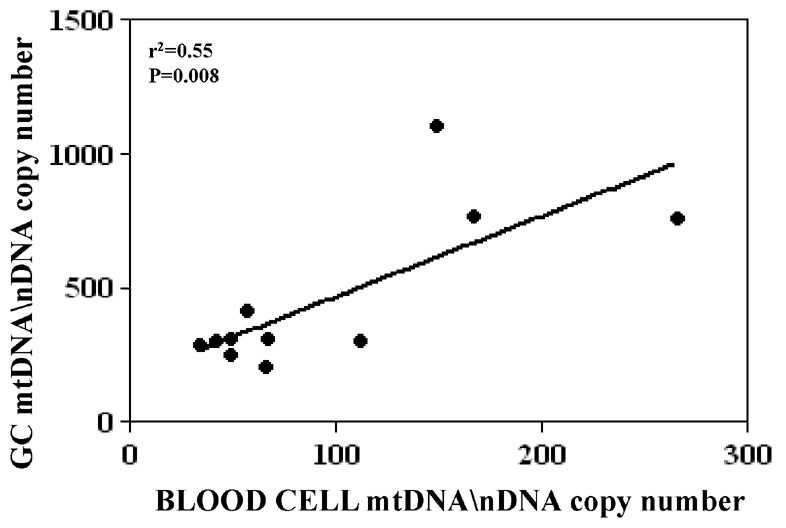
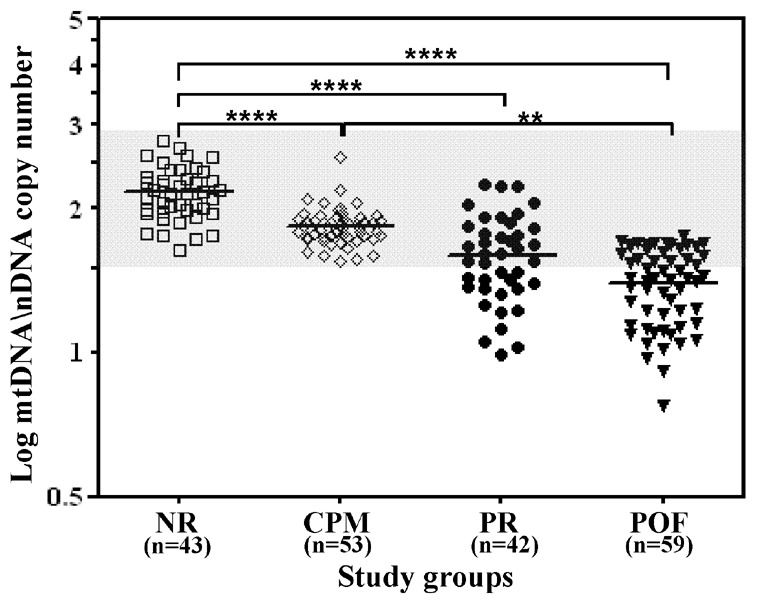
Primary ovarian insufficiency (POI) is a critical fertility defect characterized by an anticipated and silent impairment of the follicular reserve, but its pathogenesis is largely unexplained. The frequent maternal inheritance of POI together with a remarkable dependence of ovarian folliculogenesis upon mitochondrial biogenesis and bioenergetics suggested the possible involvement of a generalized mitochondrial defect. Here, we verified the existence of a significant correlation between blood and ovarian mitochondrial DNA (mtDNA) content in a group of women undergoing ovarian hyperstimulation (OH), and then aimed to verify whether mtDNA content was significantly altered in the blood cells of POI women. We recruited 101 women with an impaired ovarian reserve: 59 women with premature ovarian failure (POF) and 42 poor responders (PR) to OH. A Taqman copy number assay revealed a significant mtDNA depletion (P<0.001) in both POF and PR women in comparison with 43 women of similar age and intact ovarian reserve, or 53 very old women with a previous physiological menopause. No pathogenic variations in the mitochondrial DNA polymerase γ (POLG) gene were detected in 57 POF or PR women with low blood mtDNA content. In conclusion, blood cell mtDNA depletion is a frequent finding among women with premature ovarian aging, suggesting that a still undetermined but generalized mitochondrial defect may frequently predispose to POI which could then be considered a form of anticipated aging in which the ovarian defect may represent the first manifestation. The determination of mtDNA content in blood may become an useful tool for the POI risk prediction.
原发性卵巢功能不全 (POI) 是一种严重的生育缺陷,其特征是卵泡储备的预期和隐匿性损伤,但发病机制在很大程度上仍未得到解释。POI 频繁的母系遗传,以及卵巢卵泡发生对线粒体生物发生和生物能量学的显著依赖性,提示可能存在普遍的线粒体缺陷。在这里,我们在一组接受卵巢过度刺激 (OH) 的女性中验证了血液和卵巢线粒体 DNA (mtDNA) 含量之间存在显著相关性,然后旨在验证 POI 女性的血液细胞中 mtDNA 含量是否发生显著改变。我们招募了 101 名卵巢储备受损的女性:59 名患有卵巢早衰 (POF) 的女性和 42 名 OH 反应不良的女性。Taqman 拷贝数分析显示,与 43 名年龄相似且卵巢储备完整的女性或 53 名有先前生理性绝经的非常老的女性相比,POF 和 PR 女性的 mtDNA 明显耗竭 (P<0.001)。在 57 名血液 mtDNA 含量低的 POF 或 PR 女性中未发现线粒体 DNA 聚合酶 γ (POLG) 基因突变。总之,在有过早卵巢衰老的女性中,血细胞 mtDNA 耗竭是一种常见现象,这表明一种尚未确定但普遍存在的线粒体缺陷可能经常导致 POI,而 POI 可以被认为是一种预期衰老的形式,其中卵巢缺陷可能是第一个表现。血液中 mtDNA 含量的测定可能成为预测 POI 风险的有用工具。