Schotola Hanna, Toischer Karl, Popov Aron F, Renner André, Schmitto Jan D, Gummert Jan, Quintel Michael, Bauer Martin, Maier Lars S, Sossalla Samuel
Crit Care. 2012 Aug 13;16(4):R153. doi: 10.1186/cc11468.
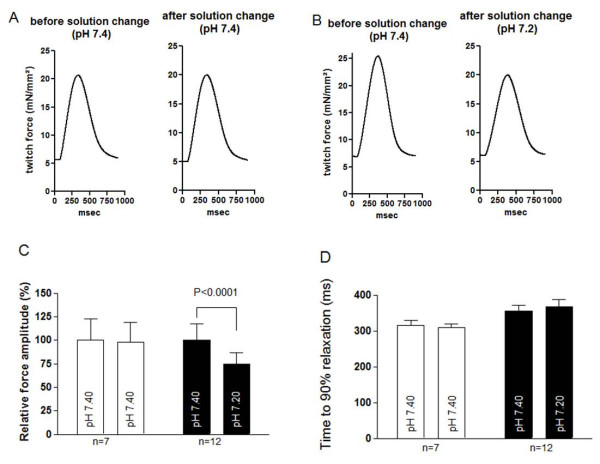
Pronounced extracellular acidosis reduces both cardiac contractility and the β-adrenergic response. In the past, this was shown in some studies using animal models. However, few data exist regarding how the human end-stage failing myocardium, in which compensatory mechanisms are exhausted, reacts to acute mild metabolic acidosis. The aim of this study was to investigate the effect of mild metabolic acidosis on contractility and the β-adrenergic response of isolated trabeculae from human end-stage failing hearts.
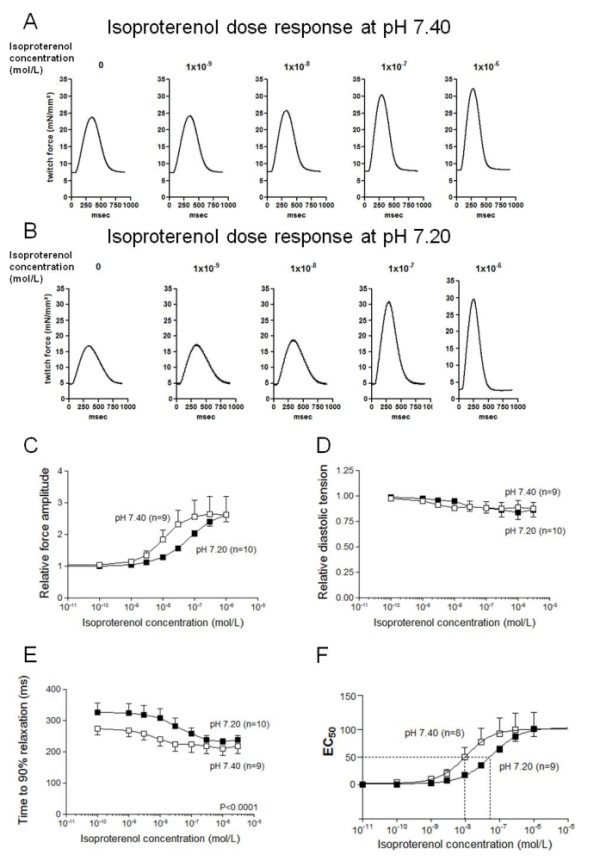
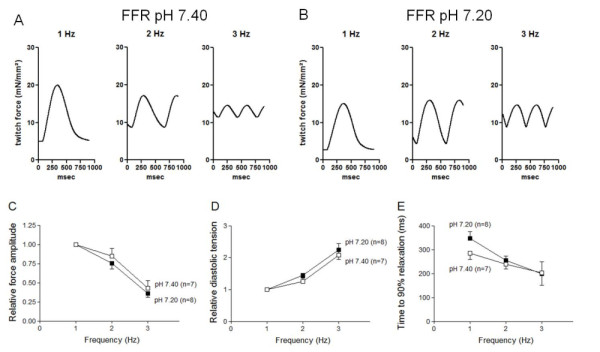
Intact isometrically twitching trabeculae isolated from patients with end-stage heart failure were exposed to mild metabolic acidosis (pH 7.20). Trabeculae were stimulated at increasing frequencies and finally exposed to increasing concentrations of isoproterenol (0 to 1 × 10(-6) M).
A mild metabolic acidosis caused a depression in twitch-force amplitude of 26% (12.1 ± 1.9 to 9.0 ± 1.5 mN/mm(2); n = 12; P < 0.01) as compared with pH 7.40. Force-frequency relation measurements yielded no further significant differences of twitch force. At the maximal isoproterenol concentration, the force amplitude was comparable in each of the two groups (pH 7.40 versus pH 7.20). However, the half-maximal effective concentration (EC50) was significantly increased in the acidosis group, with an EC50 of 5.834 × 10(-8) M (confidence interval (CI), 3.48 × 10(-8) to 9.779 × 10(-8); n = 9), compared with the control group, which had an EC50 of 1.056 × 10(-8) M (CI, 2.626 × 10(-9) to 4.243 × 10(-8); n = 10; P < 0.05), indicating an impaired β-adrenergic force response.
Our data show that mild metabolic acidosis reduces cardiac contractility and significantly impairs the β-adrenergic force response in human failing myocardium. Thus, our results could contribute to the still-controversial discussion about the therapy regimen of acidosis in patients with critical heart failure.
明显的细胞外酸中毒会降低心脏收缩力和β-肾上腺素能反应。过去,一些使用动物模型的研究已证实了这一点。然而,关于人类终末期衰竭心肌(其中代偿机制已耗尽)对急性轻度代谢性酸中毒的反应,相关数据较少。本研究的目的是探讨轻度代谢性酸中毒对人类终末期衰竭心脏分离出的小梁的收缩力和β-肾上腺素能反应的影响。
从终末期心力衰竭患者中分离出完整的等长收缩小梁,使其暴露于轻度代谢性酸中毒(pH 7.20)环境中。以递增频率刺激小梁,最后使其暴露于递增浓度的异丙肾上腺素(0至1×10⁻⁶ M)中。
与pH 7.40相比,轻度代谢性酸中毒导致抽搐力幅度降低26%(从12.1±1.9降至9.0±1.5 mN/mm²;n = 12;P < 0.01)。力-频率关系测量结果显示抽搐力无进一步显著差异。在最大异丙肾上腺素浓度下,两组(pH 7.40与pH 7.20)的力幅度相当。然而,酸中毒组的半数最大效应浓度(EC50)显著升高,为5.834×10⁻⁸ M(置信区间(CI),3.48×10⁻⁸至9.779×10⁻⁸;n = 9),而对照组的EC50为1.056×10⁻⁸ M(CI,2.626×10⁻⁹至4.243×10⁻⁸;n = 10;P < 0.05),表明β-肾上腺素能力反应受损。
我们的数据表明,轻度代谢性酸中毒会降低人类衰竭心肌的心脏收缩力,并显著损害β-肾上腺素能力反应。因此,我们的结果可能有助于解决关于重症心力衰竭患者酸中毒治疗方案的仍有争议的讨论。