Hubbard Kyle S, Gut Ian M, Scheeler Stephen M, Lyman Megan E, McNutt Patrick M
United States Army Medical Research Institute of Chemical Defense, 3100 Ricketts Point Rd, Aberdeen Proving Ground, MD 21010, USA.
BMC Res Notes. 2012 Aug 14;5:437. doi: 10.1186/1756-0500-5-437.
Simultaneous use of cell-permeant and impermeant fluorescent nuclear dyes is a common method to study cell viability and cell death progression. Although these assays are usually conducted as end-point studies, time-lapse imaging offers a powerful technique to distinguish temporal changes in cell viability at single-cell resolution. SYTO 13 and Hoechst 33342 are two commonly used cell-permeant nuclear dyes; however their suitability for live imaging has not been well characterized. We compare end-point assays with time-lapse imaging studies over a 6 h period to evaluate the compatibility of these two dyes with longitudinal imaging, using both control neurons and an apoptotic neuron model.
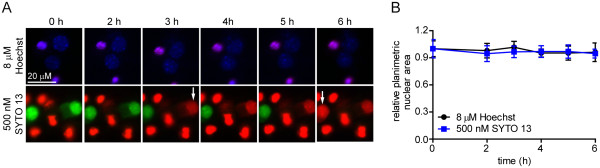
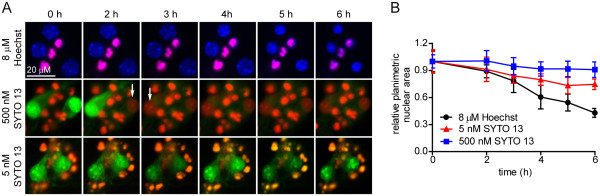
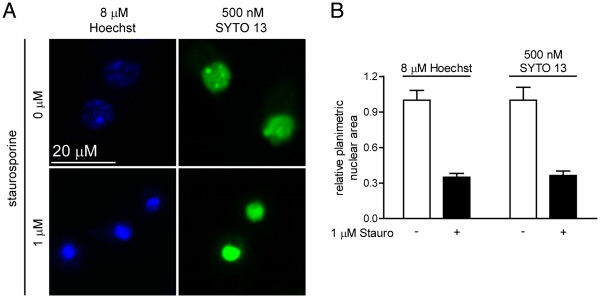
In longitudinal assays of untreated neurons, SYTO 13 addition caused acute necrosis within 3 h, whereas neurons imaged with Hoechst remained viable for at least 6 h. In a staurosporine-induced apoptotic model of neurotoxicity, determinations of the mode of cell death and measurements of nuclear size were identical between longitudinal studies using Hoechst and end-point assays. Alternatively, longitudinal studies using 500 nM or 5 nM SYTO 13 were not consistent with end-point assays.
SYTO 13 is acutely neurotoxic and when used in longitudinal studies, masked end-stage morphologic evidence of apoptotic cell death. In contrast, a single application of Hoechst evoked no evidence of toxicity over a 6 h period, and was consistent with end-point characterizations of cell viability and nuclear morphology. For longitudinal characterization of acute cell death, Hoechst is a superior option.
同时使用可穿透细胞膜和不可穿透细胞膜的荧光核染料是研究细胞活力和细胞死亡进程的常用方法。尽管这些检测通常作为终点研究进行,但延时成像提供了一种强大的技术,能够在单细胞分辨率下区分细胞活力的时间变化。SYTO 13和Hoechst 33342是两种常用的可穿透细胞膜的核染料;然而,它们对实时成像的适用性尚未得到充分表征。我们通过对照神经元和凋亡神经元模型,比较了终点检测和6小时内的延时成像研究,以评估这两种染料与纵向成像的兼容性。
在未经处理的神经元的纵向检测中,添加SYTO 13会在3小时内导致急性坏死,而用Hoechst成像的神经元至少能存活6小时。在星形孢菌素诱导的神经毒性凋亡模型中,使用Hoechst的纵向研究与终点检测在细胞死亡模式的确定和核大小的测量方面是一致的。相反,使用500 nM或5 nM SYTO 13的纵向研究与终点检测不一致。
SYTO 13具有急性神经毒性,在纵向研究中使用时,会掩盖凋亡细胞死亡的末期形态学证据。相比之下,单次应用Hoechst在6小时内未显示出毒性证据,并且与细胞活力和核形态的终点特征一致。对于急性细胞死亡的纵向表征,Hoechst是一个更好的选择。