Howard Hughes Medical Institute, Department of Internal Medicine, Center for Autophagy Research, University of Texas Southwestern Medical Center, Dallas, TX, USA.
Autophagy. 2012 Oct;8(10):1548-51. doi: 10.4161/auto.21327. Epub 2012 Aug 15.
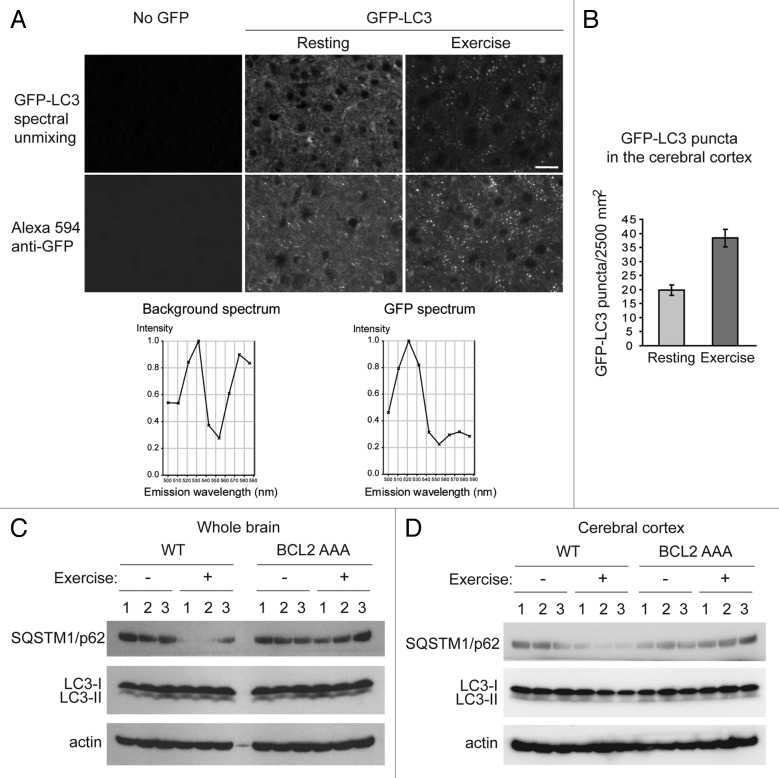
We recently identified physical exercise as a newly defined inducer of autophagy in vivo. Exercise induced autophagy in multiple organs involved in metabolic regulation, such as muscle, liver, pancreas and adipose tissue. To study the physiological role of exercise-induced autophagy, we generated mice with a knock-in nonphosphorylatable mutation in BCL2 (Thr69Ala, Ser70Ala and Ser84Ala) (BCL2 AAA) that are defective in exercise- and starvation-induced autophagy but not in basal autophagy. We found that BCL2 AAA mice could not run on a treadmill as long as wild-type mice, and did not undergo exercise-mediated increases in skeletal glucose muscle uptake. Unlike wild-type mice, the BCL2 AAA mice failed to reverse high-fat diet-induced glucose intolerance after 8 weeks of exercise training, possibly due to defects in signaling pathways that regulate muscle glucose uptake and metabolism during exercise. Together, these findings suggested a hitherto unknown important role of autophagy in mediating exercise-induced metabolic benefits. In the present addendum, we show that treadmill exercise also induces autophagy in the cerebral cortex of adult mice. This observation raises the intriguing question of whether autophagy may in part mediate the beneficial effects of exercise in neurodegeneration, adult neurogenesis and improved cognitive function.
我们最近发现,体育锻炼是体内新定义的自噬诱导物。运动诱导了参与代谢调节的多个器官中的自噬,如肌肉、肝脏、胰腺和脂肪组织。为了研究运动诱导的自噬的生理作用,我们生成了 BCL2(Thr69Ala、Ser70Ala 和 Ser84Ala)(BCL2 AAA)敲入非磷酸化突变的小鼠,这些突变在运动和饥饿诱导的自噬中是有缺陷的,但在基础自噬中不是。我们发现,BCL2 AAA 小鼠不能像野生型小鼠那样在跑步机上跑那么久,也不能进行运动介导的骨骼肌葡萄糖摄取增加。与野生型小鼠不同,BCL2 AAA 小鼠在 8 周的运动训练后不能逆转高脂肪饮食引起的葡萄糖不耐受,可能是由于调节运动期间肌肉葡萄糖摄取和代谢的信号通路缺陷所致。总之,这些发现表明自噬在介导运动引起的代谢益处方面起着迄今为止未知的重要作用。在本增刊中,我们还表明,跑步机运动也会诱导成年小鼠大脑皮层中的自噬。这一观察结果提出了一个有趣的问题,即自噬是否部分介导了运动对神经退行性变、成年神经发生和认知功能改善的有益作用。