Nick Simons Institute, Box 8975, EPC 1813, Kathmandu, Nepal.
BMJ. 2012 Aug 13;345:e4826. doi: 10.1136/bmj.e4826.
To determine, in one low income country (Nepal), which characteristics of medical students are associated with graduate doctors staying to practise in the country or in its rural areas.
Observational cohort study.
Medical college registry, with internet, phone, and personal follow-up of graduates.
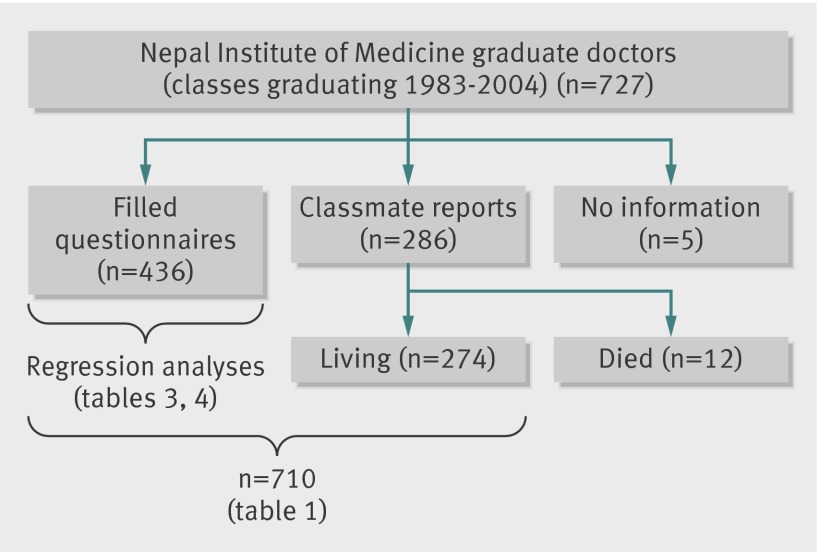
710 graduate doctors from the first 22 classes (1983-2004) of Nepal's first medical college, the Institute of Medicine.
Career practice location (foreign or in Nepal; in or outside of the capital city Kathmandu) compared with certain pre-graduation characteristics of medical student.
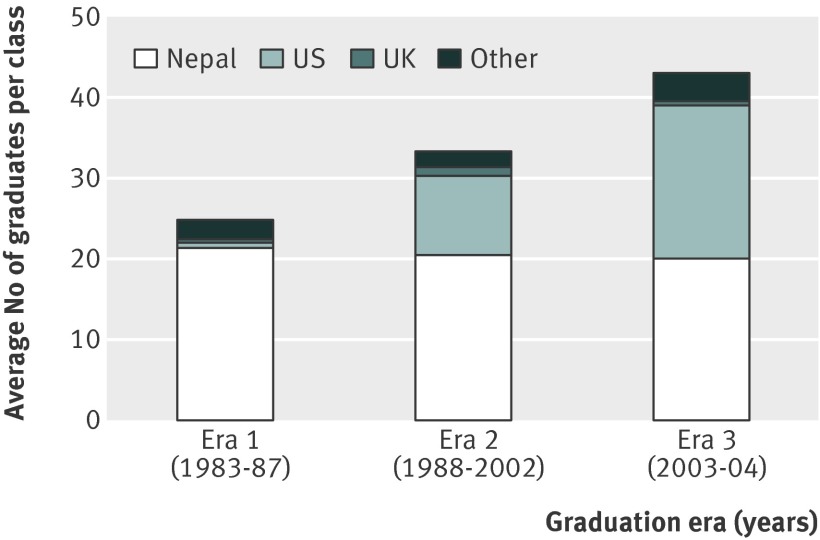
710 (97.7%) of the 727 graduates were located: 193 (27.2%) were working in Nepal in districts outside the capital city Kathmandu, 261 (36.8%) were working in Kathmandu, and 256 (36.1%) were working in foreign countries. Of 256 working abroad, 188 (73%) were in the United States. Students from later graduating classes were more likely to be working in foreign countries. Those with pre-medical education as paramedics were twice as likely to be working in Nepal and 3.5 times as likely to be in rural Nepal, compared with students with a college science background. Students who were academically in the lower third of their medical school class were twice as likely to be working in rural Nepal as those from the upper third. In a regression analysis adjusting for all variables, paramedical background (odds ratio 4.4, 95% confidence interval 1.7 to 11.6) was independently associated with a doctor remaining in Nepal. Rural birthplace (odds ratio 3.8, 1.3 to 11.5) and older age at matriculation (1.1, 1.0 to 1.2) were each independently associated with a doctor working in rural Nepal.
A cluster of medical students' characteristics, including paramedical background, rural birthplace, and lower academic rank, was associated with a doctor remaining in Nepal and with working outside the capital city of Kathmandu. Policy makers in medical education who are committed to producing doctors for underserved areas of their country could use this evidence to revise their entrance criteria for medical school.
在一个低收入国家(尼泊尔)确定医学生的哪些特征与毕业后留在国内或农村地区行医的医生有关。
观察性队列研究。
医学院注册处,通过互联网、电话和对毕业生的个人随访。
尼泊尔第一所医学院,即医学研究所的前 22 个班级(1983-2004 年)的 710 名毕业医生。
职业实践地点(国外或尼泊尔;首都加德满都内外)与医学生某些毕业前特征的比较。
727 名毕业生中,有 710 名(97.7%)确定了工作地点:193 名(27.2%)在加德满都以外的尼泊尔地区工作,261 名(36.8%)在加德满都工作,256 名(36.1%)在国外工作。在 256 名在国外工作的人中,有 188 名(73%)在美国。毕业班级较晚的学生更有可能在国外工作。具有辅助医疗教育背景的学生在尼泊尔工作的可能性是具有大学科学背景的学生的两倍,在尼泊尔农村工作的可能性是具有大学科学背景的学生的 3.5 倍。在医学院成绩中下等的学生在尼泊尔农村工作的可能性是成绩上等学生的两倍。在调整所有变量的回归分析中,辅助医疗背景(优势比 4.4,95%置信区间 1.7 至 11.6)与医生留在尼泊尔有关。农村出生地(优势比 3.8,1.3 至 11.5)和入学年龄较大(1.1,1.0 至 1.2)各自与在尼泊尔农村工作的医生有关。
一群医学生的特征,包括辅助医疗背景、农村出生地和较低的学术地位,与医生留在尼泊尔以及在加德满都以外的首都工作有关。致力于为本国服务不足地区培养医生的医学教育政策制定者可以利用这一证据来修改其医学院入学标准。