Department of Cardiology, Hamad Medical Corporation (HMC), Doha, Qatar.
BMC Cardiovasc Disord. 2012 Aug 16;12:64. doi: 10.1186/1471-2261-12-64.
Stroke is a potential complication of acute coronary syndrome (ACS). The aim of this study was to identify the prevalence, risk factors predisposing to stroke, in-hospital and 1-year mortality among patients presenting with ACS in the Middle East.
For a period of 9 months in 2008 to 2009, 7,930 consecutive ACS patients were enrolled from 65 hospitals in 6 Middle East countries.
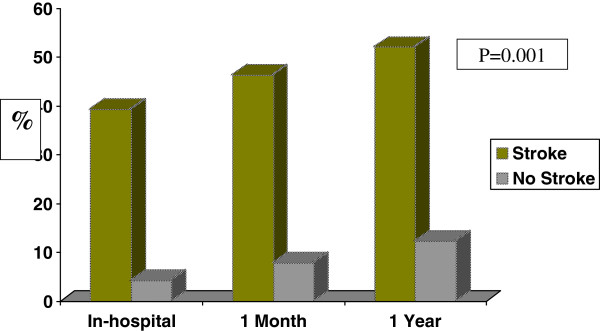
The prevalence of in-hospital stroke following ACS was 0.70%. Most cases were ST segment elevation MI-related (STEMI) and ischemic stroke in nature. Patients with in-hospital stroke were 5 years older than patients without stroke and were more likely to have hypertension (66% vs. 47.6%, P = 0.001). There were no differences between the two groups in regards to gender, other cardiovascular risk factors, or prior cardiovascular disease. Patients with stroke were more likely to present with atypical symptoms, advanced Killip class and less likely to be treated with evidence-based therapies. Independent predictors of stroke were hypertension, advanced killip class, ACS type -STEMI and cardiogenic shock. Stroke was associated with increased risk of in-hospital (39.3% vs. 4.3%) and one-year mortality (52% vs. 12.3%).
There is low incidence of in-hospital stroke in Middle-Eastern patients presenting with ACS but with very high in-hospital and one-year mortality rates. Stroke patients were less likely to be appropriately treated with evidence-based therapy. Future work should be focused on reducing the risk and improving the outcome of this devastating complication.
中风是急性冠状动脉综合征(ACS)的潜在并发症。本研究的目的是确定中东地区 ACS 患者中风的患病率、易患中风的危险因素、住院期间和 1 年死亡率。
在 2008 年至 2009 年的 9 个月期间,从中东 6 个国家的 65 家医院招募了 7930 名连续 ACS 患者。
ACS 后院内中风的患病率为 0.70%。大多数病例为 ST 段抬高型心肌梗死(STEMI)和缺血性中风。患有院内中风的患者比没有中风的患者年长 5 岁,且更有可能患有高血压(66%比 47.6%,P=0.001)。两组在性别、其他心血管危险因素或既往心血管疾病方面无差异。中风患者更有可能出现非典型症状、较高的 Killip 分级,且不太可能接受基于证据的治疗。中风的独立预测因素是高血压、较高的 Killip 分级、ACS 类型-STEMI 和心源性休克。中风与住院期间(39.3%比 4.3%)和 1 年死亡率(52%比 12.3%)的风险增加相关。
中东 ACS 患者院内中风的发病率较低,但院内和 1 年死亡率非常高。中风患者接受基于证据的治疗的可能性较小。未来的工作应集中于降低这种破坏性并发症的风险并改善其预后。