Department of Pharmacology, College of Medicine, Howard University, 520 W Street NW, Washington, DC 20059, USA.
Neurotox Res. 2013 Feb;23(2):131-44. doi: 10.1007/s12640-012-9348-1. Epub 2012 Aug 16.
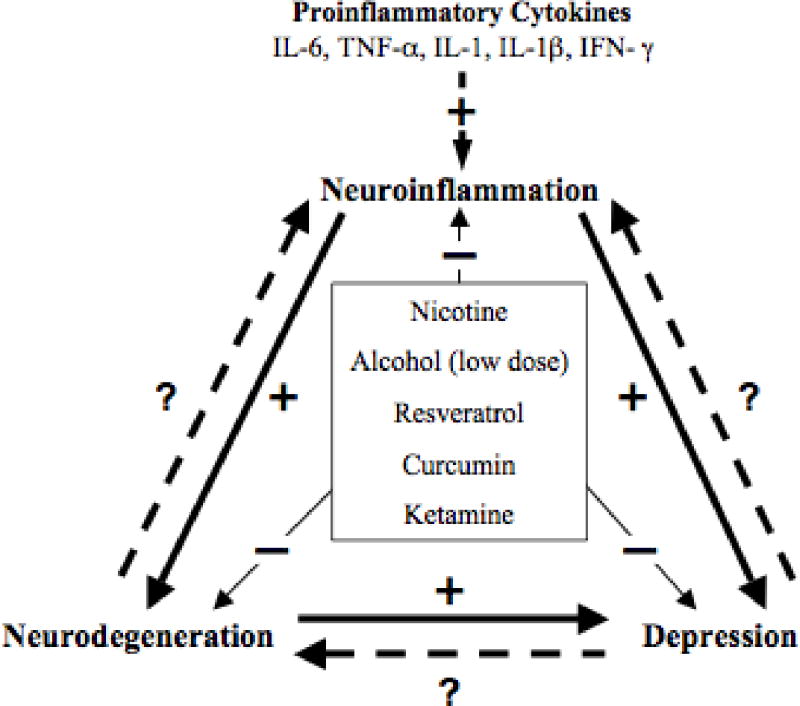
Neurodegeneration and depression are two common co-morbid conditions, particularly within the aging population. Research has linked neuroinflammation as a major contributing factor to both of these diseases. The key to neuroinflammation effects on neurodegeneration and depression appears to lie within the dysregulation of the control and release of pro- and anti-inflammatory cytokines. This can come from an internal or external insult to the system, or from changes in the individual due to aging that culminate in immune dysregulation. The need to reduce neuroinflammation has led to extensive research into neuroprotectants. We discuss the efficacy found with nicotine, alcohol, resveratrol, curcumin, and ketamine. Our main focus will be on what research tells us about the connections between neuroinflammation, neurodegeneration, and depression, and the hope that neuroprotectants research gives people suffering from neurodegeneration and depression stemming from neuroinflammation. We will conclude by making suggestions for future research in this area.
神经退行性变和抑郁症是两种常见的共病情况,尤其是在老年人群中。研究表明,神经炎症是这两种疾病的一个主要致病因素。神经炎症对神经退行性变和抑郁症的影响的关键似乎在于控制和释放促炎和抗炎细胞因子的失调。这种失调可能来自于系统内部或外部的损伤,也可能是由于个体衰老导致免疫失调而发生的变化。需要减轻神经炎症,这导致了对神经保护剂的广泛研究。我们讨论了尼古丁、酒精、白藜芦醇、姜黄素和氯胺酮的疗效。我们的主要重点将是研究告诉我们关于神经炎症、神经退行性变和抑郁症之间的联系,以及神经保护剂研究给那些因神经炎症而患有神经退行性变和抑郁症的人带来的希望。最后,我们将对该领域的未来研究提出建议。