School of Medicine, Division of Medical Oncology, University of Colorado Denver, Anschutz Medical Campus, Aurora, Colorado, United States.
J Proteome Res. 2012 Oct 5;11(10):4894-905. doi: 10.1021/pr3003744. Epub 2012 Aug 30.
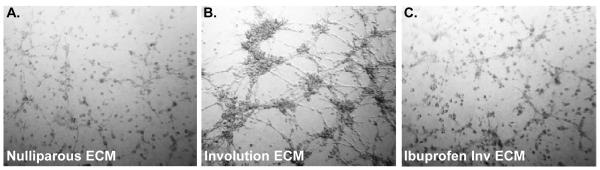
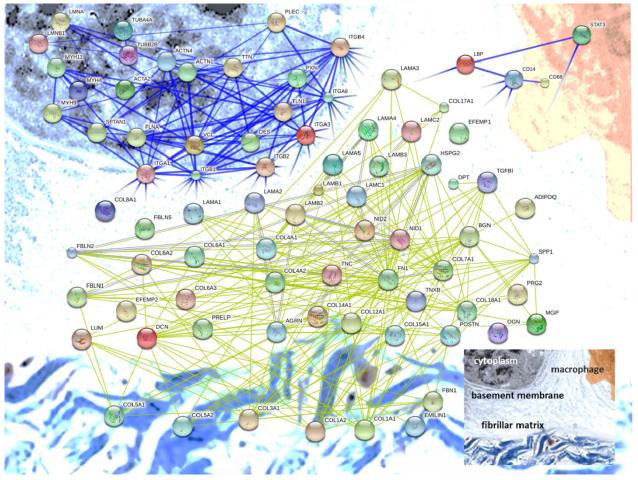
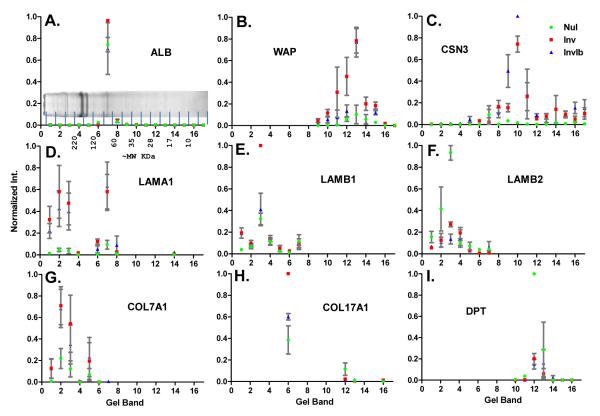
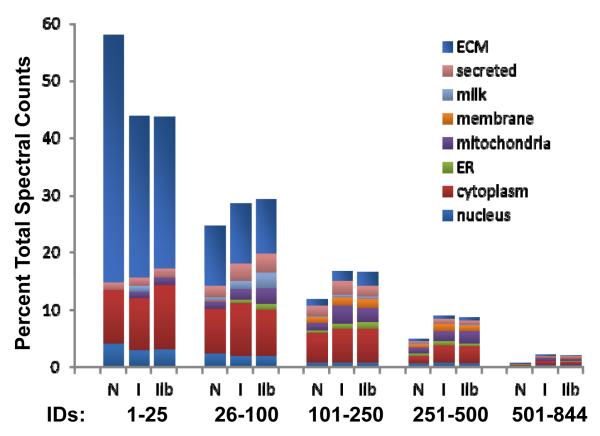
Breast cancer patients diagnosed within five years following pregnancy have increased metastasis and decreased survival. A hallmark of postpartum biology that may contribute to this poor prognosis is mammary gland involution, involving massive epithelial cell death and dramatic stromal remodeling. Previous studies show pro-tumorigenic properties of extracellular matrix (ECM) isolated from rodent mammary glands undergoing postpartum involution. More recent work demonstrates systemic ibuprofen treatment during involution decreases its tumor-promotional nature. Utilizing a proteomics approach, we identified relative differences in the composition of mammary ECM isolated from nulliparous rats and those undergoing postpartum involution, with and without ibuprofen treatment. GeLC-MS/MS experiments resulted in 20327 peptide identifications that mapped to 884 proteins with a <0.02% false discovery rate. Label-free quantification yielded several ECM differences between nulliparous and involuting glands related to collagen-fiber organization, cell motility and attachment, and cytokine regulation. Increases in known pro-tumorigenic ECM proteins osteopontin, tenascin-C, and laminin-α1 and pro-inflammatory proteins STAT3 and CD68 further identify candidate mediators of breast cancer progression specific to the involution window. With postpartum ibuprofen treatment, decreases in tenascin-C and three laminin chains were revealed. Our data suggest novel ECM mediators of breast cancer progression and demonstrate a protective influence of ibuprofen on mammary ECM composition.
产后五年内被诊断患有乳腺癌的患者转移和存活率降低。产后生物学的一个标志特征可能导致这种不良预后,即乳腺退化,涉及大量上皮细胞死亡和显著的基质重塑。先前的研究表明,从经历产后退化的啮齿动物乳腺中分离出的细胞外基质 (ECM) 具有促肿瘤特性。最近的研究表明,在退化过程中系统使用布洛芬治疗可降低其促肿瘤性质。利用蛋白质组学方法,我们鉴定了从未产大鼠和经历产后退化的大鼠乳腺中分离出的乳腺 ECM 的组成相对差异,以及有无布洛芬治疗。GeLC-MS/MS 实验产生了 20327 个肽鉴定,这些肽映射到 884 个蛋白,假发现率<0.02%。无标记定量产生了几个与胶原纤维组织、细胞迁移和附着以及细胞因子调节有关的 ECM 差异。骨桥蛋白、腱糖蛋白-C 和层粘连蛋白-α1 等已知的促肿瘤 ECM 蛋白以及 STAT3 和 CD68 等促炎蛋白的增加进一步确定了与退化窗口相关的乳腺癌进展的候选介质。产后布洛芬治疗后,发现腱糖蛋白-C 和三种层粘连蛋白链减少。我们的数据表明了乳腺癌进展的新的 ECM 介质,并证明了布洛芬对乳腺 ECM 组成的保护作用。