• 文献检索
  • 文档翻译
  • 深度研究
  • 学术资讯
  • Suppr Zotero 插件Zotero 插件
  • 邀请有礼
  • 套餐&价格
  • 历史记录
应用&插件
Suppr Zotero 插件Zotero 插件浏览器插件Mac 客户端Windows 客户端微信小程序
定价
高级版会员购买积分包购买API积分包
服务
文献检索文档翻译深度研究API 文档MCP 服务
关于我们
关于 Suppr公司介绍联系我们用户协议隐私条款
关注我们

Suppr 超能文献

核心技术专利:CN118964589B侵权必究
粤ICP备2023148730 号-1Suppr @ 2026

文献检索

告别复杂PubMed语法,用中文像聊天一样搜索,搜遍4000万医学文献。AI智能推荐,让科研检索更轻松。

立即免费搜索

文件翻译

保留排版,准确专业,支持PDF/Word/PPT等文件格式,支持 12+语言互译。

免费翻译文档

深度研究

AI帮你快速写综述,25分钟生成高质量综述,智能提取关键信息,辅助科研写作。

立即免费体验

未经训练的黑猩猩(Pan troglodytes schweinfurthii)无法模仿新动作。

Untrained chimpanzees (Pan troglodytes schweinfurthii) fail to imitate novel actions.

机构信息

Department of Developmental and Comparative Psychology, Max Planck Institute for Evolutionary Anthropology, Leipzig, Germany.

出版信息

PLoS One. 2012;7(8):e41548. doi: 10.1371/journal.pone.0041548. Epub 2012 Aug 8.

DOI:10.1371/journal.pone.0041548
PMID:22905102
原文链接:https://pmc.ncbi.nlm.nih.gov/articles/PMC3414512/
Abstract

BACKGROUND

Social learning research in apes has focused on social learning in the technical (problem solving) domain - an approach that confounds action and physical information. Successful subjects in such studies may have been able to perform target actions not as a result of imitation learning but because they had learnt some technical aspect, for example, copying the movements of an apparatus (i.e., different forms of emulation learning).

METHODS

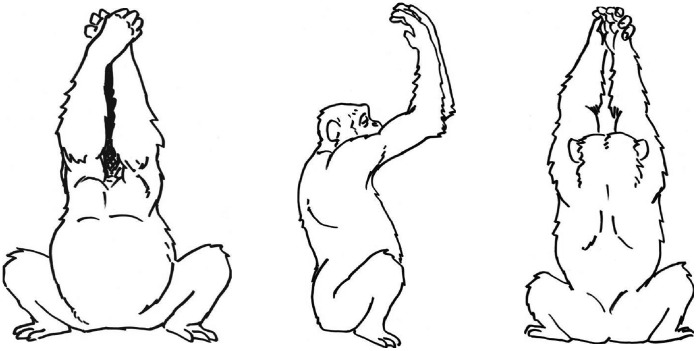
Here we present data on action copying by non-enculturated and untrained chimpanzees when physical information is removed from demonstrations. To date, only one such study (on gesture copying in a begging context) has been conducted--with negative results. Here we have improved this methodology and have also added non-begging test situations (a possible confound of the earlier study). Both familiar and novel actions were used as targets. Prior to testing, a trained conspecific demonstrator was rewarded for performing target actions in view of observers. All but one of the tested chimpanzees already failed to copy familiar actions. When retested with a novel target action, also the previously successful subject failed to copy--and he did so across several contexts.

CONCLUSION

Chimpanzees do not seem to copy novel actions, and only some ever copy familiar ones. Due to our having tested only non-enculturated and untrained chimpanzees, the performance of our test subjects speak more than most other studies of the general (dis-)ability of chimpanzees to copy actions, and especially novel actions.

摘要

背景

猿类的社会学习研究集中在技术(解决问题)领域的社会学习上——这种方法混淆了动作和物理信息。在这类研究中,成功的受试者可能不是通过模仿学习来完成目标动作,而是因为他们已经学习了某些技术方面的知识,例如,复制仪器的动作(即不同形式的仿真学习)。

方法

在这里,我们展示了非驯化和未经训练的黑猩猩在去除演示中的物理信息时的动作复制数据。到目前为止,只有一项这样的研究(关于乞讨情境中的手势复制)进行过——结果是否定的。在这里,我们改进了这种方法,还增加了非乞讨测试情境(可能是早期研究的一个混淆因素)。使用熟悉和新颖的动作作为目标。在测试之前,经过训练的同种示教者因在观察者面前执行目标动作而获得奖励。除了一只被测试的黑猩猩外,所有的黑猩猩都无法复制熟悉的动作。当用一个新的目标动作进行重新测试时,之前成功的受试者也无法复制——而且他在几个情境中都这样做了。

结论

黑猩猩似乎不会复制新的动作,而且只有一些会复制熟悉的动作。由于我们只测试了非驯化和未经训练的黑猩猩,因此我们的测试对象的表现比大多数其他关于黑猩猩复制动作的一般(不)能力的研究更能说明问题,尤其是对新颖动作的复制。
https://cdn.ncbi.nlm.nih.gov/pmc/blobs/182a/3414512/c3dbbebe00c9/pone.0041548.g004.jpg
https://cdn.ncbi.nlm.nih.gov/pmc/blobs/182a/3414512/79c5b61a3764/pone.0041548.g001.jpg
https://cdn.ncbi.nlm.nih.gov/pmc/blobs/182a/3414512/1f16e8d14145/pone.0041548.g002.jpg
https://cdn.ncbi.nlm.nih.gov/pmc/blobs/182a/3414512/7991d9134f71/pone.0041548.g003.jpg
https://cdn.ncbi.nlm.nih.gov/pmc/blobs/182a/3414512/c3dbbebe00c9/pone.0041548.g004.jpg
https://cdn.ncbi.nlm.nih.gov/pmc/blobs/182a/3414512/79c5b61a3764/pone.0041548.g001.jpg
https://cdn.ncbi.nlm.nih.gov/pmc/blobs/182a/3414512/1f16e8d14145/pone.0041548.g002.jpg
https://cdn.ncbi.nlm.nih.gov/pmc/blobs/182a/3414512/7991d9134f71/pone.0041548.g003.jpg
https://cdn.ncbi.nlm.nih.gov/pmc/blobs/182a/3414512/c3dbbebe00c9/pone.0041548.g004.jpg

相似文献

1
Untrained chimpanzees (Pan troglodytes schweinfurthii) fail to imitate novel actions.未经训练的黑猩猩(Pan troglodytes schweinfurthii)无法模仿新动作。
PLoS One. 2012;7(8):e41548. doi: 10.1371/journal.pone.0041548. Epub 2012 Aug 8.
2
Copying results and copying actions in the process of social learning: chimpanzees (Pan troglodytes) and human children (Homo sapiens).社会学习过程中的结果模仿与行为模仿:黑猩猩(黑猩猩属)和人类儿童(智人)
Anim Cogn. 2005 Jul;8(3):151-63. doi: 10.1007/s10071-004-0237-8. Epub 2004 Oct 15.
3
New evidence on imitation in an enculturated chimpanzee (Pan troglodytes).关于一只被驯化黑猩猩(黑猩猩属)模仿行为的新证据。
J Comp Psychol. 2009 Nov;123(4):385-90. doi: 10.1037/a0016275.
4
Causal knowledge and imitation/emulation switching in chimpanzees (Pan troglodytes) and children (Homo sapiens).黑猩猩(Pan troglodytes)和儿童(Homo sapiens)的因果知识与模仿/仿效转换
Anim Cogn. 2005 Jul;8(3):164-81. doi: 10.1007/s10071-004-0239-6. Epub 2004 Nov 11.
5
Imitative learning of actions on objects by children, chimpanzees, and enculturated chimpanzees.儿童、黑猩猩和驯化黑猩猩对物体进行动作的模仿学习。
Child Dev. 1993 Dec;64(6):1688-705.
6
Enculturated chimpanzees imitate rationally.适应了人类文化的黑猩猩会进行理性模仿。
Dev Sci. 2007 Jul;10(4):F31-8. doi: 10.1111/j.1467-7687.2007.00630.x.
7
Factors influencing imitation of manipulatory actions in chimpanzees (Pan troglodytes).影响黑猩猩(黑猩猩属)操纵行为模仿的因素。
J Comp Psychol. 1999 Jun;113(2):128-36. doi: 10.1037/0735-7036.113.2.128.
8
Emulation, imitation, over-imitation and the scope of culture for child and chimpanzee.儿童与黑猩猩的模仿、效仿、过度模仿及文化范畴
Philos Trans R Soc Lond B Biol Sci. 2009 Aug 27;364(1528):2417-28. doi: 10.1098/rstb.2009.0069.
9
Observational learning in chimpanzees and children studied through 'ghost' conditions.通过“幽灵”条件研究黑猩猩和儿童的观察性学习。
Proc Biol Sci. 2008 Apr 7;275(1636):835-40. doi: 10.1098/rspb.2007.1542.
10
The generalization of deferred imitation in enculturated chimpanzees (Pan troglodytes).圈养黑猩猩(Pan troglodytes)延迟模仿行为的普遍性。
Anim Cogn. 2002 Mar;5(1):49-58. doi: 10.1007/s10071-001-0124-5.

引用本文的文献

1
Third-party imitation is not restricted to humans.第三方模仿并不局限于人类。
Sci Rep. 2025 Sep 4;15(1):30580. doi: 10.1038/s41598-025-11665-9.
2
A computational approach to selective attention in embodied approaches to cognitive archaeology.具身认知考古学中选择性注意的计算方法。
J R Soc Interface. 2024 Oct;21(219):20240508. doi: 10.1098/rsif.2024.0508. Epub 2024 Oct 9.
3
The origin of great ape gestural forms.类人猿手势形式的起源。

本文引用的文献

1
Chimpanzees' socially maintained food preferences indicate both conservatism and conformity.黑猩猩通过社交维持的食物偏好既体现了保守性又体现了从众性。
Anim Behav. 2011 Jun 1;81(6):1195-1202. doi: 10.1016/j.anbehav.2011.03.002.
2
Can competitive paradigms increase the validity of experiments on primate social cognition?竞争范式能否提高灵长类动物社会认知实验的有效性?
Anim Cogn. 2001 Nov;4(3-4):269-80. doi: 10.1007/s100710100084. Epub 2001 Jun 2.
3
The question of animal culture.动物文化问题。
Biol Rev Camb Philos Soc. 2025 Feb;100(1):190-204. doi: 10.1111/brv.13136. Epub 2024 Aug 27.
4
Chimpanzees use social information to acquire a skill they fail to innovate.黑猩猩利用社会信息来获得一项他们无法创新的技能。
Nat Hum Behav. 2024 May;8(5):891-902. doi: 10.1038/s41562-024-01836-5. Epub 2024 Mar 6.
5
Naïve, adult, captive chimpanzees do not socially learn how to make and use sharp stone tools.天真的、成年的、圈养的黑猩猩不会通过社会学习来制作和使用锋利的石器。
Sci Rep. 2023 Dec 20;13(1):22733. doi: 10.1038/s41598-023-49780-0.
6
Cultural adaptation is maximised when intelligent individuals rarely think for themselves.当聪明的个体很少独立思考时,文化适应就会最大化。
Evol Hum Sci. 2020 Aug 10;2:e43. doi: 10.1017/ehs.2020.42. eCollection 2020.
7
Observational approaches to chimpanzee behavior in an African sanctuary: Implications for research, welfare, and capacity-building.非洲保护区内黑猩猩行为的观察方法:对研究、福利和能力建设的启示。
Am J Primatol. 2023 Sep;85(9):e23534. doi: 10.1002/ajp.23534. Epub 2023 Jul 17.
8
The method of exclusion (still) cannot identify specific mechanisms of cultural inheritance.排除法(仍然)无法确定文化传承的具体机制。
Sci Rep. 2022 Dec 15;12(1):21680. doi: 10.1038/s41598-022-25646-9.
9
Learning from communication versus observation in great apes.从类人猿的交流与观察中学习。
Sci Rep. 2022 Feb 21;12(1):2917. doi: 10.1038/s41598-022-07053-2.
10
Experimental investigation of orangutans' lithic percussive and sharp stone tool behaviours.猩猩石器敲击和锐石工具行为的实验研究。
PLoS One. 2022 Feb 16;17(2):e0263343. doi: 10.1371/journal.pone.0263343. eCollection 2022.
Hum Nat. 1992 Jun;3(2):157-78. doi: 10.1007/BF02692251.
4
Cultural intelligence is key to explaining human tool use.文化智能是解释人类工具使用的关键。
Behav Brain Sci. 2012 Aug;35(4):242-3. doi: 10.1017/S0140525X11001968. Epub 2012 Jun 15.
5
Identification of the social and cognitive processes underlying human cumulative culture.人类累积文化的社会和认知过程的识别。
Science. 2012 Mar 2;335(6072):1114-8. doi: 10.1126/science.1213969.
6
Community-specific evaluation of tool affordances in wild chimpanzees.野生黑猩猩工具使用能力的社区特异性评估。
Sci Rep. 2011;1:128. doi: 10.1038/srep00128. Epub 2011 Nov 3.
7
An evaluation of the efficacy of video displays for use with chimpanzees (Pan troglodytes).评估视频显示器在使用于黑猩猩(Pan troglodytes)方面的功效。
Am J Primatol. 2012 May;74(5):442-9. doi: 10.1002/ajp.22001. Epub 2012 Feb 8.
8
Putting the social into social learning: explaining both selectivity and fidelity in children's copying behavior.将社会性融入社会学习:解释儿童模仿行为中的选择性和忠实性。
J Comp Psychol. 2012 May;126(2):182-92. doi: 10.1037/a0024555. Epub 2011 Jul 18.
9
Comparing the performances of apes (Gorilla gorilla, Pan troglodytes, Pongo pygmaeus) and human children (Homo sapiens) in the floating peanut task.比较猿类(大猩猩、黑猩猩、猩猩)和人类儿童(智人)在漂浮花生任务中的表现。
PLoS One. 2011;6(6):e19555. doi: 10.1371/journal.pone.0019555. Epub 2011 Jun 8.
10
Modeling imitation and emulation in constrained search spaces.在受限搜索空间中对模仿和仿真进行建模。
Learn Behav. 2011 May;39(2):104-14. doi: 10.3758/s13420-010-0009-z.