School of Pharmacy, University of Southern California, Los Angeles, California, United States of America.
PLoS One. 2012;7(8):e42973. doi: 10.1371/journal.pone.0042973. Epub 2012 Aug 8.
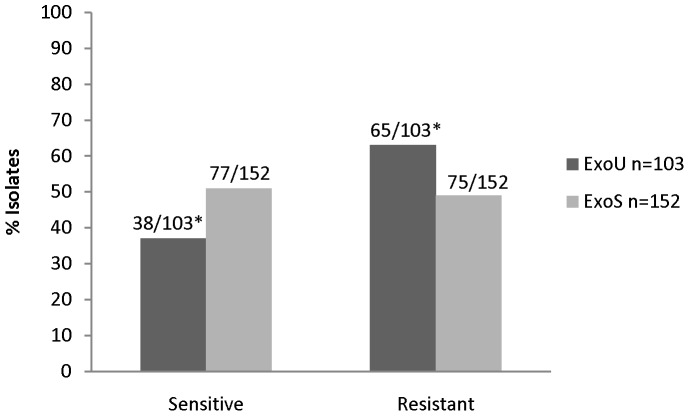
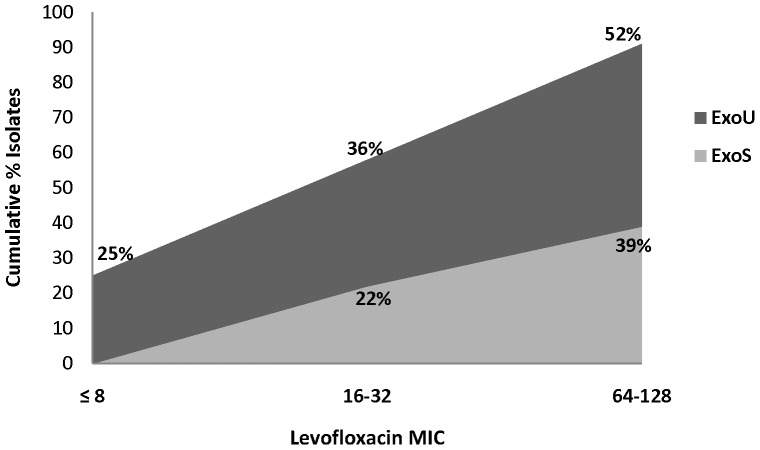
Pseudomonas aeruginosa is a leading pathogen that has become increasingly resistant to the fluoroquinolone antibiotics due to widespread prescribing. Adverse outcomes have been shown for patients infected with fluoroquinolone-resistant strains. The type III secretion system (TTSS) is a major virulence determinant during acute infections through the injection of effector toxins into host cells. Most strains exhibit a unique TTSS virulence genotype defined by the presence of either exoS or exoU gene encoding two of the effector toxins, ExoS and ExoU, respectively. Specific TTSS effector genotype has been shown previously to differentially impact virulence in pneumonia. In this study, we examined the relationship between TTSS effector genotype and fluoroquinolone resistance mechanisms in a collection of 270 respiratory isolates. We found that a higher proportion of exoU+ strains were fluoroquinolone-resistant compared to exoS+ strains (63% vs 49%, p = 0.03) despite its lower overall prevalence (38% exoU+ vs 56% exoS+). Results from sequencing the quinolone resistance determining regions (QRDRs) of the 4 target genes (gyrA, gyrB, parC, parE) indicated that strains containing the exoU gene were more likely to acquire ≥ 2 mutations than exoS+ strains at MICs ≤ 8 µg/ml (13% vs none) and twice as likely to have mutations in both gyrA and parC than exoS+ strains (48% vs 24% p = 0.0439). Our findings indicate that P. aeruginosa strains differentially develop resistance-conferring mutations that correlate with TTSS effector genotype and the more virulent exoU+ subpopulation. Differences in mutational processes by virulence genotype that were observed suggest co-evolution of resistance and virulence traits favoring a more virulent genotype in the quinolone-rich clinical environment.
铜绿假单胞菌是一种主要的病原体,由于广泛的处方,它对氟喹诺酮类抗生素的耐药性日益增强。感染氟喹诺酮类耐药菌株的患者出现了不良后果。III 型分泌系统(TTSS)是急性感染期间将效应毒素注入宿主细胞的主要毒力决定因素。大多数菌株表现出独特的 TTSS 毒力基因型,其特征是存在编码两种效应毒素 ExoS 和 ExoU 的 exoS 或 exoU 基因。以前已经表明,特定的 TTSS 效应基因型在肺炎中的毒力有差异。在这项研究中,我们研究了 270 株呼吸道分离株中 TTSS 效应基因型与氟喹诺酮耐药机制之间的关系。我们发现,与 exoS+菌株相比,更高比例的 exoU+菌株对氟喹诺酮耐药(63%比 49%,p=0.03),尽管其总体流行率较低(38% exoU+比 56% exoS+)。对 4 个靶基因(gyrA、gyrB、parC、parE)的喹诺酮耐药决定区(QRDR)进行测序的结果表明,在 MICs≤8µg/ml 时,携带 exoU 基因的菌株比 exoS+菌株更有可能获得≥2 个突变(13%比无),并且在 gyrA 和 parC 中都有突变的可能性是 exoS+菌株的两倍(48%比 24%,p=0.0439)。我们的研究结果表明,铜绿假单胞菌菌株不同地发展出与 TTSS 效应基因型相关的耐药性赋予突变,并且具有更毒力的 exoU+亚群。观察到的毒力基因型的突变过程差异表明,在喹诺酮丰富的临床环境中,耐药性和毒力特征的共同进化有利于更毒力的基因型。