Department of Psychology, University of Pennsylvania, Philadelphia, PA 19104, USA.
J Exp Psychol Learn Mem Cogn. 2013 May;39(3):773-81. doi: 10.1037/a0029684. Epub 2012 Aug 20.
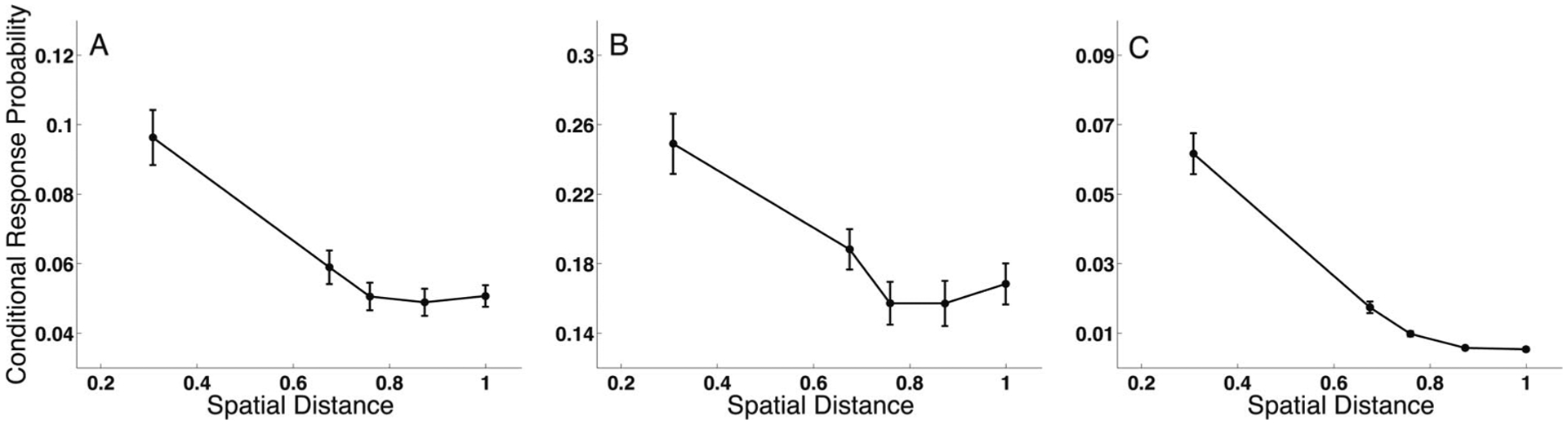
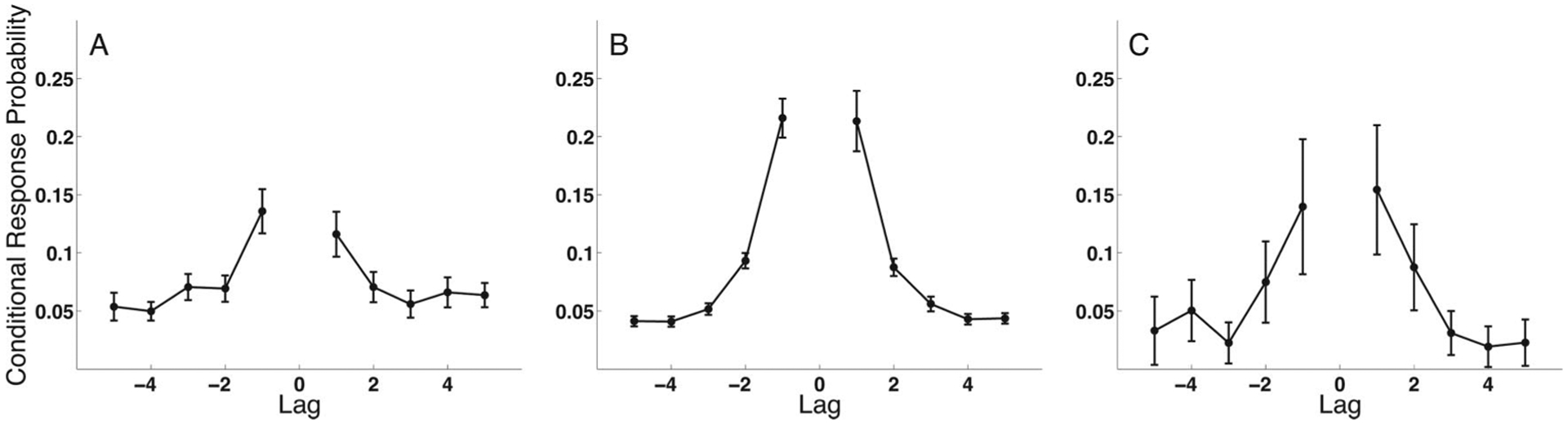
In recalling a list of previously experienced items, participants are known to organize their responses on the basis of the items' semantic and temporal similarities. Here, we examine how spatial information influences the organization of responses in free recall. In Experiment 1, participants studied and subsequently recalled lists of landmarks. In Experiment 2, participants played a game in which they delivered objects to landmarks in a virtual environment and later recalled the delivered objects. Participants in both experiments were simply asked to recall as many items as they could remember in any order. By analyzing the conditional probabilities of recall transitions, we demonstrate strong spatial and temporal organization of studied items in both experiments.
在回忆一系列之前经历过的项目时,人们已知会根据项目的语义和时间相似性来组织他们的回答。在这里,我们研究了空间信息如何影响自由回忆中回答的组织。在实验 1 中,参与者学习并随后回忆了地标列表。在实验 2 中,参与者玩了一个游戏,他们在虚拟环境中将物体送到地标,然后回忆起被送到的物体。在这两个实验中,参与者都只需按照任何顺序尽可能多地回忆起他们能记住的项目。通过分析回忆过渡的条件概率,我们证明了在这两个实验中,学习项目具有很强的空间和时间组织。