Department of Chemistry and Chemical Biology, Indiana University-Purdue University Indianapolis, 402 North Blackford Street, Indianapolis, IN 46202, USA.
Biochemistry. 2012 Sep 11;51(36):7173-88. doi: 10.1021/bi3010945. Epub 2012 Aug 31.
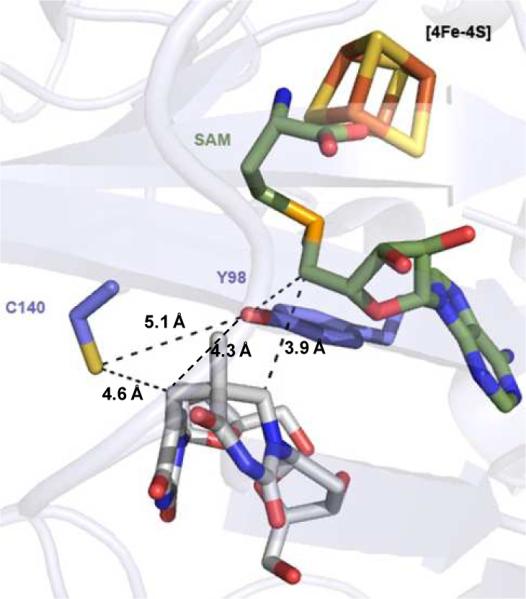
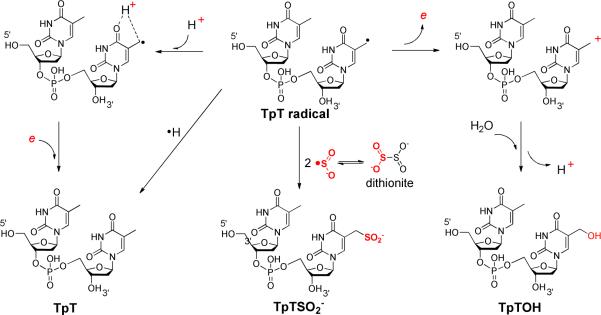
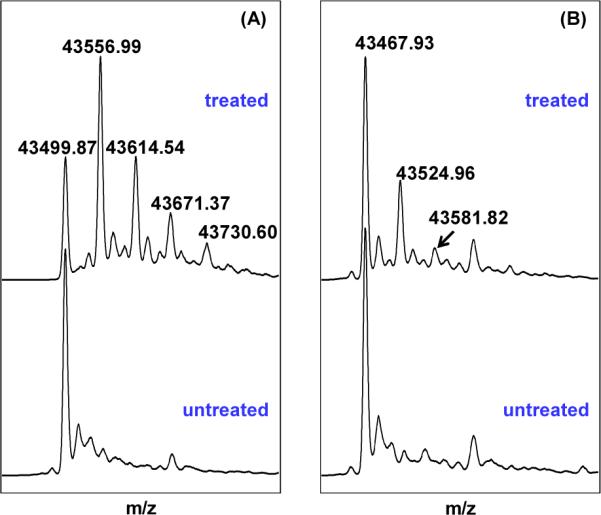
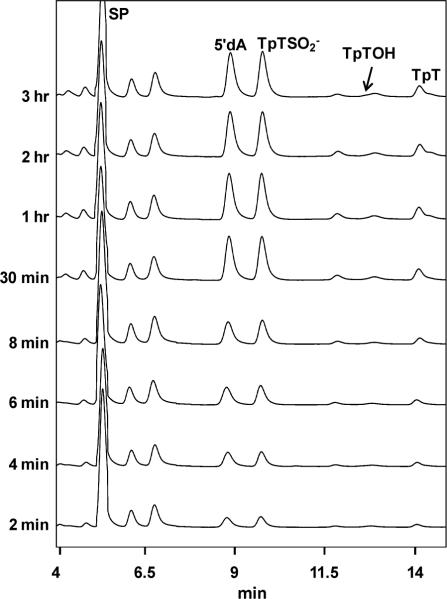
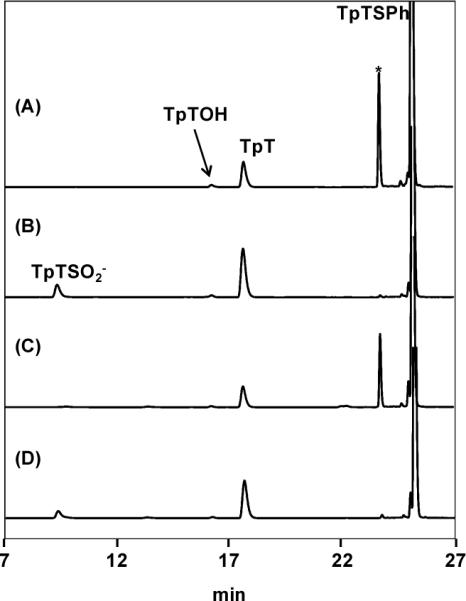
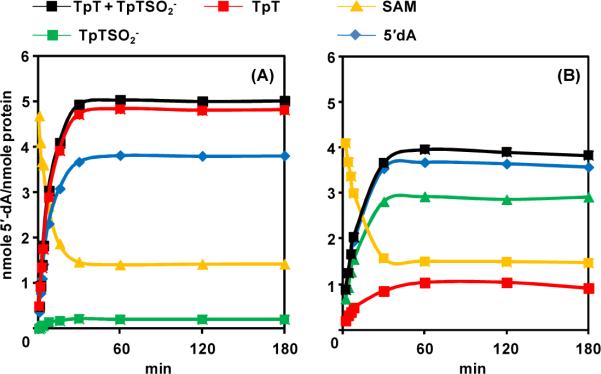
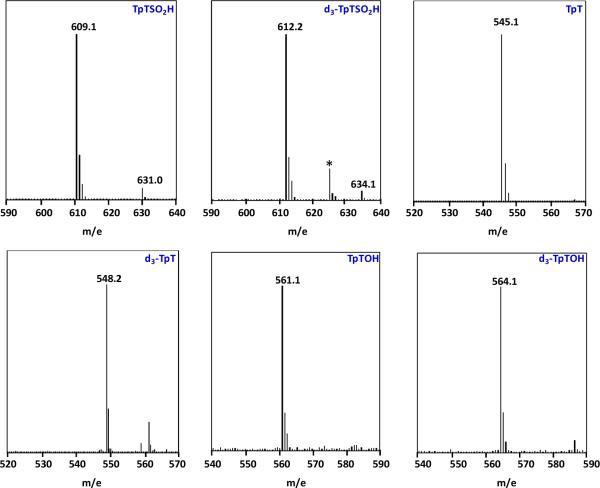
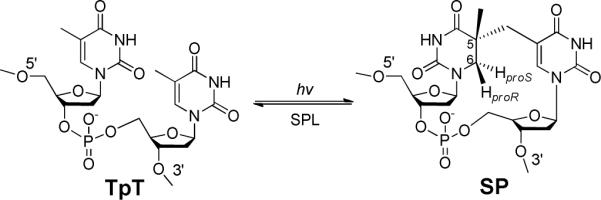
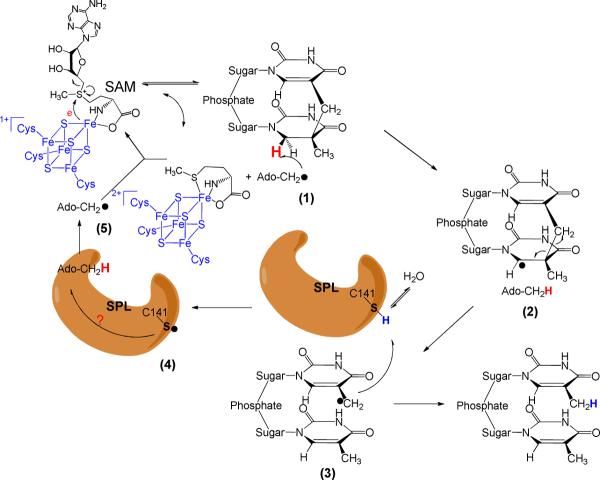
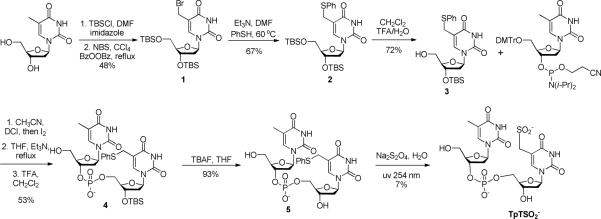
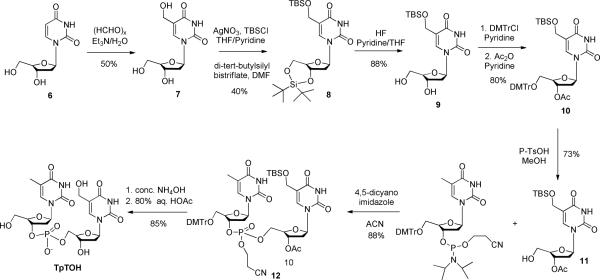
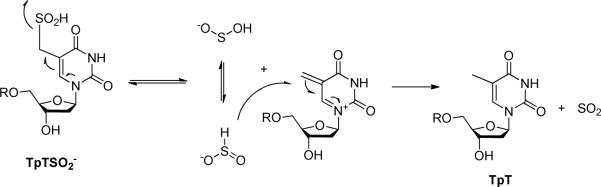
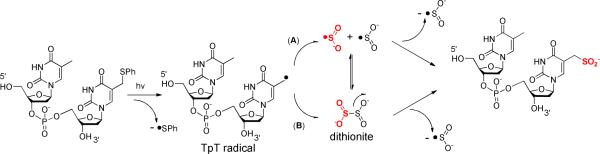
5-Thyminyl-5,6-dihydrothymine (also called spore photoproduct or SP) is the exclusive DNA photodamage product in bacterial endospores. It is repaired by a radical SAM (S-adenosylmethionine) enzyme, the spore photoproduct lyase (SPL), at the bacterial early germination phase. Our previous studies proved that SPL utilizes the 5'-dA• generated by the SAM cleavage reaction to abstract the H(6proR) atom to initiate the SP repair process. The resulting thymine allylic radical was suggested to take an H atom from an unknown protein source, most likely cysteine 141. Here we show that C141 can be readily alkylated in the native SPL by an iodoacetamide treatment, suggesting that it is accessible to the TpT radical. SP repair by the SPL C141A mutant yields TpTSO(2)(-) and TpT simultaneously from the very beginning of the reaction; no lag phase is observed for TpTSO(2)(-) formation. Should any other protein residue serve as the H donor, its presence would result in TpT being the major product at least for the first enzyme turnover. These observations provide strong evidence to support C141 as the direct H atom donor. Moreover, because of the lack of this intrinsic H donor, the C141A mutant produces TpT via an unprecedented thymine cation radical reduction (proton-coupled electron transfer) process, contrasting to the H atom transfer mechanism in the wild-type (WT) SPL reaction. The C141A mutant repairs SP at a rate that is ~3-fold slower than that of the WT enzyme. Formation of TpTSO(2)(-) and TpT exhibits a V(max) deuterium kinetic isotope effect (KIE) of 1.7 ± 0.2, which is smaller than the (D)V(max) KIE of 2.8 ± 0.3 determined for the WT SPL reaction. These findings suggest that removing the intrinsic H atom donor disturbs the rate-limiting process during enzyme catalysis. As expected, the prereduced C141A mutant supports only ~0.4 turnover, which is in sharp contrast to the >5 turnovers exhibited by the WT SPL reaction, suggesting that the enzyme catalytic cycle (SAM regeneration) is disrupted by this single mutation.
5-胸腺嘧啶-5,6-二氢胸腺嘧啶(也称为孢子光产物或 SP)是细菌芽孢中唯一的 DNA 光损伤产物。它由一种自由基 SAM(S-腺苷甲硫氨酸)酶,即孢子光产物裂合酶(SPL),在细菌早期萌发阶段修复。我们之前的研究证明,SPL 利用 SAM 裂解反应产生的 5'-dA• 来抽取 H(6proR)原子,从而启动 SP 修复过程。由此产生的胸腺嘧啶烯丙基自由基被认为从未知的蛋白质来源(很可能是半胱氨酸 141)获取一个 H 原子。在这里,我们表明,在天然 SPL 中,通过碘乙酰胺处理可以轻易地使 C141 烷基化,这表明它可以与 TpT 自由基接触。SPL 突变体 C141A 的 SP 修复反应从一开始就同时产生 TpTSO(2)(-) 和 TpT,没有观察到 TpTSO(2)(-) 形成的滞后期。如果任何其他蛋白质残基作为 H 供体,那么它的存在至少在第一个酶转化中会导致 TpT 成为主要产物。这些观察结果为 C141 作为直接 H 原子供体提供了强有力的证据。此外,由于缺乏这种内在的 H 供体,C141A 突变体通过前所未有的胸腺嘧啶阳离子自由基还原(质子耦合电子转移)过程产生 TpT,与野生型(WT)SPL 反应中的 H 原子转移机制形成对比。C141A 突变体修复 SP 的速度比 WT 酶慢约 3 倍。TpTSO(2)(-)和 TpT 的形成表现出 1.7±0.2 的 V(max)氘动力学同位素效应(KIE),小于 WT SPL 反应确定的 2.8±0.3 的(D)V(max) KIE。这些发现表明,去除内在的 H 原子供体扰乱了酶催化过程中的限速步骤。正如预期的那样,预还原的 C141A 突变体仅支持约 0.4 次转化,与 WT SPL 反应中表现出的>5 次转化形成鲜明对比,表明该酶催化循环(SAM 再生)被这一个单一突变所破坏。