Program Development Centre, CIRO+, centre of expertise for chronic organ failure, Hornerheide 1, Horn, NM 6085, The Netherlands.
Health Qual Life Outcomes. 2012 Aug 21;10:98. doi: 10.1186/1477-7525-10-98.
Longitudinal studies analyzing the correlations between disease-specific and generic health status questionnaires at different time points in patients with advanced COPD are lacking. The aim of this study was to determine whether and to what extent a disease-specific health status questionnaire (Saint George's Respiratory Questionnaire, SGRQ) correlates with generic health status questionnaires (EuroQol-5-Dimensions, EQ-5D; Assessment of Quality of Life instrument, AQoL; Medical Outcomes Study 36-Item Short-Form Health Survey, SF-36) at four different time points in patients with advanced COPD; and to determine the correlation between the changes in these questionnaires during one-year follow-up.
Demographic and clinical characteristics were assessed in 105 outpatients with advanced COPD at baseline. Disease-specific health status (SGRQ) and generic health status (EQ-5D, AQoL, SF-36) were assessed at baseline, four, eight, and 12 months. Correlations were determined between SGRQ and EQ-5D, AQoL, and SF-36 scores and changes in these scores. Agreement in direction of change was assessed.
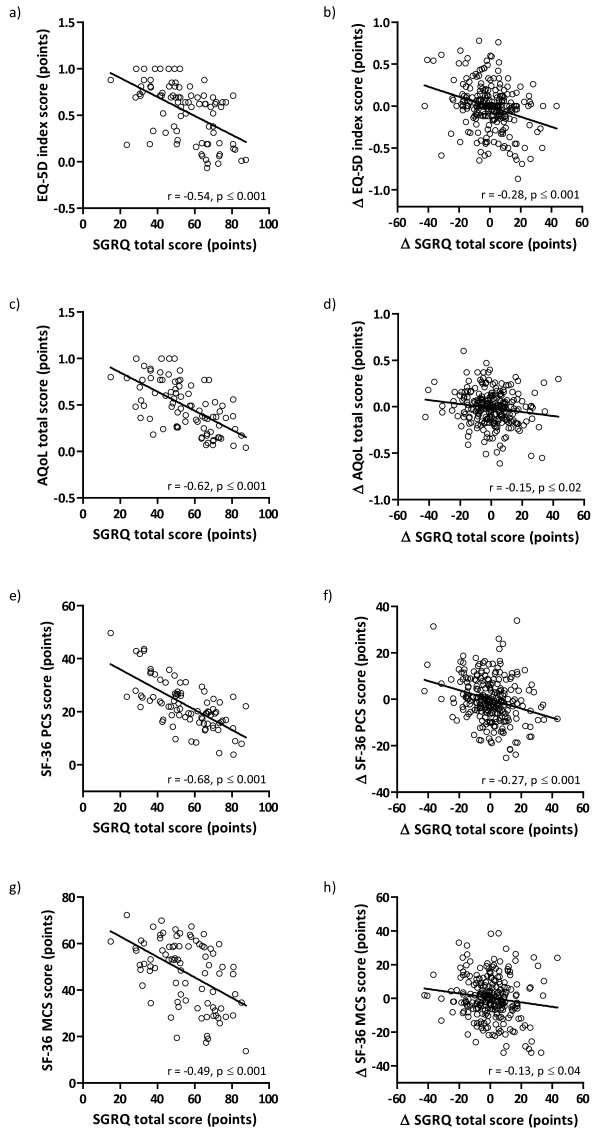
Eighty-four patients (80%) completed one-year follow-up and were included for analysis. SGRQ total score and EQ-5D index score, AQoL total score and SF-36 Physical Component Summary measure (SF-36 PCS) score were moderately to strongly correlated. The correlation of the changes between the SGRQ total score and EQ-5D index score, AQoL total score, SF-36 PCS, and SF-36 Mental Component Summary measure (SF-36 MCS) score were weak or absent. The direction of changes in SGRQ total scores agreed slightly with the direction of changes in EQ-5D index score, AQoL total score, and SF-36 PCS score.
At four, eight and 12 months after baseline, SGRQ total scores and EQ-5D index scores, AQoL total scores and SF-36 PCS scores were moderately to strongly correlated, while SGRQ total scores were weakly correlated with SF-36 MCS scores. The correlations between changes over time were weak or even absent. Disease-specific health status questionnaires and generic health status questionnaires should be used together to gain complete insight in health status and changes in health status over time in patients with advanced COPD.
缺乏分析晚期 COPD 患者在不同时间点疾病特异性和通用健康状况问卷之间相关性的纵向研究。本研究的目的是确定在晚期 COPD 患者的四个不同时间点,疾病特异性健康状况问卷(圣乔治呼吸问卷,SGRQ)与通用健康状况问卷(EuroQol-5-维度,EQ-5D;生活质量评估工具,AQoL;医疗结果研究 36-项简明健康调查,SF-36)之间是否存在关联,以及在一年的随访期间这些问卷的变化之间存在何种关联。
在基线时评估了 105 名晚期 COPD 门诊患者的人口统计学和临床特征。在基线时、四个月、八个月和十二个月评估了疾病特异性健康状况(SGRQ)和通用健康状况(EQ-5D、AQoL、SF-36)。确定了 SGRQ 与 EQ-5D、AQoL 和 SF-36 评分之间的相关性以及这些评分的变化。评估了变化方向的一致性。
84 名患者(80%)完成了一年的随访并被纳入分析。SGRQ 总分和 EQ-5D 指数评分、AQoL 总分和 SF-36 生理成分综合评分(SF-36 PCS)评分呈中度至强相关性。SGRQ 总分与 EQ-5D 指数评分、AQoL 总分、SF-36 PCS 和 SF-36 心理成分综合评分(SF-36 MCS)评分之间的变化相关性较弱或不存在。SGRQ 总分变化的方向与 EQ-5D 指数评分、AQoL 总分和 SF-36 PCS 评分的变化方向略有一致。
在基线后四个、八个和十二个月,SGRQ 总分和 EQ-5D 指数评分、AQoL 总分和 SF-36 PCS 评分中度至强相关,而 SGRQ 总分与 SF-36 MCS 评分弱相关。随着时间的推移,这些变化之间的相关性较弱甚至不存在。疾病特异性健康状况问卷和通用健康状况问卷应一起使用,以全面了解晚期 COPD 患者的健康状况和随时间的健康状况变化。