Department of Cell and Developmental Biology, University College London, London WC1E 6BT UK.
Development. 2012 Sep;139(18):3326-31. doi: 10.1242/dev.079418.
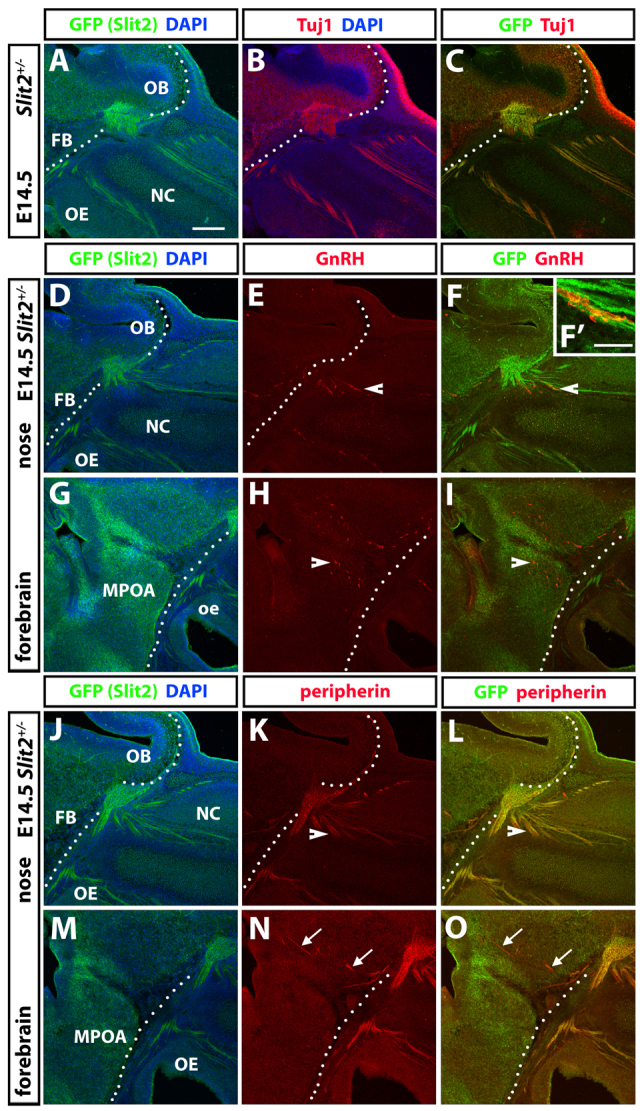
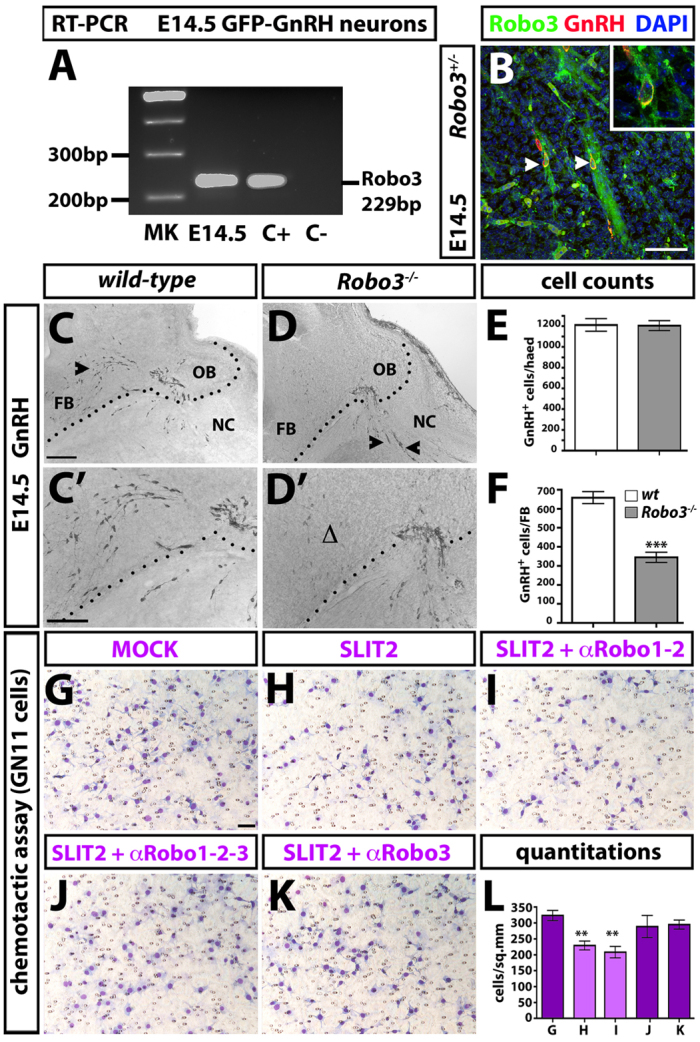
Gonadotropin-releasing hormone (GnRH) neurons are born in the nasal placode and migrate along olfactory and vomeronasal axons to reach the forebrain and settle in the hypothalamus, where they control reproduction. The molecular cues that guide their migration have not been fully identified, but are thought to control either cell movement directly or the patterning of their axonal substrates. Using genetically altered mouse models we show that the migration of GnRH neurons is directly modulated by Slit2 and Robo3, members of the axon guidance Slit ligand and Robo receptor families. Mice lacking Slit2 or Robo3 have a reduced number of GnRH neurons in the forebrain, but a normal complement of their supporting axons, pointing to a direct role for these molecules in GnRH neuron migration.
促性腺激素释放激素(GnRH)神经元起源于鼻基板,并沿着嗅觉和犁鼻神经轴突迁移,到达前脑并定位于下丘脑,在那里它们控制生殖。指导其迁移的分子线索尚未完全确定,但据认为它们要么直接控制细胞运动,要么控制其轴突基质的模式形成。使用基因改变的小鼠模型,我们表明 GnRH 神经元的迁移受 Slit2 和 Robo3 的直接调节,Slit2 和 Robo3 是轴突导向 Slit 配体和 Robo 受体家族的成员。缺乏 Slit2 或 Robo3 的小鼠在前脑的 GnRH 神经元数量减少,但它们的支持轴突数量正常,这表明这些分子在 GnRH 神经元迁移中具有直接作用。