Alfa Institute of Biomedical Sciences (AIBS), Athens, Greece.
PLoS One. 2012;7(8):e41870. doi: 10.1371/journal.pone.0041870. Epub 2012 Aug 16.
The epidemiology and antibiotic resistance of Staphylococcus aureus have evolved, underscoring the need for novel antibiotics, particularly against methicillin-resistant S. aureus (MRSA). Telavancin is a bactericidal lipoglycopeptide with potent activity against Gram-positive pathogens.
To systematically review and synthesize the available evidence from randomized controlled trials (RCTs) evaluating telavancin in the treatment of patients with infections due to Gram-positive organisms with the methodology of meta-analysis.
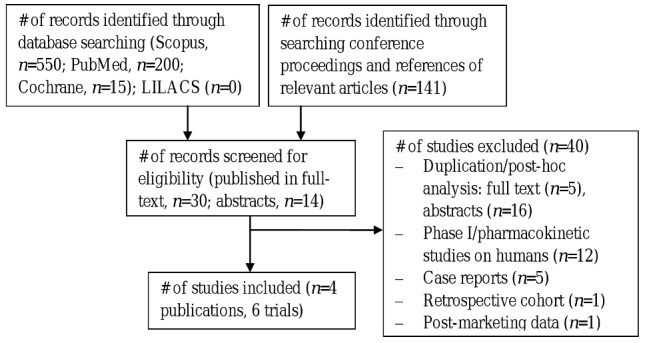
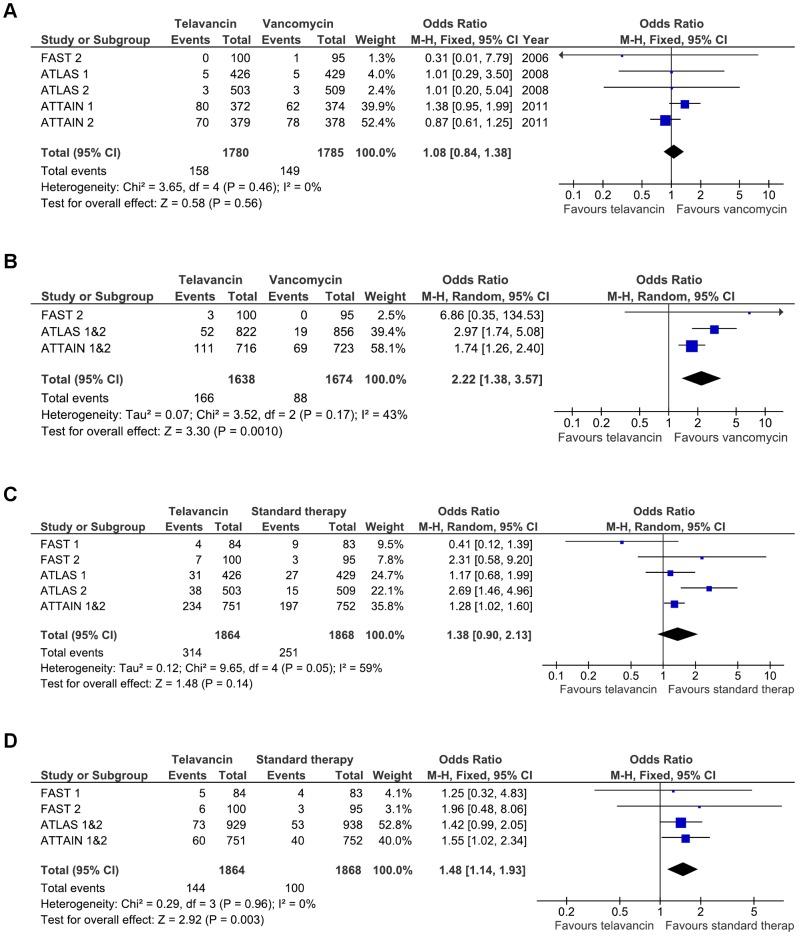
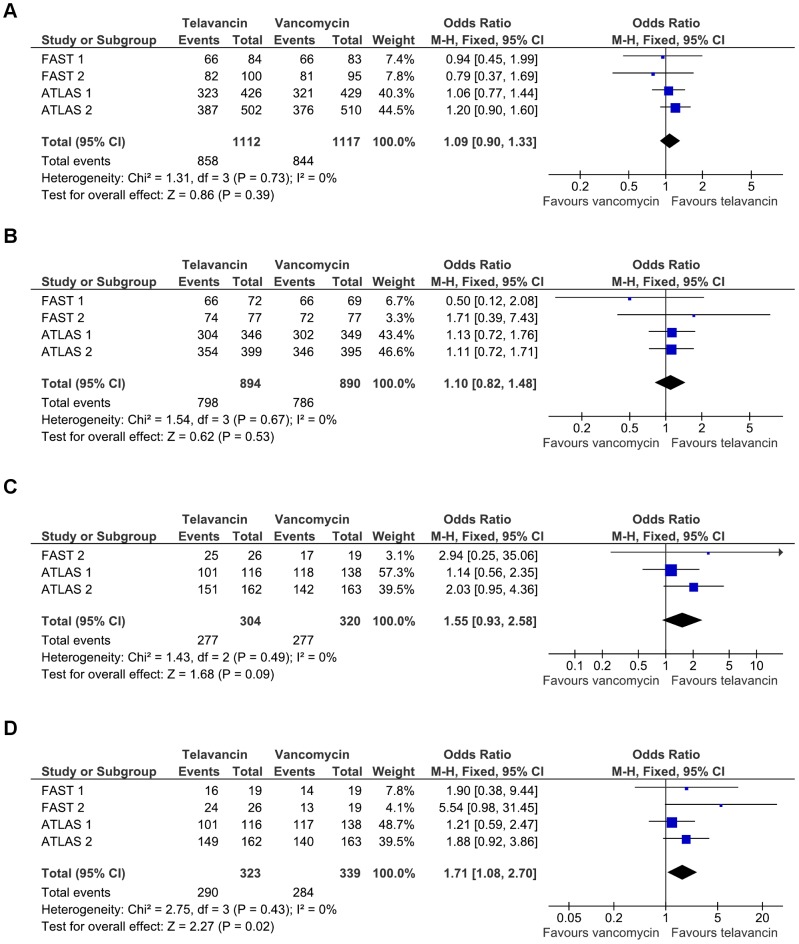
Six RCTs comparing telavancin with vancomycin were included; 4 (2229 patients) referred to complicated skin and soft tissue infections (cSSTIs) and 2 (1503 patients) to hospital-acquired pneumonia (HAP). Regarding cSSTIs, telavancin and vancomycin showed comparable efficacy in clinically evaluable patients (odds ratio [OR] =1.10 [95% confidence intervals: 0.82-1.48]). Among patients with MRSA infection, telavancin showed higher eradication rates (OR=1.71 [1.08-2.70]) and a trend towards better clinical response (OR=1.55 [0.93-2.58]). Regarding HAP, telavancin was non-inferior to vancomycin in terms of clinical response in two Phase III RCTs; mortality rates for the pooled trials were comparable with telavancin (20%) and vancomycin (18.6%). Pooled data from cSSTIs and HAP studies on telavancin 10 mg/kg indicated higher rates of serum creatinine increases (OR=2.22 [1.38-3.57]), serious adverse events (OR=1.53 [1.05-2.24]), and adverse event-related withdrawals (OR=1.49 [1.14-1.95]) among telavancin recipients.
Telavancin might be an alternative to vancomycin in cases of difficult-to-treat MRSA infections. The potent antistaphylococcal activity of telavancin should be weighted against the potential for nephrotoxicity.
金黄色葡萄球菌的流行病学和抗生素耐药性已经发生了变化,这突显了需要新型抗生素,特别是针对耐甲氧西林金黄色葡萄球菌(MRSA)的抗生素。他伐沙星是一种具有杀菌作用的糖肽类抗生素,对革兰氏阳性病原体具有强大的活性。
通过荟萃分析的方法,系统地回顾和综合现有随机对照试验(RCT)评估他伐沙星治疗革兰氏阳性菌感染的证据。
纳入了 6 项比较他伐沙星和万古霉素的 RCT;其中 4 项(2229 例患者)涉及复杂性皮肤和软组织感染(cSSTIs),2 项(1503 例患者)涉及医院获得性肺炎(HAP)。对于 cSSTIs,他伐沙星和万古霉素在可临床评估的患者中疗效相当(比值比 [OR] =1.10 [95%置信区间:0.82-1.48])。在 MRSA 感染患者中,他伐沙星的清除率更高(OR=1.71 [1.08-2.70]),临床反应也有改善趋势(OR=1.55 [0.93-2.58])。对于 HAP,在 2 项 III 期 RCT 中,他伐沙星在临床反应方面不劣于万古霉素;汇总试验的死亡率与他伐沙星(20%)和万古霉素(18.6%)相当。来自 cSSTIs 和 HAP 研究的他伐沙星 10mg/kg 数据汇总表明,他伐沙星组血清肌酐升高(OR=2.22 [1.38-3.57])、严重不良事件(OR=1.53 [1.05-2.24])和与不良事件相关的停药(OR=1.49 [1.14-1.95])的发生率更高。
他伐沙星可能是治疗困难治疗的 MRSA 感染的万古霉素替代药物。他伐沙星强大的抗葡萄球菌活性应与潜在的肾毒性相权衡。