Division of Medical Technology, School of Allied Medical Professions, The Ohio State University, Columbus, OH, 43210, USA.
Mol Cancer. 2012 Aug 24;11:61. doi: 10.1186/1476-4598-11-61.
The oncogenic roles contributed by the Akt/PKB kinase family remain controversial and presumably depend on cell context, but are perceived to be modulated by an interplay and net balance between various isoforms. This study is intended to decipher whether distinct Akt kinase isoforms exert either redundant or unique functions in regulating neoplastic features of breast cancer cells, including epithelial-mesenchymal transition (EMT), cell motility, and stem/progenitor cell expansion.
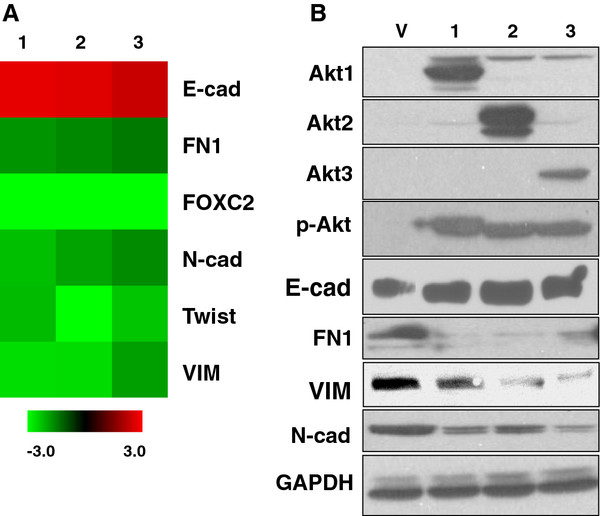
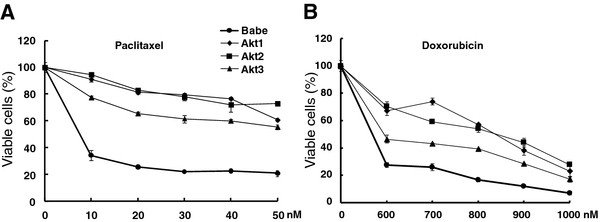
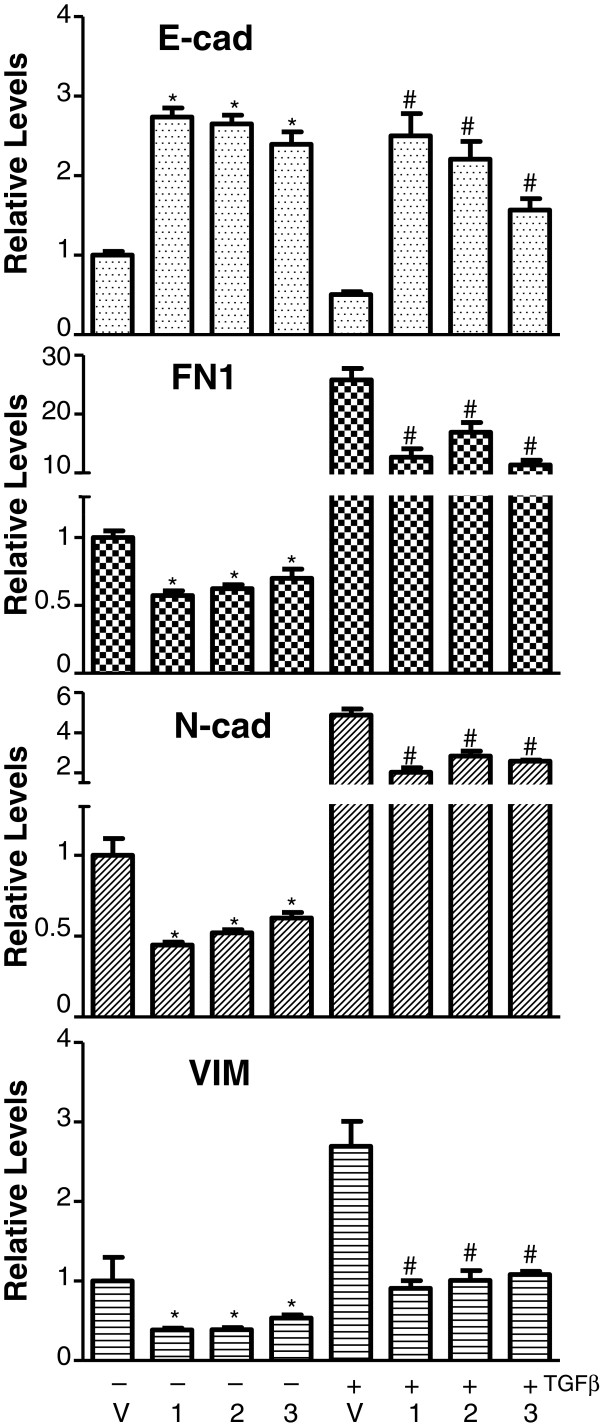
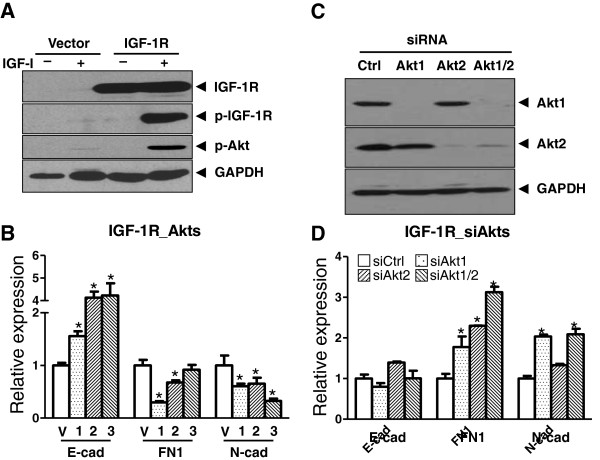
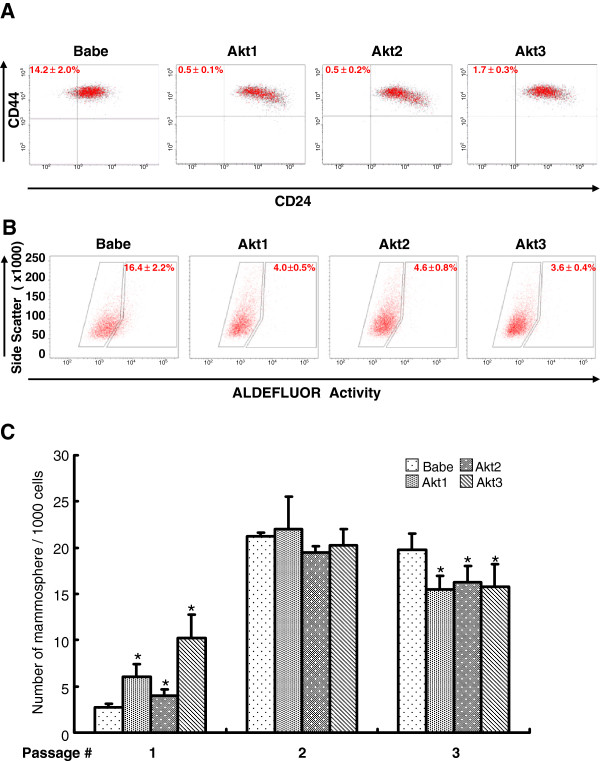
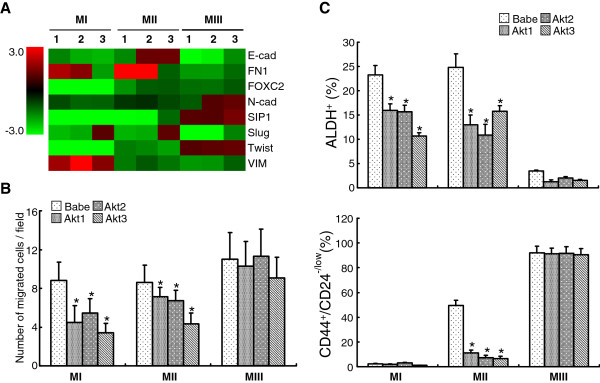
We demonstrate that overactivation of Akt signaling in nonmalignant MCF10A cells and in primary cultures of normal human mammary epithelial tissue results in previously unreported inhibitory effects on EMT, cell motility and stem/progenitor cell expansion. Importantly, this effect is largely redundant and independent of Akt isoform types. However, using a series of isogenic cell lines derived from MCF-10A cells but exhibiting varying stages of progressive tumorigenesis, we observe that this inhibition of neoplastic behavior can be reversed in epithelial cells that have advanced to a highly malignant state. In contrast to the tumor suppressive properties of Akt, activated Akt signaling in MCF10A cells can rescue cell viability upon treatment with cytotoxic agents. This feature is regarded as tumor-promoting.
We demonstrate that Akt signaling conveys novel dichotomy effects in which its oncogenic properties contributes mainly to sustaining cell viability, as opposed to the its tumor suppressing effects, which are mediated by repressing EMT, cell motility, and stem/progenitor cell expansion. While the former exerts a tumor-enhancing effect, the latter merely acts as a safeguard by restraining epithelial cells at the primary sites until metastatic spread can be moved forward, a process that is presumably dictated by the permissive tumor microenvironment or additional oncogenic insults.
Akt/PKB 激酶家族的致癌作用仍然存在争议,推测取决于细胞环境,但被认为受到各种同工型之间的相互作用和净平衡的调节。本研究旨在破译不同的 Akt 激酶同工型在调节乳腺癌细胞的肿瘤特征(包括上皮-间质转化(EMT)、细胞迁移和干细胞/祖细胞扩增)中是否发挥冗余或独特的功能。
我们证明,在非恶性 MCF10A 细胞和正常人类乳腺上皮组织的原代培养物中过度激活 Akt 信号会导致 EMT、细胞迁移和干细胞/祖细胞扩增的先前未报道的抑制作用。重要的是,这种效应在很大程度上是冗余的,并且独立于 Akt 同工型类型。然而,使用一系列源自 MCF-10A 细胞但表现出不同程度进行性肿瘤发生的同基因细胞系,我们观察到在已经进展到高度恶性状态的上皮细胞中,可以逆转这种对肿瘤行为的抑制作用。与 Akt 的肿瘤抑制特性相反,在用细胞毒性剂处理时,激活的 Akt 信号在 MCF10A 细胞中可以挽救细胞活力。这种特征被认为是促进肿瘤的。
我们证明 Akt 信号传递了新的二分法效应,其中其致癌特性主要有助于维持细胞活力,而不是其肿瘤抑制效应,后者通过抑制 EMT、细胞迁移和干细胞/祖细胞扩增来介导。虽然前者发挥了促进肿瘤的作用,但后者仅仅作为一种保护作用,将上皮细胞限制在原发性部位,直到可以推进转移扩散,这个过程大概是由允许的肿瘤微环境或其他致癌性损伤决定的。